

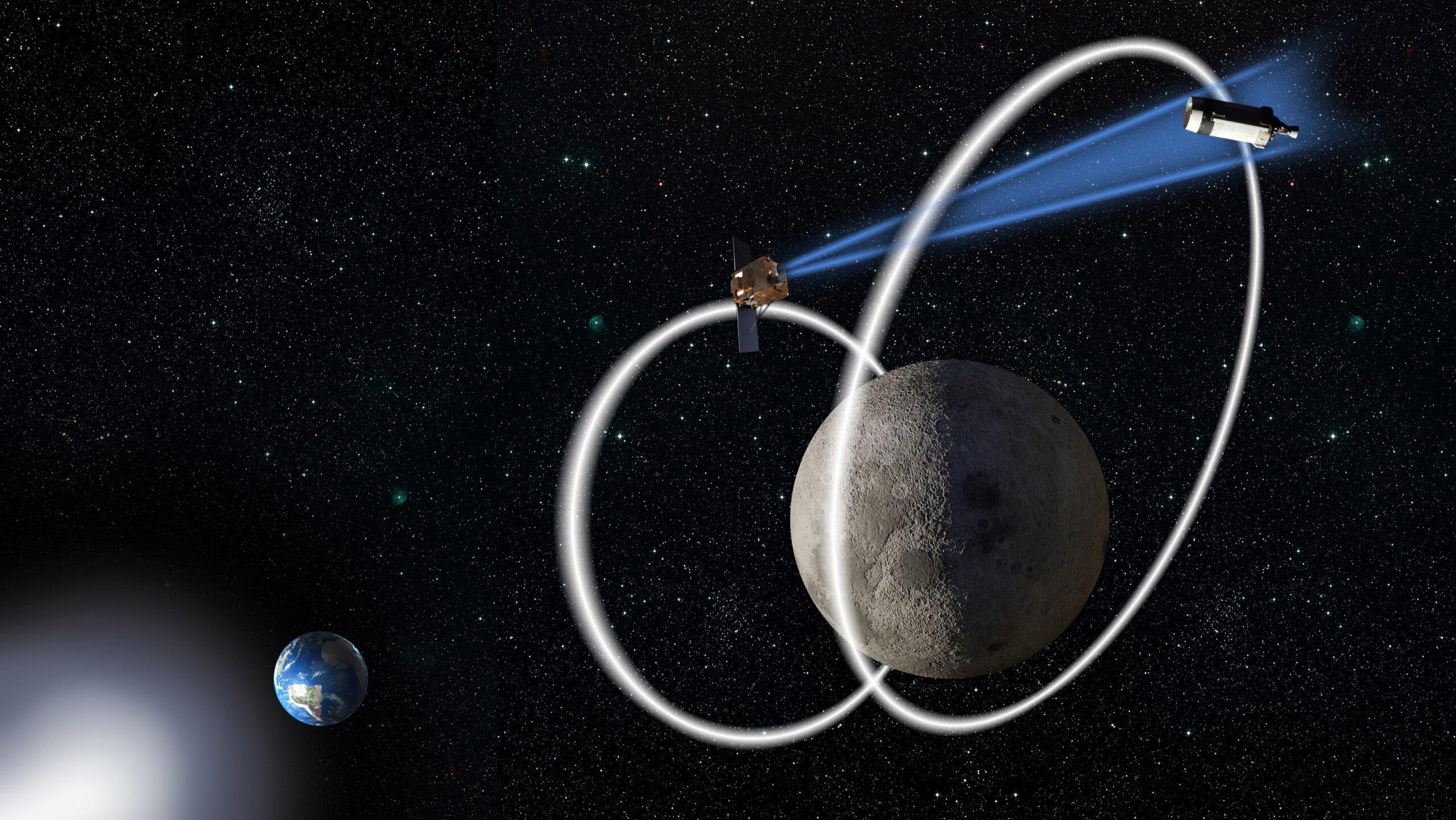
COLORADO SPRINGS — The Space Force is launching a new acquisition task force to study how the Defense Department should move into cislunar space as it looks to support a planned NASA moon base, according to Maj. Gen. Stephen Purdy, senior advisor to Air Force Secretary Troy Mink for space acquisition.
“We’re going to stand up a Cislunar Coordination Office on the Space Force acquisition side,” he told the annual Space Symposium here on April 15, who said the new office will bring together program managers and engineers to “build road maps” for “acquiring the necessary technology and a schedule for action.”
The plan is an outgrowth of President Donald Trump’s December Executive Order on space superiority, Purdy said. That order mandates the establishment of the “initial elements of a permanent lunar outpost by 2030 to ensure a sustained American presence in space and enable the next steps in Mars exploration.”
Chief of Space Operations Gen. Chance Saltzman told reporters here on Wednesday that the Space Force will be ready to support US cislunar goals.
“Wherever US interests go, so will go the US Space Force. If our interests go to a lunar base, the Space Force will have to make sure that it’s safe to get out there, it’s secure once they’re there [and] it’s sustainable,” he said.
The new group will be led by Jamie Stearns, who has been serving as the head of the Air Force Research Laboratory (AFRL) Vehicle’s Directorate space control shop at Kirtland Air Force Base in New Mexico, Purdy said.
As a first step, Purdy explained, the office will map out all the government organizations with that will have a hand in cislunar activities.
“There’s actually a surprising amount of government involvement. When you look at DARPA and AFRL and DNI [Director of National Intelligence] and DoD, there’s a lot of activity going on. Of course, our biggest partner there’s obviously NASA,” Purdy said.
Further, he stressed, the Space Force will be looking to partner with industry to develop new tech and capabilities.
Saltzman noted that there is “overlap” between NASA and Space Force when it comes to cislunar missions, including the need for space domain awareness and communications networks.
“Let’s not underestimate what it takes to do space domain awareness out at cislunar. It is different math and needs different tools to get it right,” he said. “Communication out there is different so we have to make sure it’s continuous, it’s low latency. It protects the people that are out there if they can communicate. We want to make sure that that’s always secured,” he said.
Further, Saltzman said, the Space Force will need to up its launch “ops tempo” to support a lunar outpost.
“Sustaining a presence on the Moon is going to stress our launch infrastructure. We’ve got to make sure that it’s our responsibility to make sure public safety is taken care of, that all of the storage of the consumables are handled properly to work with other agencies like NASA, [and] that we have the right kind of infrastructure to support that ops tempo,” he said.
Saltzman noted that the service interacts with NASA on a routine basis already.
“We meet pretty regularly. I talk to Administrator [Jared] Isaacsman all the time,” he said. “At lower levels, we continue to support the astronaut program. That’s an easy way to keep their operations connected to our operations, having that common vocabulary between the two. And I’m sure there’ll be a myriad of working groups like Kennedy Space Center and Cape Canaveral. We’ll have to work together to make sure those infrastructures are in place, and so at all echelons, we will continue to collaborate closely with NASA.”
Monitoring The Moon
Meanwhile AFRL is gearing up to launch its experimental cislunar monitoring satellite, called Oracle Prime, next year, James Firth, principle investigator for the program at the Space Vehicles Directorate, told Breaking Defense in an April 16 interview.
Oracle is a “unique mission,” Firth said, as the first-ever satellite designed to undertake sustained operations in the L-1 Lagrange Point.
Lagrange Points are orbital positions where space objects are more or less balanced by the gravitational pulls of two larger bodies, such as the Earth and the Moon, or the Earth and the Sun. There are five such points in any orbital three-body system. L1 is located some 326,000 kilometers (202,500 miles) in altitude directly between the Earth and the Moon, and Oracle will use a specialized “halo” orbit to remain essentially hovering there.
Firth explained that the satellite will attempt “un-cued” surveillance of local space objects using an on-board camera, and discern between debris and active satellites that are quite dim due to the distances involved. There are about 10 such satellites in the region, he added, including China’s Queqiao-2 communications relay satellite launched in 2024 to an elliptical orbit around the Moon in support of Beijing’s own planned lunar outpost.
Oracle is being built by prime contractor Advanced Space, with partners Terran Orbital and Quantum Space. However, Firth said, the satellite “will be government owned and operated” — with Advanced Space providing expertise to help the lab staff learn the ropes.
The satellite will have a two-year life span, he added, although much of that time will be spent in transit to L1. While AFRL originally planned to power Oracle with a experimental “green” fuel called Advanced Spacecraft Energetic Non-Toxic, or ASCENT, the lab decided against doing so as not to overly complicate the already complex mission, he said.
“The Oracle-Prime program represents a critical next step in enabling sustainable operations throughout cislunar space. With this program, we will gain essential space situational awareness in the region between Earth and the Moon,” Bradley Cheetham, president and CEO of Advanced Space, told Breaking Defense.
Advanced Space also built and is operating NASA’s Cislunar Autonomous Positioning System Technology Operations and Navigation Experiment (CAPSTONE) launched in June 2022. CAPSTONE is a small experimental spacecraft that was designed as a pathfinder to gather operational data ahead for the Artemis program.
The space agency successfully launched the crewed Artemis II lunar flyby on April 1, with the four astronauts completing a 10-day mission before splashing back down safely. NASA currently is planning to land a crew on the Moon in 2028 for the first time since 1972.
