

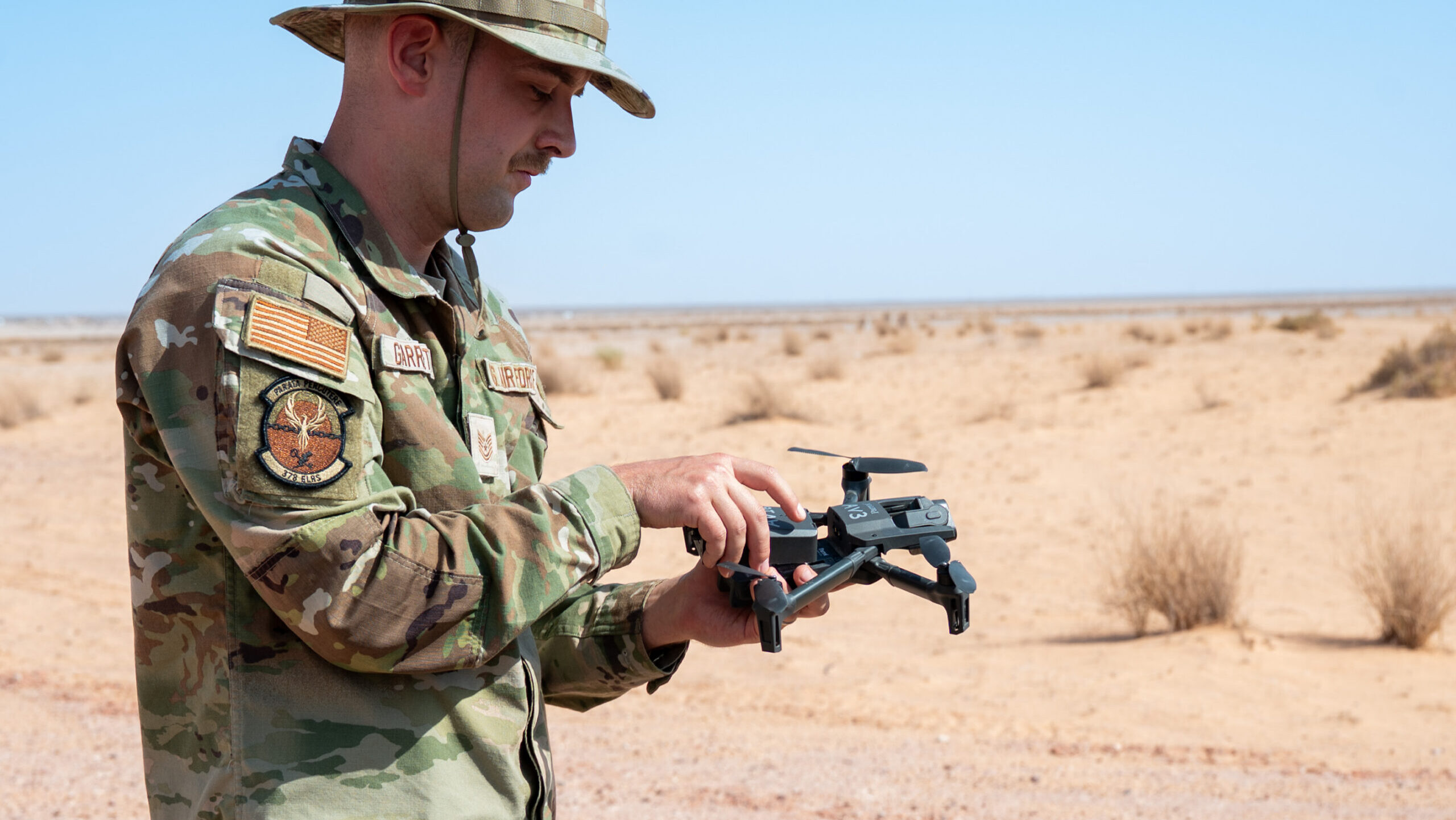
WASHINGTON — The Pentagon is betting big on drone and autonomy development next year with plans to spend nearly $55 billion on its replacement for the Replicator initiative, dubbed the Defense Autonomous Warfare Group (DAWG).
“I think of the DAWG as a pathfinder, they’re out there finding the best technology for us and working on integration,” Jules “Jay” Hurst, who is performing the duties of the Pentagon comptroller, told reporters today. “They’re with these companies, live right now, testing different systems and orchestration tools for autonomy, and they’re giving them live feedback.”
The DAWG essentially absorbed the Biden-era Replicator initiative designed to acquire thousands of low-cost “attritable” drones, particularly for use in the Pacific. In its latest iteration, the department is looking to supercharge development investments across an array of platforms and collaborative autonomy efforts.
But to do that, it will take a big investment in the form of a 24,070 percent increase over the $225.9 million DAWG received in fiscal 2026. Specifically, the Pentagon is seeking a $54.6 billion ask for research and development dollars in the FY27 budget request — $1 billion in the base budget and the remaining $53.6 billion coming from the more flexible future reconciliation pot.
Lt. Gen. Steven Whitney — the director for Force Structure, Resources and Assessment — said that by and large those funds will be used on rapid innovation and “the ability to spin and develop new capabilities.”
“That’s really what we are. It’s not that you’re buying one set baseline and you’re going to procure it forever,” the three-star Air Force general added. “It’s an incremental capability. … You can buy items with research and development, but you just typically don’t buy a large lot of … one particular thing.”
Those DAWG dollars are part of the department’s larger plan to spend at least $1.5 trillion on defense next year with $1.15 trillion in the base budget request and an additional $350 billion from a forthcoming reconciliation bill. (There could also be a separate supplemental spending bill coming to cover operations in the Middle East.) Given that mid-term elections are coming up later this year and Democrats could reclaim one chamber, prospects of future reconciliation bills are dim. This means that FY27 could simply be a one-year surge in funding, with Hurst calling the FY27 request a “generational investment.”
However, placing the bulk of the DAWG request in the reconciliation pot is also a gamble — albeit one that would give the department more time to spend the funds and placed alongside other such high profile priorities as Golden Dome and critical munitions.
“We put a lot of high priority things in there for a variety of reasons,” Hurst said today.
“Number one, we have some more flexibility on when we obligate those funds. Number two, we did it for things that were kind of a one time plus up that we really want to increase our funding of. And then finally, when there’s technology that’s changing quickly, like for Golden Dome, for the DAWG, we try to put things there.”
The Office of Strategic Capital’s loan program (OSC) is another one of those initiatives that will be primarily funded in FY27 through reconciliation. The Pentagon is requesting nearly $20.2 billion with $216 million in the base budget and $20 billion in the reconciliation plan. If Congress approves that ask, it would be a 1,247 percent hike over the FY26 $1.5 billion pot.
OSC provides debt financing for critical technology manufacturing, and Hurst said that if the office receives the total ask for next year, it could potentially spend the entire pot in one year.
“If they don’t have a lot of good opportunities, they may delay obligating those funds into future fiscal years,” he added. “That’s part of what we were doing. We engineered the reconciliation part of this budget. We were looking at things where we may need that flexibility based on opportunities.”
