

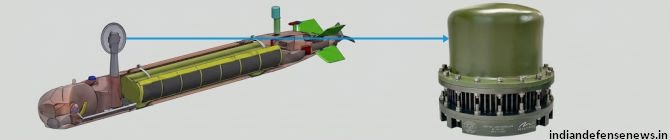
The High Endurance High Endurance Autonomous UnderWater Vehicle, or HEAUV, developed by DRDO’s Naval Science and Technological Laboratory (NSTL), represents a significant advancement in India’s underwater capabilities.
This 6-ton, nearly 10-meter-long platform, with a 1-meter diameter, achieves up to 15 days of endurance at 3 knots (max speed 8 knots) and operates at depths of 300 meters.
Designed for missions like anti-submarine warfare, mine countermeasures, ISR, and bathymetry, it features modular swappable payloads, advanced sonars, and proven dynamics in surface/submerged trials.
The rationale behind the development of the HEAUV, is to provide an effective tool for extending the operational reach of a mother ship into waters that are either inaccessible or contested.
This approach reduces the risk to human life and protects high-value assets by deploying autonomous systems instead of crewed vessels.
The radar system designed for HEAUV is a low-power, portable X-band surveillance radar that supports the vehicle during Intelligence, Surveillance, and Reconnaissance operations. Its purpose is to detect and track sub-surface targets at periodic intervals, thereby enhancing situational awareness and mission effectiveness.
The radar system offers sea surface surveillance capabilities, enabling the detection of targets such as boats, ships, channel markers, and buoys. This ensures that the HEAUV can navigate safely and avoid collisions while conducting its operations.
The design is optimised for Size, Weight, and Power (SWaP), making it lightweight, portable, and energy-efficient, which is critical for autonomous underwater missions where endurance and efficiency are paramount.
A cylindrical slotted waveguide antenna provides full 360-degree azimuth coverage, ensuring comprehensive monitoring of the surrounding environment. The system employs a blind mating approach, eliminating the need for internal cabling and simplifying integration with the vehicle. The radar is housed within a Radome rated to withstand pressures up to 45 bar, with a hydrophobic coating that enhances performance during underwater operations.
The radar incorporates multi-layered RF boards and element-level digital beamforming, which improve detection accuracy and signal processing efficiency. Sector-based electronic scanning further enhances its adaptability, allowing the system to focus on specific areas of interest as required by mission parameters. This flexibility ensures that the HEAUV can operate effectively in diverse maritime environments.
The signal processor and radar data processor functionalities are integrated into a single custom system-on-chip board, streamlining the architecture and reducing hardware complexity. This integration contributes to the radar’s compact design and reliability, making it well-suited for autonomous platforms where space and power are limited.
Ease of use is a defining feature of the system. It is designed for quick installation, operates on battery power, and requires minimal maintenance. These attributes make it highly practical for deployment in demanding operational scenarios, where rapid setup and sustained performance are essential.
The collision avoidance radar for HEAUV combines advanced surveillance capabilities with a lightweight, portable design. It enhances safety, efficiency, and mission success by providing reliable detection and tracking of surface and sub-surface targets, while maintaining operational simplicity and resilience in underwater environments.
IDN (With Agency Inputs)
