

Introduction
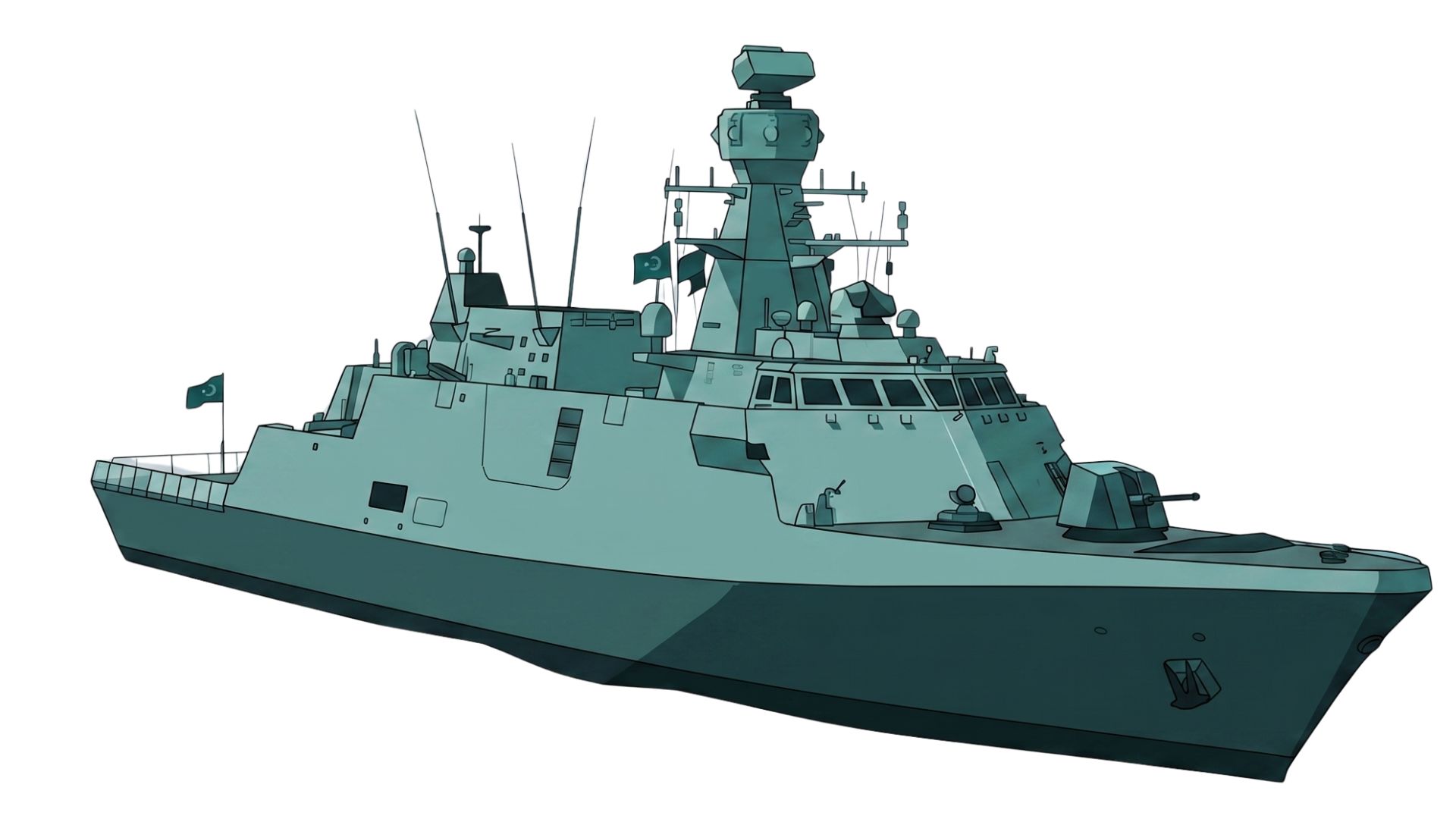
Since 2007, the Pakistan Navy (PN) surface combatant fleet has seen significant expansion in numbers and advancements in capabilities. It has grown from eight second-hand ex-Royal Navy (RN) frigates with, at best, semi-multi-mission capabilities (i.e., a typical configuration of the ex-RN Type 21 would either involve anti-ship warfare missiles or short-range surface-to-air missiles) to a fleet of 13 – and still growing – new-build 2,900+ ton platforms fully integrated with anti-surface/ship warfare (ASu/ShW), anti-submarine warfare (ASW), and area-wide, medium-range anti-air warfare (AAW) capabilities. Moreover, the PN replaced its second-hand ex-RN ships with new-build platforms, thus crossing the threshold of once being confined to only mothballed and second-hand ships to not only new-build ones, but commencing from the Babur-class (MILGEM) corvette, custom-designed combatants. It also moved away from depending solely on Western suppliers and, in their place, diversified by sourcing from China and Turkiye (alongside Damen Group of the Netherlands, the sole Western OEM).
In this 19-year period, the evolution of the PN’s surface combatant fleet underwent three arcs, each with distinct shifts in how the Naval Headquarters (NHQ) leadership set the long-term goal of the surface combatant fleet. The first arc drove a conservative vision, one aimed towards replacing the ex-RN ships with cost-effective, generationally newer platforms of both new Chinese and used American make. The second arc was a response to the inability to complete the first arc as originally planned (which relied on six ex-US Navy frigates that could not be secured) and to the need to reevaluate suppliers. The third arc was driven by an intentional goal to expand the surface fleet, thereby imbuing the PN with presence in the Arabian Sea as both a capable peacetime maritime security player.
This retrospective covers the aforementioned three arcs in detail and concludes with an analysis of how a fourth arc might develop, one that must balance a structural realignment to focus on the Arabian Gulf and Middle East with traditional India-centric anti-access and area-denial (A2/AD) imperatives.
First Arc: Conservative Iteration (2007–2012)
Pursuit of Ex-US Navy Oliver Hazard Perry-Class Frigates
The first arc involved an attempt to replace the aging Tariq-class (ex-Royal Navy Type 21) frigates with six ex-US Navy FFG-7 Oliver Hazard Perry (OHP) frigates. The PN had begun contracting the Turkish company Havelsan to provide its GENESIS combat management system (CMS) for the frigates. In 2010, the lead ship — PNS Alamgir — was inducted, but the remainder of the procurement program fell through due to changes (read: tighter restrictions) in the US’ arms transfers to Pakistan. Consequently, the PN was left with a lone OHP-class frigate – PNS Alamgir – and was consequently forced to alter its procurement plans.
PNS Alamgir (ex-USS McInerney, FFG-8) was transferred to the PN in 2010 as a single-ship acquisition under the US Excess Defense Articles (EDA) program. The OHP is a 4,100-ton full-load displacement frigate, measuring 138 m in length and 13.7 m in beam. Powered by two General Electric LM2500 gas turbines producing 41,000 shaft horsepower through a single shaft, the class can exceed 29 knots. The standard US configuration included a Mk. 13 single-arm launcher for SM-1MR surface-to-air missiles and RGM-84 Harpoon anti-ship missiles, a 76 mm Mk. 75 main gun, Phalanx CIWS, Mk. 32 triple-cell torpedo launchers for Mk 46 lightweight torpedoes, and a SH-60B Seahawk helicopter. However, the US stripped the Mk 13 launcher and associated fire-control systems before the EDA transfer, leaving PNS Alamgir with significantly reduced anti-air and anti-ship capabilities upon delivery.
The Havelsan-led upgrades were intended to set the basis for a multi-mission suite comprising anti-ship warfare (AShW), anti-submarine warfare (ASW), and anti-air warfare (AAW) capabilities — effectively a Western-standard CMS layer that could integrate the ship’s sensors, weapons, and data-link systems into a cohesive package. Havelsan confirmed the export of GENESIS to the PN in 2013. The intent was to replicate this CMS installation across all six OHP hulls, which would have given the PN a uniform fleet of multi-mission frigates with a modern Turkish CMS core. The collapse of the remaining five-ship plan — driven by tightening US restrictions on arms transfers to Pakistan, compounded by the 2011 deterioration in bilateral relations — left the PN with one frigate and the sunk cost of a fleet-wide CMS integration plan.
PNS Alamgir — Key Milestones
| Date | Event |
|---|---|
| 2008–2009 | PN begins negotiations for ex-USN OHP frigates under EDA |
| 2009 | Havelsan contracted to supply GENESIS CMS for PNS Alamgir |
| 2010 | PNS Alamgir (ex-USS McInerney) transferred and inducted into the PN fleet |
| 2013 | Havelsan confirms delivery of GENESIS CMS to the PN |
PNS Alamgir — Specifications
| Parameter | Value |
|---|---|
| Displacement | 4,100 tons (full load) |
| Length | 138 m |
| Beam | 13.7 m |
| Propulsion | 2× GE LM2500 gas turbines, 41,000 shp, single shaft |
| Speed | 29+ knots |
| Range | ~4,500 nmi at 20 knots |
| CMS | Havelsan GENESIS |
| AAW | Phalanx CIWS (Mk 13 launcher removed before transfer) |
| AShW | 76 mm Mk 75 gun; Harpoon capability restored post-upgrade |
| ASW | Mk 32 triple torpedo tubes (Mk 46 LWT); SH-60/Z-9EC helicopter |
Zulfiquar-Class (F-22P) Frigate
Concurrently, the PN also inducted four Zulfiquar-class (F-22P) frigates during this period, an upgraded variant of the Chinese Type 053H3. Contracted in 2006, these ships replaced the PN’s two Shamsher-class (ex-Royal Navy Leander) frigates. The PN inducted all four frigates by 2013, setting the groundwork for the modern fleet.
The Zulfiquar-class displaces 3,144 tons at full load and measures 123 m in length. The first three hulls — PNS Zulfiquar, PNS Shamsheer, and PNS Aslat — were built by Hudong–Zhonghua Shipbuilding in Shanghai, while the fourth, PNS Saif, was constructed at Karachi Shipyard & Engineering Works (KSEW), making it one of the PN’s earliest modern co-production programs.
The ships carry a multi-mission weapons suite: C-802 anti-ship missiles in two quad-cell launchers, dual triple-cell ET-52C torpedo launchers with Yu-7 lightweight torpedoes, two six-cell RDC-32 ASW rocket launchers, and a 76 mm main gun. However, while the F-22P provided adept AShW and ASW capabilities — and was the PN’s most modern multi-mission platform through the 2010s as new ships entered construction — its AAW remained short-range and point-defence-oriented (FM-90N SHORAD). It did not provide area-wide anti-air warfare (AAW) coverage for a flotilla. Later PN ships — the Tughril-class and Babur-class — would rectify this gap via the LY-80N and CAMM-ER, respectively.
Notably, the previous CNS, Admiral Amjad Khan Niazi, reportedly evaluated the option of configuring the Zulfiquar-class with the MBDA CAMM-ER as part of a potential mid-life update (MLU). If implemented, this would standardize area-wide AAW across the Zulfiquar-class, Babur-class, and the forthcoming Jinnah-class — a key commonality objective the PN has pursued since the Babur-class program. As noted in Quwa’s analysis, the PN’s selection of the CAMM-ER for both the Babur-class and the upcoming Jinnah-class is “a strong first step towards creating a standardized air defence ecosystem,” though the fleet will still operate at least two different VLS families (Chinese on the Tughril-class, Western on the rest).
In its first arc, the PN focused on iterating upon its existing surface fleet composition. In other words, NHQ at the time had a vision that would largely keep the fleet the same — or slightly larger — in size, with generationally newer ships with multi-mission capabilities. The first arc occurred from 2007 to 2012.
The second arc was a response to the gradual tightening of arms supplies to Pakistan, with the PN — alongside its sister service arms, the Pakistan Army (PA) and Pakistan Air Force (PAF) — pivoting away from its traditional suppliers in the West and toward China instead, with Turkiye following within that period — i.e., 2012–2018. This saw the PN ordering four Tughril-class (Type 054A/P) frigates, four Babur-class (MILGEM) corvettes, and two (plus two optional) offshore patrol vessels (OPVs), from Damen Group in the Netherlands (which was the sole traditional Western supplier in the new mix).
