

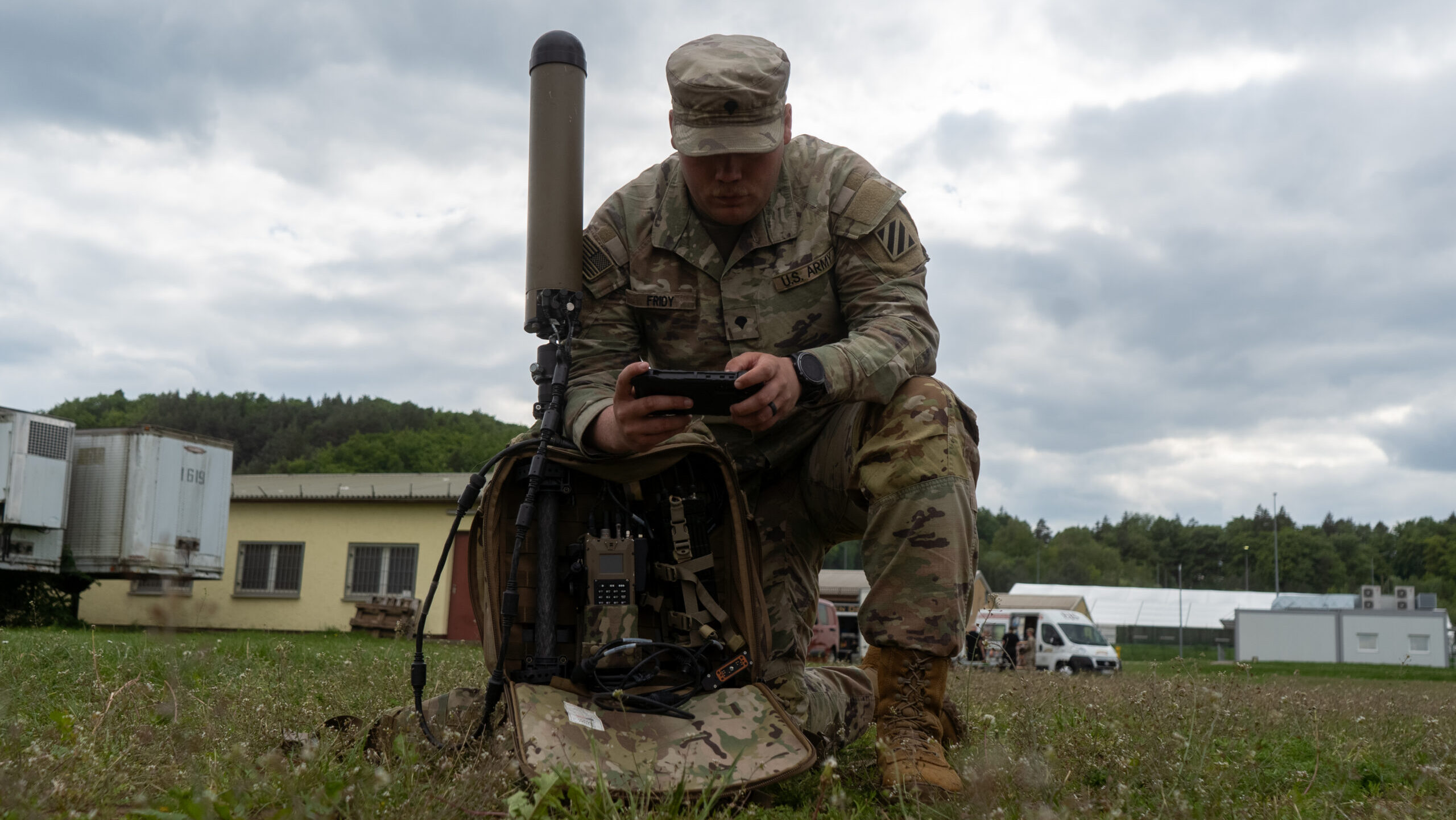
WASHINGTON — The Army is on the prowl for industry solutions related to electronic warfare and signals intelligence to become part of a new “library” of commercial tech from which commanders can draw as needed.
The Rapid Electromagnetic Warfare & Signals Intelligence Commercial Solutions Offering (REWSI), unveiled by Capability Program Executive Intelligence and Spectrum Warfare (CPE ISW) on Thursday, is part of the service’s effort to reinvigorate its electromagnetic spectrum capabilities and embrace more commercial, rather than bespoke, solutions.
“The Call for Solutions is a key step in building a rigorously vetted library of commercial technologies, allowing Commanders to quickly select the best tools for their specific mission,” Danielle Moyer, executive director of Army Contracting Command – Aberdeen Proving Ground, said in a release. “This approach allows us to tap into a more flexible model and encourages early and continued competition as the call will remain open and updated as specific capabilities needs emerge.”
The library will serve as a repository for white papers and indefinite delivery indefinite quantity (IDIQ) efforts, acting as a one-stop-shop for units to identify possible solutions for electronic warfare and signals operational needs, according to a CPE ISW spokesperson. If a desired capability is not in the library, the spokesperson said the commercial solutions offering (CSO) offers a path to quickly prototype and assess operational utility before procuring.
Evaluations of proposals will be conducted on a continuous, rolling basis throughout the 12-month open period of the CSO. Specific testing parameters for those selected for step two pitch session, and vendor technical demonstration may entail detailed laboratory, environmental, and threat-emulation parameters, according to the spokesperson.
Decisions on fielding and quantities will be dependent on the viability of presented solutions, funding levels and operational demands.
The library approach “allows for the rapid integration of commercial technologies and non-developmental items, bypassing traditional, lengthy development cycles to ensure Soldiers have advanced capabilities in a relevant timeframe,” Joseph Welch, Portfolio Acquisition Executive for Command and Control (C2)/Counter C2, said in the Army release.
After divesting much of its advanced capabilities after the Cold War, the Army has sought to modernize its electronic warfare arsenal since Russia’s incursion in Ukraine’s Crimea in 2014. The Army is trying to get away from developing exquisite and bespoke systems, which can take years to produce and face many hurdles — in some cases, never fielding — in favor of more rapid, commercial capabilities that can be procured faster.
With a bevy of commercial solutions that currently exist, the Army wants to see what’s out there and field it to meet needs much faster. The push for faster, more flexible acquisition is furthermore hardly relegated to EW of signals intelligence, but is a priority for the Trump administration Pentagon-wide.
This call for solutions solicits a variety of mature capabilities for areas the Army already has requirements, as outlined in the EMOS Characteristics of Need.
Released in February, the CoN acts as a broad call to industry to submit capabilities under four broad categories: attack, support, protect and common services. The Army has sought to use the CoN approach elsewhere as a means of acknowledging a problem area, but not being too prescriptive to industry in dictating a specific solution.
“The EMSO battlespace is at the forefront of all Army operations and the pace of change within this fast-moving environment. The EMSO CoN focuses on operational challenges and required capabilities rather than pre-defined solutions and will afford us greater flexibility in addressing evolving threats with emerging technologies,” Col. Scott Shaffer, Project Manager Electromagnetic Warfare & Collection, said in the Army release.
