

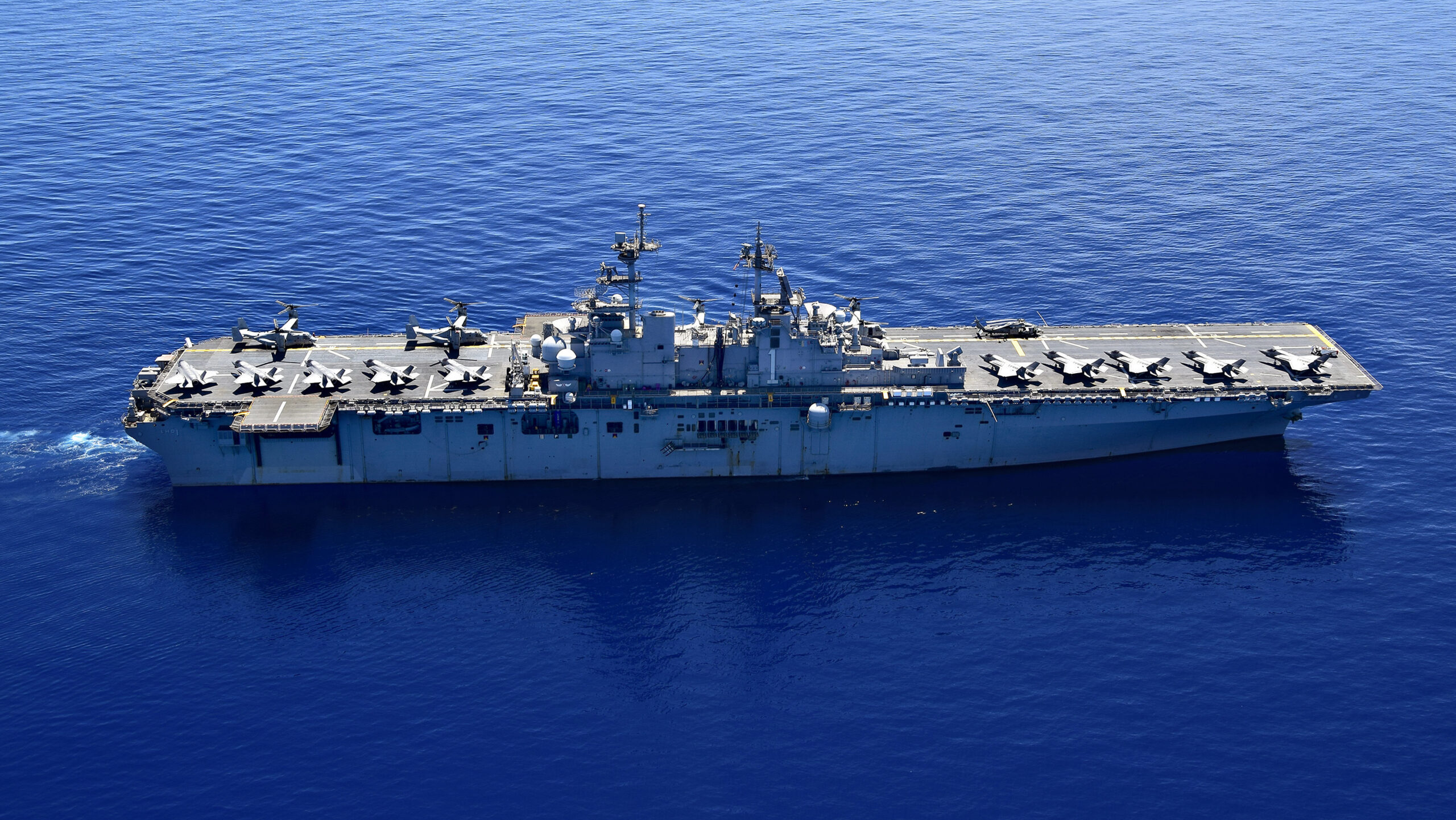
WASHINGTON — The amphibious assault ship USS Wasp’s service life has been extended five years, and the Navy and Marine Corps are evaluating additional extensions for other amphibious vessels.
“This fall, the CNO approved the service life extension of the USS Wasp, that’s the LHD one, the first of her class, a steam ship, and he extended it by five years until 2034,” Expeditionary Warfare Director Brig. Gen. Lee Meyer said at the Modern Day Marine exposition Tuesday. “The other LHDs — we’ve got to study to see if we can extend them, and the plan is going to be to do that.”
According to Meyer, extending the service life of the Wasp is “an example of what we would like to do with other ships.”
“But we’ve yet to analyze exactly what that would look like, and to be clear, it’s not a one size fits all,” Meyer said.
Likewise, Meyer said that another study is underway evaluating the status of the dock landing ship (LSD) that is expected to wrap up “very soon” and provide recommendations for service life extensions for that class of ship. Once that study is received, Meyer said the services must figure out how they want to employ, resource, and sustain the fleet.
“I want to look at every class of amphibious ship in a deliberate way, find out ways that I can invest in that, with modernization, with maintenance, in order to extend the life of those ships,” Meyer said.
The Navy and Marine Corps recently stood up the Amphibious Force Readiness Board (AFRB) in March, which is seeking to address amphibious readiness issues and is evaluating how many amphibious ships are needed.
“Those service life extensions are key factors in our readiness as we look to generate the number of amphibs that we need based on what the commandant and the CNO are guiding us to,” Meyer said.
Current law requires the Department of the Navy to maintain a fleet of at least 31 amphibious ships, but Meyer noted that both Vice Chief of Naval Operations Adm. Jim Kilby and Gen. Bradford Gering, the assistant commandant of the Marine Corps, have testified that more are needed. For example, Gering told lawmakers on the Senate Armed Services Committee that the right number is “probably somewhere near 40.”
These ships work together to form an Amphibious Ready Group (ARG) formation, which typically includes an assault ship, a transport dock, and a support vessel that carry an embarked Marine Expeditionary Unit (MEU) of at least 2,200 Marines. Together, this forms what the Marine Corps refers to as an “ARG-MEU,” and the Corps aims to maintain a 3.0 ARG-MEU presence globally.
Commandant of the Marine Corps Gen. Eric Austin said at the Sea Air Space exposition this month that while three ARG-MEUs are currently deployed, combatant commanders are requesting a 5.5 ARG-MEU presence and the force can’t meet that demand.
As a result, Smith said that the Navy and the Marine Corps are looking at several ways to improve the availability of its amphibious fleet, including extending the service lives of some ships.
