

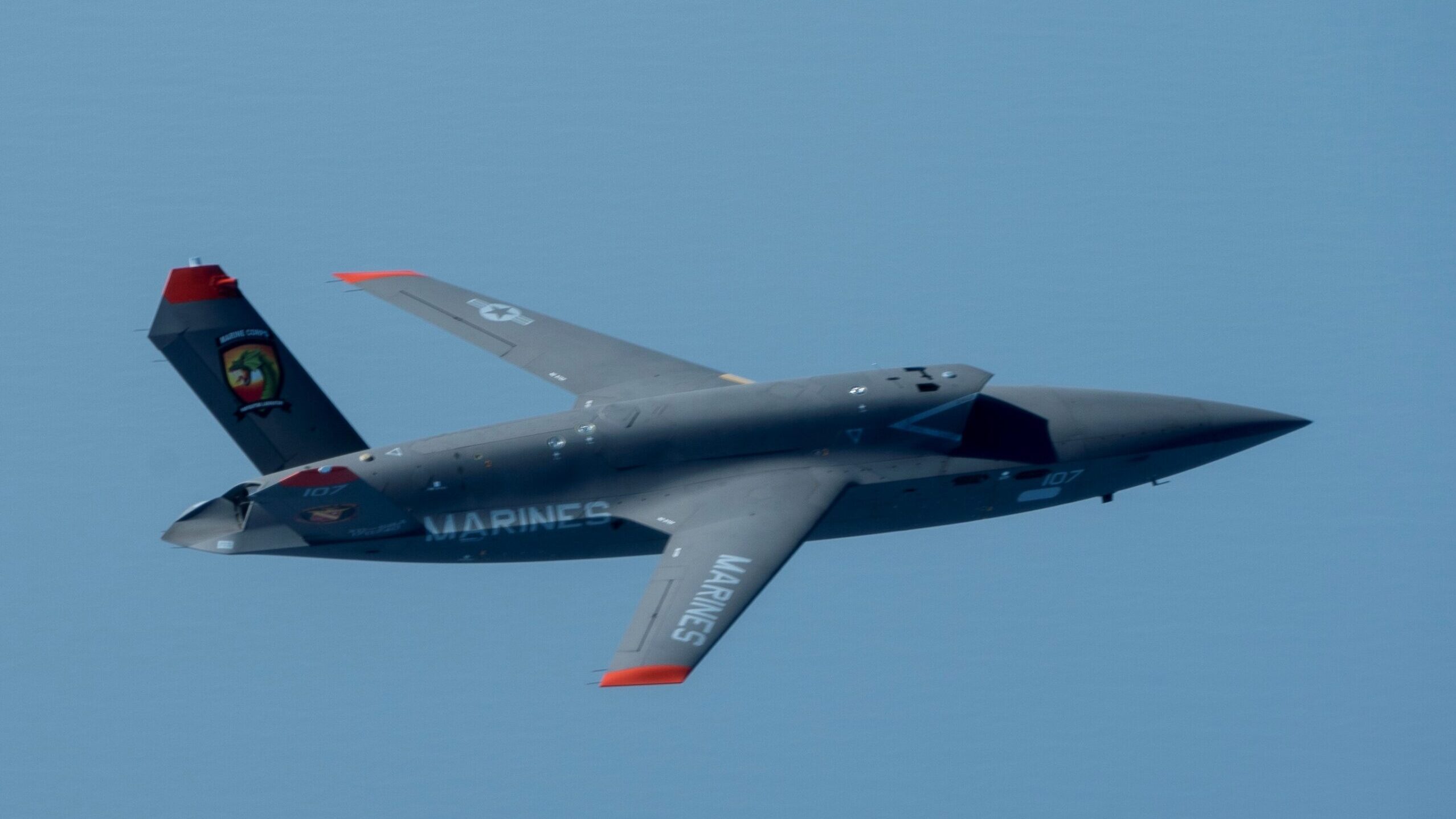
WASHINGTON — Drones will change the way the Marine Corps operates, officials said during the Modern Day Marine conference here this week, including in separate roles like unmanned wingmen and aerial reconnaissance that can reduce reliance on contractors.
One key new Marine Corps unmanned program on the horizon, an effort to field drone wingmen for fighter jets, should get hardware in the hands of troops before the end of the decade, according to Cunningham Group Branch Head Col. Richard Rusnok. The Cunningham Group, whose analysis informs key Marine Corps aviation programs, also provides input on the service’s Collaborative Combat Aircraft (CCA) effort.
The Marine Corps earlier this year picked Kratos’s XQ-58 Valkyrie as part of a team led by Northrop Grumman for the first round of the service’s CCA program, called Marine Air-Ground Task Force Uncrewed Expeditionary Tactical Aircraft (MUX TACAIR). The Marines are now working with the contractors to put landing gear on the aircraft for conventional takeoff and landing operations, Rusnok said Wednesday.
“We are going to, over the next couple years, do the developmental test to make sure that the air vehicle itself in that configuration is safe and effective to fly. And then we are working to put the mission systems into the airplane. So that will be an effort over the next two or three years to work through the developmental test milestones,” he said.
The drone will then undergo operational testing with the Marine Corps VMX-1 test squadron starting in “about 2029” before being fielded for combat. A separate Marine Corps official first disclosed that timeline in an address on Monday.
“We’re going to start out small, work our way up,” Rusnok said. “We are opening up an entirely new realm in Marine aviation here, and I think this is potentially as seismic as what we did when we introduced rotary wing aircraft to the fleet back in the 1950s.”
Like budding programs for the Air Force and Navy, the Marine Corps expects its CCA drones to operate in tandem with manned aircraft like fighters. The unmanned wingmen are envisioned to serve roles like lugging extra missiles to battle or carrying additional sensors to help improve battlespace awareness, and are expected to be cheaper than manned aircraft.
Marine Corps Surveillance: No More COCO?
During a separate presentation Wednesday, Marine Corps Maj. Michael Zbonack said drones could herald a different evolution — this time in ISR (intelligence, surveillance and reconnaissance), which he said the service is currently reliant on contractors to conduct, typically through contractor-owned, contractor-operated (COCO) arrangements.
In the coming years, however, Zbonack said the the service should be able move away from the COCO model to do its own or “organic” ISR due to “return to Group 3 UAS [unmanned aerial system] operations,” referring to mid-size drones. The drones can “provide persistent overhead coverage for Marines on the ground,” he said, citing “value propositions” like scalable production and austere launch and recovery operations.
In response to a question from Breaking Defense, Zbonack said in the “short term” services look like “continued COCO support.” The Navy and Marine Corps have previously issued awards for drone-based ISR services, and the US military has also used manned, contractor-operated aircraft for those missions — such as one aircraft that crashed in the Philippines last year, killing four aboard including one Marine.
Technological leaps should play out over the next few years, Zbonack said, which can help facilitate the Marines’ organic ISR vision. At that point, officials will survey what’s available to determine “whether or not we want to acquire a specific system.”
Zbonack additionally said the Marine Corps has a binding aspiration across its unmanned platforms: a common controller software solution, which would ideally allow troops to hand off operating the drone to one another based on battlefield dynamics. The Marine Corps is on a “campaign of learning” with industry for how that approach might be implemented, emphasizing that eschewing “vendor lock” will be a key objective.
“We don’t want bespoke solutions,” Lt. Col. Ben Link, who heads the Cunningham Group’s future vertical takeoff and landing concepts, said beside Zbonack. “The open architecture behind that, to add, drop, change and manipulate, is going to be really important in the future.”
