

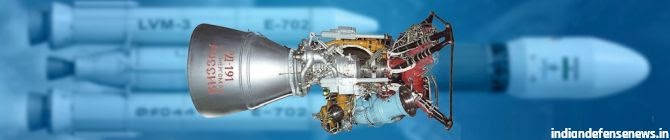
Indian officials from the space agency ISRO have held technical discussions in Moscow with Roscosmos regarding the procurement of semi-cryogenic rocket engines.
The talks are part of a long-drawn process aimed at enhancing India’s rocketry muscle power, particularly the payload capacity of its most capable rocket, the Launch Vehicle Mark-3 (LVM-3).
According to ISRO’s Annual Report for 2025–26, the draft contract for the delivery of these engines is currently under the approval process. This marks the first time an official ISRO document has publicly referred to the negotiations with Russia for high-thrust rocket engines, underscoring the seriousness of India’s intent to reduce reliance on foreign launches and strengthen its independent space capabilities.
The Parliamentary Standing Committee on Science and Technology recently highlighted that ISRO has been allocated funds in 2026–27 specifically for the “Induction of procured Semi-cryogenic engine towards expediting the enhancement of LVM-3 launch vehicle payload capability.”
This allocation reflects the government’s commitment to supporting ISRO’s technological advancement and ensuring India’s competitiveness in the global space sector.
Neither the ISRO annual report nor the Parliamentary committee document specifies which semi-cryogenic engine variant is being procured from Russia. However, since 2023, reports have consistently pointed to the RD-191 engine as the likely candidate.
Russia remains a longstanding strategic partner for India across defence, nuclear energy, and space technology, making such a procurement both technically and geopolitically significant.
The RD-191 is a high-performance semi-cryogenic rocket engine that uses rocket-grade kerosene as fuel and liquid oxygen as the oxidiser. Kerosene can be stored at room temperature, while liquid oxygen must be maintained at cryogenic temperatures below –150 degrees Celsius. This combination provides high thrust efficiency and reliability, making the RD-191 a proven choice for heavy-lift missions.
For India, the induction of semi-cryogenic engines represents a crucial step forward. Current Indian rockets rely on solid-fuel, liquid-fuel, and cryogenic engines, but the absence of a proven semi-cryogenic system has limited payload expansion.
Indigenous development of the SE-2000 semi-cryogenic engine is ongoing, yet it remains years away from being flight-ready. Procuring the RD-191 offers ISRO an immediate solution to bridge this technological gap while continuing parallel efforts to develop indigenous capability.
The move is expected to significantly boost LVM-3’s payload capacity, enabling India to launch heavier satellites and potentially support more ambitious missions, including deep space exploration and commercial launches. It also aligns with India’s broader strategy of reducing dependence on foreign launch services, thereby strengthening its position in the global space economy.
This procurement, once finalised, will mark a milestone in Indo-Russian space collaboration and reinforce India’s trajectory towards greater self-reliance in advanced rocket technology.
Agencies
