

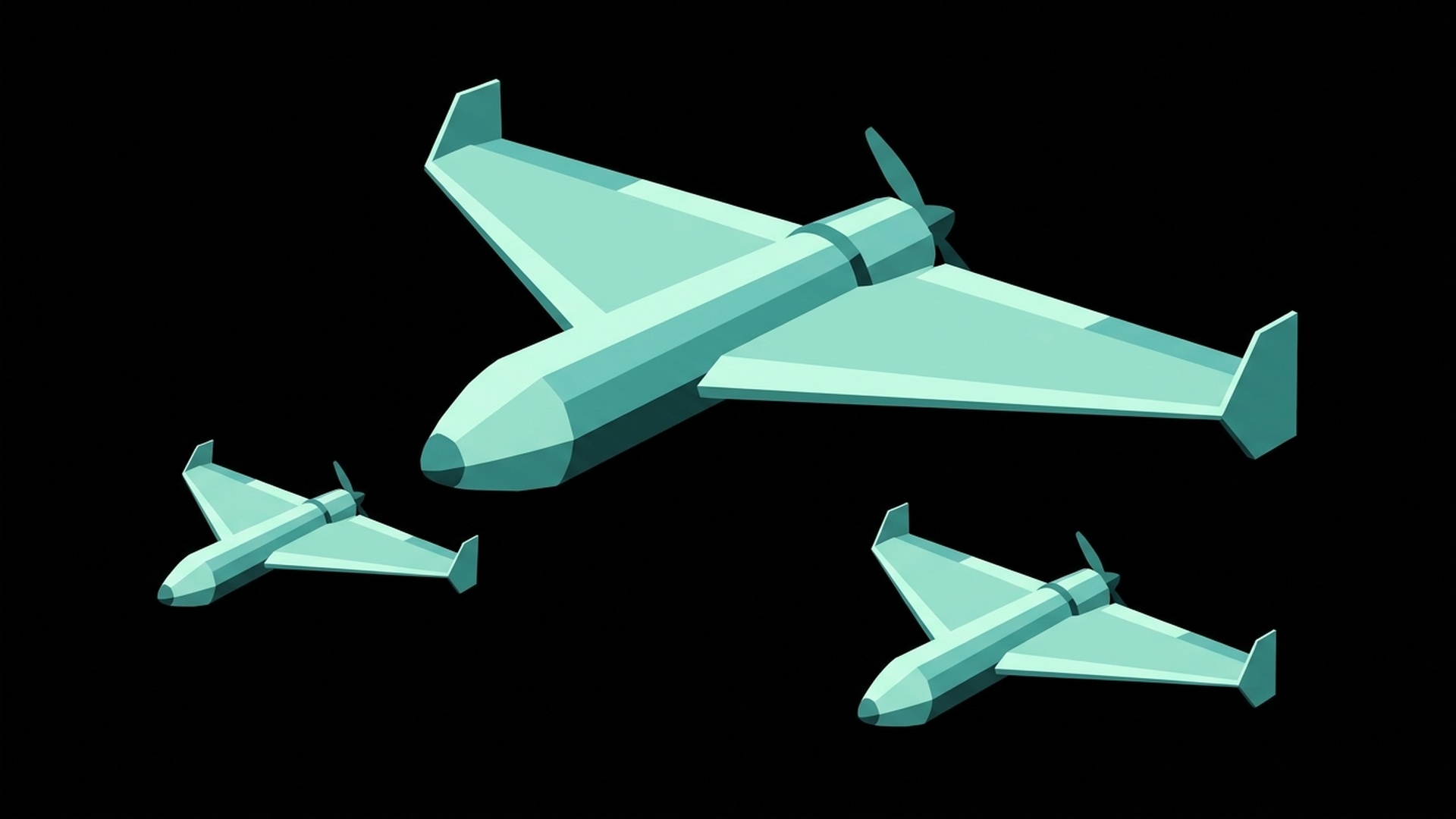
Iran’s Shahed family of one-way attack (OWA) drones has emerged as the single most consequential asymmetric weapon system of the 2026 US-Iran war. Across six months of sustained combat operations – from the first retaliatory strikes in March 2026 to the ongoing attritional campaigns against Gulf-based American installations – the Shahed programme has imposed a cost-exchange ratio that no Western air defence architecture was designed to sustain.
The Islamic Republic of Iran Aircraft Manufacturing Industries Corporation (HESA), operating under the Islamic Revolutionary Guard Corps Aerospace Force (IRGC-ASF), has scaled production of the Shahed-136 and its jet-powered successor, the Shahed-238, to rates that appear to exceed 200 units per month from Iranian facilities alone. When combined with output from the Yelabuga Special Economic Zone in Russia’s Tatarstan – where the Geran-2 (the Russian-designated export variant) is manufactured under licence – total monthly production capacity likely approaches 400–500 airframes.
This article examines the Shahed family’s technical evolution, production economics, operational deployment in the 2026 conflict, and the structural cost-exchange crisis it has imposed on United States Central Command (CENTCOM) air defence operations.
Get the Latest Defence News & Analysis
Follow Iran and the wider Middle Eastern and South Asian security environment with news coverage and analysis that answers what’s happening and let’s you see what’s coming.
The Shahed Family: From Shahed-131 to Shahed-238
The Shahed lineage traces to Iran’s earliest experiments with loitering munitions in the mid-2010s, but the operationally significant variants are the Shahed-131, Shahed-136, and Shahed-238.
The Shahed-131 is the smallest of the three – a delta-wing airframe with a wingspan of approximately 2.5 m, a range of 900 km, and a warhead of 10–15 kg. It functions primarily as a harassment and suppression weapon, forcing defenders to expend tracking and engagement resources on a platform whose loss is strategically inconsequential to the attacker.
The Shahed-136 – designated Geran-2 in Russian service – represents the programme’s mass-production workhorse. With a wingspan of 2.5 m, a range of 2,000–2,500 km, and a 40–50 kg high-explosive warhead, the Shahed-136 occupies a unique niche between a cruise missile and a loitering munition. It follows a pre-programmed flight path using a combination of inertial navigation system (INS) and satellite-aided guidance – initially GLONASS, with later variants incorporating Iran’s domestic correction systems to resist GPS-denial environments.
The Shahed-238, first publicly acknowledged in 2023 and operationally deployed since late 2025, marks a generational leap. It replaces the Shahed-136’s piston-driven propeller with a compact turbojet – likely derived from the Toloue-10 family – enabling speeds of 500–600 km/h versus the Shahed-136’s 180–185 km/h cruise speed. This speed increase compresses defender reaction timelines and complicates interception by gun-based close-in weapon systems (CIWS).
Given these speed and guidance improvements, the Shahed-238 appears designed specifically to defeat the layered counter-unmanned aerial system (C-UAS) defences that had achieved 90%+ interception rates against the slower Shahed-136 in Ukraine.
A fourth variant – the Shahed-149 Gaza – occupies a separate role within the family. This is a medium-altitude long-endurance (MALE) platform with a wingspan of approximately 5 m, designed for intelligence, surveillance, and reconnaissance (ISR) rather than strike. Its relevance to the attrition campaign is indirect but operationally significant: Shahed-149 sorties provide the targeting data that enables Shahed-136 and -238 strikes to reach their intended aim-points with minimal reliance on pre-programmed coordinates.
The overall family architecture thus presents defenders with a spectrum of threats – from the slow, cheap, mass-produced Shahed-131 at the low end to the fast, precision-guided Shahed-238 at the high end – all sharing common manufacturing infrastructure and overlapping supply chains.
Technical Specifications and Guidance Evolution
The propulsion architecture of the Shahed family is central to understanding both its capability ceiling and its supply chain vulnerabilities.
The Shahed-136 relies on the MD550 piston engine – a reverse-engineered derivative of small commercial aviation engines – driving a rear-mounted pusher propeller. This engine gives the airframe an endurance of approximately 12–14 hours at cruise speed, translating to maximum ranges of 2,000–2,500 km depending on payload configuration and flight profile.
The Shahed-238’s turbojet propulsion – drawing on engine technology from the Czech PBS TJ150 family and Chinese Telefly equivalents – enables a fundamentally different engagement profile. Where the Shahed-136 approaches at the speed of a light aircraft, the Shahed-238 arrives at transonic approach speeds in its terminal dive phase, reducing the engagement window for short-range air defence (SHORAD) systems from tens of seconds to single digits.
Guidance systems have similarly evolved. Early Shahed-136 variants relied on INS with GLONASS correction, leaving them vulnerable to electronic warfare (EW) jamming – a weakness Ukrainian forces exploited extensively between 2022 and 2024. Variants recovered in the 2026 conflict theatre show the addition of terrain-contour-matching algorithms and – in a subset of airframes – electro-optical terminal seekers capable of autonomous target recognition in the final 5–10 km of flight.
Thus, the Shahed programme has not remained static. Each operational deployment cycle has generated performance data that HESA has fed back into rapid engineering iteration – a hallmark of Iran’s defence-industrial approach since the Imposed War era.
Production Economics: Yelabuga, HESA, and the Scale Advantage
The cost-per-unit of a Shahed-136 is estimated at $20,000–$50,000 depending on variant, production batch, and the accounting treatment of shared infrastructure costs. The Shahed-238, with its more complex turbojet propulsion, likely costs $70,000–$100,000 per unit – still a fraction of any missile-based interceptor.
HESA’s facilities in Isfahan have been producing Shahed variants since at least 2020, with capacity expansions documented through satellite imagery in 2023 and 2024. Estimates of Iranian domestic production capacity vary, but the consensus among open-source intelligence analysts places it at 150–250 units per month across the Shahed-131, -136, and -238 variants combined.
The Yelabuga Special Economic Zone in Tatarstan represents the programme’s second production axis. Established under a 2023 agreement between Iran and Russia, the facility was designed to produce 6,000 Geran-2 airframes annually – approximately 500 per month – though whether it has reached full-rate production remains unclear. Reports of Russian-manufactured components found in Shaheds recovered in the Middle East theatre confirm that the bidirectional pipeline between Yelabuga and IRGC-ASF is active.
In this vein, one can see the Shahed programme’s production model as fundamentally different from Western precision-munition manufacturing. Where an AGM-158 Joint Air-to-Surface Standoff Missile (JASSM) requires months of production lead time and costs $1.5–2.5 million per unit, a Shahed-136 can be produced in days using commercial-off-the-shelf (COTS) components – automotive-grade GPS receivers, commercially available flight controllers, and simple stamped-metal airframe components.
This production elasticity – the ability to scale output faster than an adversary can scale interception capacity – is the strategic logic underpinning Iran’s entire OWA programme.
The implications for sustained conflict are straightforward. Iran can produce 200 Shaheds per month at a total cost of $4–10 million. Intercepting those 200 Shaheds with Patriot PAC-3 missiles – assuming two interceptors per engagement – would cost the United States approximately $1.64 billion per month.
Even if Iran doubles its production rate, the additional fiscal burden on Tehran is negligible; the additional burden on Washington’s interceptor logistics is potentially overwhelming.
Moreover, the Shahed’s manufacturing process is designed for resilience against air attack. Unlike a ballistic missile assembly line – which requires specialised facilities, precision machining, and weeks of integration time – a Shahed assembly operation can function in any industrial shed with basic metalworking tools. Dispersal across dozens of small workshops, rather than concentration in a single targetable facility, means that even comprehensive strikes against known production sites would only temporarily degrade output.
The Engine Supply Chain: PBS, Telefly, and Western Components
The Shahed programme’s dependence on foreign engine technology represents both an enabler and a vulnerability.
The core propulsion unit for the Shahed-136 – the MD550 and its variants – draws heavily on design heritage from the Czech PBS Velka Bites TJ150 micro-turbojet family, examples of which Iran acquired through grey-market channels prior to 2020. Subsequent sanctions enforcement has complicated but not eliminated this supply route.
Chinese manufacturers – particularly firms associated with the Telefly marque – have emerged as an alternative engine source. These units offer comparable thrust-to-weight ratios at lower per-unit costs, albeit with reported reliability penalties in extended-endurance flight profiles.
Perhaps most consequentially, component-level analysis of recovered Shahed airframes has revealed Western-manufactured microprocessors and chipsets – including products from Intel and Texas Instruments – embedded in guidance and flight-control subsystems. These components enter Iran’s supply chain through intermediary jurisdictions, highlighting the limits of export-control regimes when applied to dual-use microelectronics with global distribution networks.
Given these supply chain dynamics, one can assume that even a maximally effective sanctions regime would take 18–24 months to meaningfully constrain Shahed production rates – a timeline that exceeds the current conflict’s duration thus far.
The deeper problem for sanctions enforcement is the dual-use nature of nearly every Shahed component. The airframe is stamped aluminium sheet – indistinguishable from material used in automotive or HVAC manufacturing. The guidance computers use chips found in consumer electronics.
The explosive payload uses standard military-grade compositions available from multiple state and non-state sources. Only the engine represents a genuinely specialised component, and even there, Iran has developed sufficient indigenous manufacturing capability – drawing on decades of reverse-engineering experience – to sustain production without imports, albeit at reduced quality margins.
Conflict Armament Research (CAR) and the Royal United Services Institute (RUSI) have both published component-tracing studies showing that sanctioned Western chips reach Iran through supply chains transiting the UAE, Turkey, and Central Asian states. The volume of chips required – dozens per airframe – is small enough to conceal within legitimate commercial electronics trade flows, making interdiction at scale effectively impossible with current enforcement mechanisms.
Operational Deployment in the 2026 US-Iran War
The Shahed programme’s role in the 2026 conflict has been qualitatively different from its employment in Ukraine or its earlier use in Houthi operations against Saudi Arabia.
In the initial Iranian retaliatory strikes following Operation Epic Fury – the US air campaign against Iranian nuclear and military infrastructure – the IRGC-ASF launched mixed salvos combining Shahed-136 drones with Fattah hypersonic ballistic missiles. This combined-arms approach forced CENTCOM’s Integrated Air and Missile Defence (IAMD) systems to simultaneously engage threats across multiple speed regimes and altitude bands.
Prince Sultan Air Base in Saudi Arabia – CENTCOM’s primary forward operating location in the Gulf – absorbed repeated Shahed swarms of 30–50 airframes per wave, with multiple waves launched across 72-hour cycles. CENTCOM’s layered defence architecture – comprising Patriot PAC-3 batteries, Terminal High Altitude Area Defense (THAAD) systems, and short-range Stinger and C-RAM installations – achieved interception rates of 87–93% per wave.
However, at saturation volumes of 40+ drones per wave, even a 90% interception rate means 4+ airframes reach their targets per salvo. As Patriot interceptor stocks became strained, CENTCOM was forced to implement a tiered engagement protocol – reserving PAC-3 missiles for larger threats and relying on lower-cost SHORAD systems for Shahed interception.
The deployment of Ukrainian-developed drone interceptors – including STING-type kinetic interceptor drones costing $2,000–$5,000 per unit – represents CENTCOM’s adaptation to this cost-exchange imbalance, though these systems remain in early operational deployment as of May 2026.
The operational pattern also reveals a doctrinal sophistication beyond simple saturation. IRGC-ASF planners have employed Shaheds in multi-axis attacks – launching from Iranian territory, from forward positions in Iraq via proxy militias, and from maritime platforms in the Gulf simultaneously. This multi-axis approach complicates CENTCOM’s radar coverage geometry and forces defenders to maintain 360-degree alertness rather than concentrating sensors on a single threat azimuth.
Additionally, the mixing of Shahed-136 and Shahed-238 variants within a single salvo creates a tactical dilemma for air defence operators. The slower Shahed-136 appears first on radar, drawing initial engagement resources, while the faster Shahed-238 – arriving minutes later on a compressed timeline – encounters defenders whose ready magazines are partially depleted and whose fire-control radars are saturated with tracking data from the first wave.
The IRGC-ASF has also demonstrated adaptive routing – programming Shaheds to follow circuitous flight paths that exploit gaps in radar coverage, terrain-mask behind the Zagros mountains during the initial phase of flight, and approach targets from unexpected azimuths. This is not the behaviour of an unsophisticated adversary; it reflects four years of observational learning from the Ukrainian theatre.
The Cost-Exchange Crisis: $50,000 Drones vs $4 Million Interceptors
The defining strategic dynamic of the Shahed programme is the cost-exchange ratio it imposes on defending forces.
A single Patriot PAC-3 Missile Segment Enhancement (MSE) interceptor costs approximately $4.1 million. A THAAD interceptor costs $12.7 million.
A Shahed-136 costs $20,000–$50,000. Even the most expensive Shahed-238 variant, at an estimated $70,000–$100,000, creates a 40:1 to 60:1 cost-exchange ratio when engaged by a PAC-3.
This ratio becomes strategically unsustainable at the engagement volumes observed in the 2026 conflict. If CENTCOM expends two PAC-3 missiles per Shahed engagement – standard doctrine for high-value asset defence – and faces 150–200 Shahed launches per week, the weekly interceptor expenditure exceeds $1.2–1.6 billion in missile costs alone.
In this vein, the Shahed programme achieves strategic effect regardless of whether individual drones reach their targets. The programme’s primary function is not target destruction – it is interceptor depletion. Each Shahed that forces a Patriot launch has fulfilled its strategic purpose even if it is destroyed 15 km from its target.
Thus, the scramble to procure low-cost alternatives – gun-based systems like Rheinmetall’s Skynex (cost per engagement: ~$500), directed energy weapons ($1–10 per shot at the beam level), and interceptor drones ($2,000–$5,000) – is not merely a procurement preference. It is an operational necessity driven by the arithmetic of attrition.
Interception Rates and Saturation Arithmetic
Open-source data from both the Ukrainian theatre (2022–2025) and the Gulf theatre (2025–2026) provides a consistent picture of Shahed interception performance.
Against the slower Shahed-136, multi-layered air defence systems achieve 83–94% interception rates depending on the density of defensive coverage, terrain masking opportunities, and the degree of radar saturation from simultaneous launches. Ukrainian mobile air defence units – operating Gepard gun systems, IRIS-T SLM batteries, and adapted S-300 radars – achieved the highest published rates of 92–94% during winter 2024–2025.
In the Gulf theatre, where CENTCOM operates a denser sensor network but faces drones approaching over open water with minimal terrain-masking opportunity, interception rates have averaged 87–91% per published CENTCOM statements. The lower bound reflects engagements during peak saturation waves where 50+ drones arrive simultaneously from multiple azimuths.
The critical arithmetic, however, is not the interception percentage – it is the absolute number of leakers. A 90% interception rate against a salvo of 50 drones means 5 airframes penetrate to target. Against a salvo of 100, it means 10.
If Iran sustains launch rates of 200+ per week – which current production capacity supports – defenders face 20+ impacts per week even at consistently high interception performance.
That said, these impacts carry 40–50 kg warheads – significant against soft targets (fuel depots, parked aircraft, command facilities) but insufficient against hardened infrastructure. The strategic calculation for Iran thus requires volume sufficient not just to deplete interceptors but to achieve enough target impacts to degrade the adversary’s operational tempo.
The warhead limitation also shapes target selection. IRGC-ASF planners have directed Shahed strikes preferentially against high-value soft targets – exposed fuel bladders, satellite communications antennae, unmanned aerial vehicle (UAV) ground stations, and logistics vehicles – where a 40 kg warhead can achieve a mission kill. A single Shahed impact on a fuel bladder containing 50,000 litres of JP-8 produces secondary effects far exceeding the drone’s own explosive payload.
This targeting logic explains why CENTCOM has been forced to harden previously unprotected rear-area infrastructure – an adaptation that carries its own costs in construction materials, engineering time, and the dispersal penalties imposed on operational tempo when assets must be separated and concealed rather than concentrated for maximum sortie generation.
Counter-Drone Adaptation: STING, Gepard, and the Race to Cheaper Kill
The counter-Shahed problem has generated three parallel technological responses, each operating at a different cost tier.
At the lowest cost tier, electronic warfare and GPS-denial systems offer per-engagement costs measured in electricity consumption rather than munition expenditure. However, the evolution of Shahed guidance toward terrain-following and electro-optical terminal seekers has degraded EW effectiveness from the 30–40% soft-kill rates observed in Ukraine in 2023 to an estimated 10–15% against 2026-standard variants.
The middle tier – gun-based CIWS and SHORAD systems – offers the most favourable cost-exchange ratio among kinetic options. The Rheinmetall Skynex, firing 35mm programmable airburst ammunition at approximately $500 per burst, achieves engagement costs 8,000x lower than a Patriot interceptor. The system’s limitation is range – effective engagement at 4–5 km maximum, requiring dense forward deployment around every defended asset.
The emerging top tier of counter-OWA technology – autonomous interceptor drones such as the STING system developed by Ukrainian firm UkrSpecSystems and now deployed at Prince Sultan Air Base – offers a $2,000–$5,000 kinetic kill against a $20,000–$50,000 target. This inverts the cost-exchange ratio in the defender’s favour for the first time in the conflict.
However, these systems remain in early operational deployment. The transfer of Ukrainian counter-drone technology to Gulf States and CENTCOM – driven by Ukraine’s four years of operational experience against Shaheds – represents the most significant counter-proliferation dynamic of the 2026 conflict.
Distributed Lethality: The Shahed in Iranian Doctrine
The Shahed programme is not an isolated weapons project – it is the material expression of a doctrinal concept the IRGC has developed since the mid-2000s.
Iran’s strategic theory – articulated in IRGC-ASF publications and visible in procurement patterns since the Imposed War – rests on the principle of asymmetric cost imposition. Unable to match American conventional superiority in platforms, Iran has pursued systems that impose disproportionate costs on the adversary’s defensive infrastructure.
The Shahed programme embodies this logic more completely than Iran’s ballistic missile force. While ballistic missiles like the Fattah and Emad impose high per-unit costs on THAAD and Patriot batteries, their own production costs ($500,000–$2 million per missile) limit Iran’s ability to sustain attritional campaigns beyond initial salvos.
The Shahed inverts this constraint. At $20,000–$50,000 per unit with production rates exceeding 200 per month, Iran can sustain continuous attritional pressure for months – potentially years – without exhausting either its industrial capacity or its fiscal resources. The programme’s annual production cost at maximum rate – approximately $50–100 million – is trivial relative to Iran’s defence budget.
In this vein, one could see the Shahed programme as Iran’s answer to the precision-guided munition revolution – not by matching Western accuracy (though later variants approach it), but by substituting volume and cost efficiency for per-unit lethality.
Strategic Assessment: Did Attrition Achieve Its Objectives?
Six months into sustained Shahed employment against CENTCOM targets, the programme’s strategic record is mixed but not insignificant.
On the material level, Shahed strikes have damaged or destroyed fuel storage infrastructure, caused temporary closures of taxiways and aircraft shelters at Prince Sultan and Al Dhafra, and forced the dispersal of high-value assets – including F-35s and KC-46 tankers – to more distant rear bases. These effects are real but not decisive.
On the cost-imposition level, the programme has achieved its primary doctrinal objective. CENTCOM’s interceptor expenditure against Shaheds alone has exceeded $3 billion in the first six months of conflict – a figure that does not account for the opportunity costs of diverting Patriot and THAAD batteries from the ballistic missile defence mission, nor the logistics burden of transporting interceptor reloads to forward positions.
However, it is too early to assess whether this cost imposition has translated into strategic bargaining power for Tehran at the negotiating table. The programme’s effectiveness is ultimately a function of whether the United States perceives interceptor depletion as an existential constraint on continued operations – or merely as an elevated cost of doing business in a major theatre war.
One can see the adaptation race continuing beyond any ceasefire. The technologies fielded to counter the Shahed – autonomous interceptor drones, directed energy weapons, AI-enabled sensor fusion – will reshape air defence architectures globally. Conversely, Iran’s next-generation variants – likely incorporating greater autonomy, swarm coordination, and signature reduction – will seek to restore the attacker’s advantage.
The Shahed’s legacy in reshaping defence procurement – from Pakistan to the Gulf states to NATO – may ultimately prove more consequential than its direct operational effects in the 2026 conflict itself.
For defence planners worldwide, the lesson is structural rather than tactical. A state with modest industrial capacity and access to COTS electronics can, within 5–7 years, build an OWA programme capable of imposing billions of dollars in defensive costs on a superpower adversary. The barrier to entry is not technological sophistication – it is the institutional willingness to accept ‘good enough’ accuracy in exchange for overwhelming volume.
In this vein, one could see the proliferation of jet-powered attack drones – whether by state or non-state actors – as the defining air-power challenge of the next decade. The Shahed has demonstrated the concept; the question is how many actors will replicate it, and whether defensive technology can close the cost-exchange gap before the next war arrives.
Quwa Pro
Market Intelligence on South Asia & Middle East
Get ahead of your buyers’ requirements by identifying emerging threats to their national security posture.
Featured & Trusted By
