

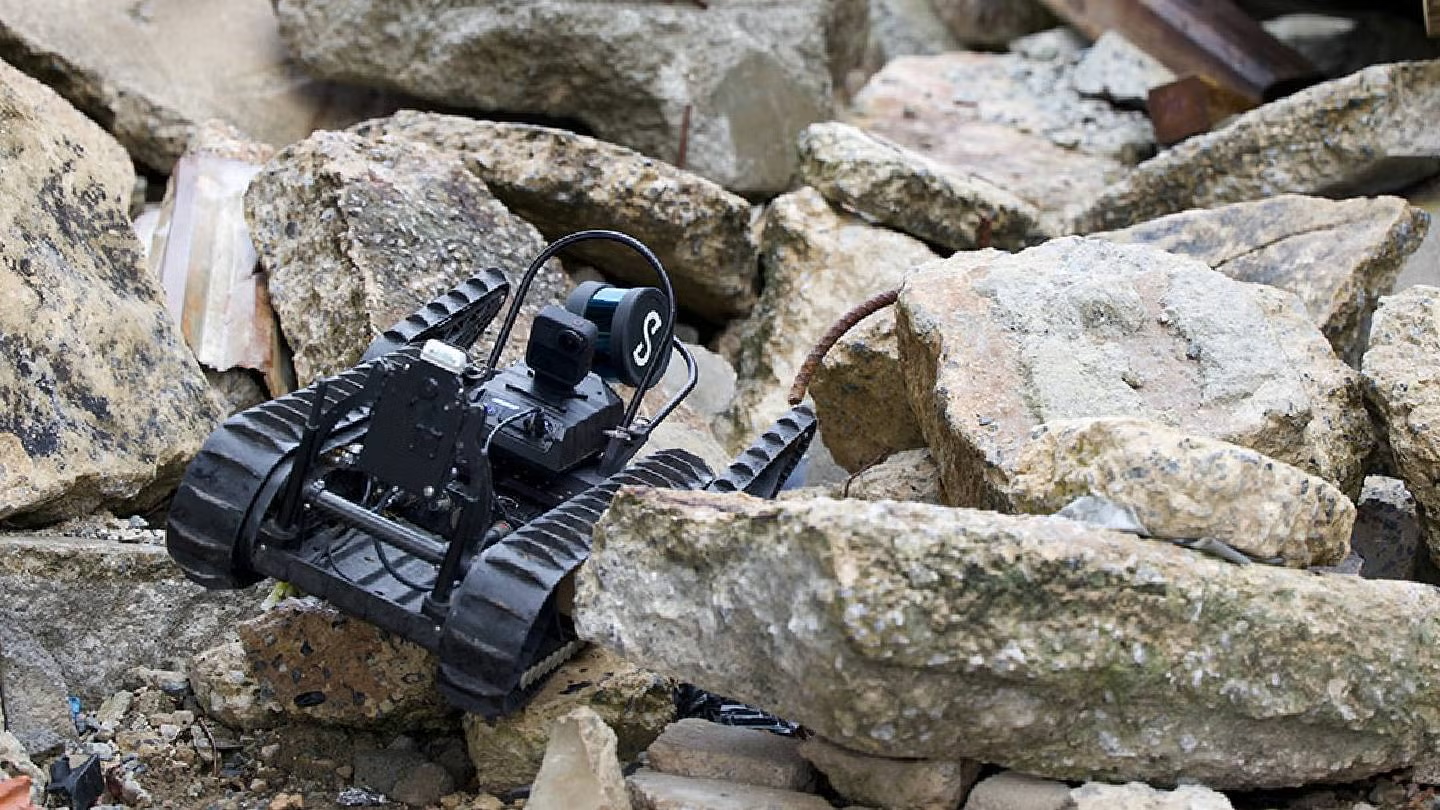
Teledyne FLIR Defense has certified Emesent’s Hovermap LiDAR payload for use across its uncrewed aerial systems (UAS), ground robots, and radiation detection platforms.
The certification, announced at Modern Day Marine 2026, expands Teledyne FLIR’s Third-Party Payload Integration Program.

Discover B2B Marketing That Performs
Combine business intelligence and editorial excellence to reach engaged professionals across 36 leading media platforms.
As part of this collaboration, Emesent’s 3D mapping technology, which does not rely on GPS, will be able to operate on a range of Teledyne FLIR hardware.
The approach addresses operational needs in environments where uncrewed systems can lose GPS connectivity, including tunnels, urban structures, and areas affected by chemical, biological, radiological, and nuclear (CBRN) threats.
The Hovermap system utilises LiDAR-based Simultaneous Localization and Mapping (SLAM) to generate real-time, accurate 3D models without the need for external infrastructure.
According to Teledyne FLIR, the integration of this system into its SkyRanger R70 and R80D SkyRaider UAS will enable mapping in locations without GPS.
When used with the SUGV 325 ground robot, the system provides continuous 3D data for navigation in complex indoor or underground environments.
Combined with the MUVE R430 radiation detection payload, operators can view both the robot’s path and areas with elevated radiation, supplying CBRN teams with geo-referenced threat information.
Teledyne FLIR Defense North America Unmanned Systems vice president Tung Ng said: “Teledyne FLIR builds platforms trusted for the most demanding CBRN missions in the world. Working with Emesent, we’ll be able to give operators a fused, spatial picture of the threat environment they simply haven’t had access to before. This is the direction the whole field is heading in, and we’re delivering it now through certified third-party payloads like Hovermap.”
Teledyne FLIR Defense, a subsidiary of Teledyne Technologies, certifies payloads following assessments of mechanical and electrical compatibility, software integration, and flight performance.
This process, supported by its open-architecture development model, aims to support a variety of mission requirements through its partner ecosystem.
The partnership with Emesent includes plans for ongoing development in autonomous navigation and enhanced sensor integration for a range of CBRN detection applications.
Both firms indicated that the technical developments from this cooperation would support future capabilities.
Joint solutions from Emesent and Teledyne FLIR Defense were presented during Modern Day Marine 2026 at Marine Corps Base Quantico.

