

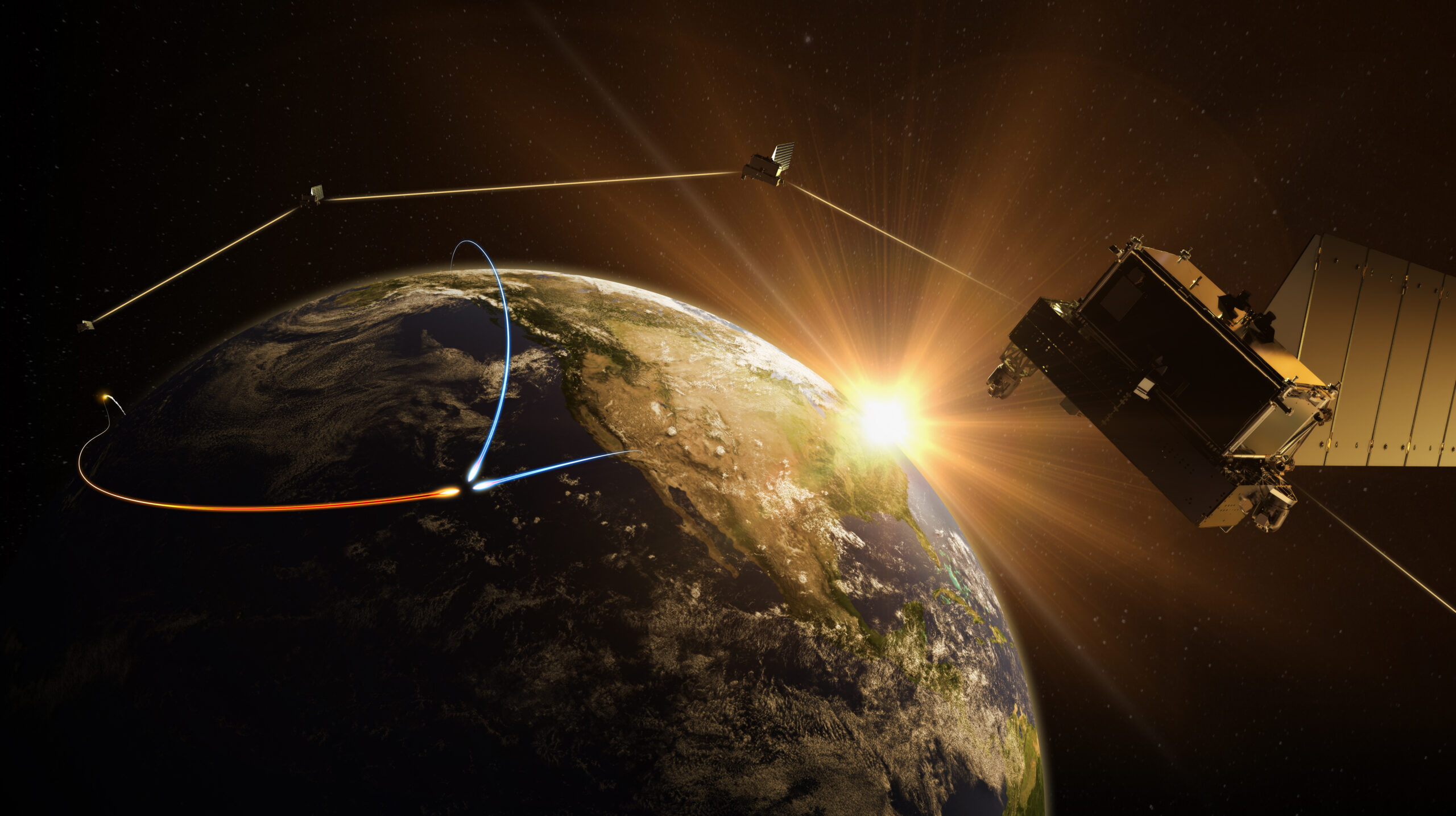
As threats from adversaries around the world continue to become more complex, building an infrastructure to stop them has become increasingly urgent.
As seen from recent military action in the Middle East, combinations of missiles and drone swarms can create overwhelming challenges for air and missile defense systems. Adversaries around the globe are developing threats ranging from ballistic missiles to hypersonics to space-based bombardment systems. Building a system that can counter all those threats will require an advanced, adaptable air-and-missile-defense infrastructure that can meet both current threats and future developments in offensive weaponry.
Breaking Defense discussed these challenges and how industry is working with the Pentagon to solve them with Rob Mitrevski, President, Golden Dome Strategy and Integration, L3Harris.
Breaking Defense: What are the threats to the United States that make an air and missile defense shield necessary to defend our homeland?
Mitrevski: There are usually four major threats that we talk about: China, Russia, Iran and North Korea. Each of these countries has demonstrated strength in a unique type of threat scenario.
I’ll start with Iran, given current events. As we’ve seen, Iran had a real capability in deploying and launching a multitude of well-stocked multi-domain threats, ranging from several classes of missiles through several classes of UAVs. We saw a significant number of them deployed concurrently and set to hit their targets within short time frames. The Iranian threat was unique in that it challenged the defender to defeat low-cost threats with low-cost defensive means, and defeat high-cost, more capable threats with more capable effectors.
China has demonstrated a significant number of advanced threats in the ground, air, maritime and space domains, ranging from UAVs to cruise missiles, intercontinental ballistic missiles, hypersonics and fractional orbital bombardment systems. They have a huge and growing stockpile that is evolving and becoming more capable with each passing day. Among the four nations that present the greatest threat to the U.S., China has the most global influence, regional leverage and economic power.
Russia is the country which has demonstrated the most operational capability in hypersonics, cruise missiles and ballistic missiles – both in combat and in test scenarios. Like China, the Russians have broad multi-domain capabilities in the ground, air, sea and space domains, although with more pressure on their stockpiles given their conflict with Ukraine.
North Korea is typically seen as a bit more rogue with increasing capabilities in size and range of ICBMs. They’ve also demonstrated a desire to launch test events over sovereign nations’ territories.
If you look at those in aggregate, you’re going to see a significant and diverse threat set for which we need a multi-layered, multi-domain defense. It clearly shows why we need to create and optimize a defense shield for our nation.
Given recent military action in Iran, do you think it is still one of those primary threats?
Iran’s retaliatory actions have certainly given us real-world confirmation of what we knew about their capabilities. Regardless of the outcome of this specific conflict, the multi-domain, concurrent attack capability on a diverse set of targets with significant numbers of weapons is the type of scenario we’re going to have to get used to thinking about in the way we protect ourselves.
Stopping an ICBM is one thing. Stopping a drone swarm is another thing. Stopping hypersonics is another thing entirely. How do you build that sensor infrastructure to be able to quickly identify what type of threat you’re facing, where it’s coming from, where it’s headed to, and how to best intercept it?
Gen. Guetlein and his team at Space Force have done a really nice job of developing an architecture that we’re certain will continue to evolve and grow. It needs to stay ahead of our adversaries’ intentions and anticipate the threats we just talked about.
In the simplest of terms, there are three major categories in an architecture for this mission set. First, there’s a sensing layer to detect the threat, track it, make sense of its intentions and pass the right actionable information along to the warfighter. The sensing layer can be at any altitude and uses a multitude of technology capabilities. Then, you need a ubiquitous communications layer to transmit the messages from the sensing layer in a very low-latency time frame – real time or near real time. Again, that communications layer is multi-domain and includes a command and control aspect to assure the assets in the architecture can interoperate. Finally, you need an intercept layer to neutralize the threats.
All three of these layers have to be able to deal with threats of various quantities, types, speeds, maneuverability, brightness and ease of tracking, as well as prioritization, decision support and verification, among many other things. That’s what makes this a complex problem, but it’s still a solvable problem based on the capabilities and the technology that we as an industry have developed. L3Harris has a portfolio of capabilities in sensing, communications and intercept that is well aligned with those three architecture layers.
Even going back to the “Star Wars” days, where the concern was 1980s-era ballistic missiles and intercontinental capabilities, along with cost and complexity, air and missile defense has still been tough to solve. Given how the challenges have increased in complexity since then, you still think this is a solvable problem?
I do. Those of us who remember SDI in the 1980s saw that as a technology challenge. I see today’s technology and our progress over the last 40-plus years as making this an integration challenge more than a technology challenge. If you look at the cost of satellites and the cost of launch these days versus what used to be the norm, you will see a significant efficiency improvement curve in terms of affordability for capability. You can look up the published costs per space vehicle on the Space Development Agency Tracking Layer awards and you’ll see that for something that had never been done from space before – which is a combination of detecting and tracking ballistic and hypersonic threats with enough accuracy to inform an interceptor – we’re doing it with very affordable assets from space these days, for a fraction of the cost of legacy systems whose mission was to only warn of a threat.
It’s up to us in the industry, alongside Gen. Guetlein and his team, to solve the problem. The architecture and the implementation plan that Gen. Guetlein has been working are moving, the spend plan is finished and the initial reconciliation budget categories around this mission area are flowing. We have the tools at the ready for it, so it’s solvable. It’s solvable through a thorough, rigorous systems architecture approach. It’s not just one layer or one type of asset in the system or one kind of threat. It’s about looking at that “system of systems” and making sure all three simplified layers I explained earlier work together as one – and that it’s accurate, fast, reliable and affordable enough to get the job done when you need it.
Israel’s Iron Dome and David’s Sling are the obvious reference points for air and missile defense, but that is protecting a relatively small area. How do you scale up air and missile defense to protect a country the size of the U.S.?
It’s always been a discussion about a layered defense system. Most people who talk about Israel talk about Iron Dome when in fact there are three layers of capability that Israel uses: Iron Dome, David’s Sling and Arrow. Each layer has a unique set of threat parameters that it’s targeting – some are more regionalized, some are more national and some are a little more global. That’s exactly the same analysis that we’re doing in the same solution set that we’re going to have to deal with.
A multi-layer architecture is the way you’re going to have to defend against these threats, and you’re going to have different tools in your tool set to deal with each one. That’s why a multi-layer architecture will include air, ground, maritime and space-based capability, with different sorts of sensing at each of those layers, different communications paths and different effectors that will intercept or neutralize the threat.
What insight have you gleaned from the National Defense Strategy, and what are you doing right now to be ready to meet those demand signals?
When you read not only the NDS but all the executive orders, the reconciliation budget, acquisition reform initiatives and other policy pieces together, there are plenty of demand signals – including the Department of War’s priorities to defend the homeland with next-generation air and missile defense and supercharge the defense industrial base.
In many ways, we’ve been responding to those demand signals for a while now. When we were posed with the unmet national need of tracking a hypersonic glide vehicle from space about seven years ago, we realized pretty fast that solving that challenge would be transformative for our industry and our company. So when we successfully demonstrated these capabilities from space with solutions like the Hypersonic and Ballistic Tracking Space Sensor, where we were the company to uniquely meet or exceed the Missile Defense Agency’s three mission success criteria for tracking hypersonics, we responded to that demand signal by delivering first-of-its-kind capability that was affordable and on an accelerated timeline.
The Department of War has been clear that we need to be able to predictably manufacture capabilities at scale, so we’ve spent about $250 million on advanced modern manufacturing facilities for space assets in Indiana and Florida. We’re also investing billions of dollars into modernizing and expanding our solid rocket motor production sites to significantly increase capacity to produce propulsion systems for critical missile programs.
L3Harris is well aligned with the administration’s defense priorities. Now, it’s a matter of continuing to turn the crank and execute on those objectives. Our industry and our nation are facing complex challenges, and this is a moment where our ingenuity, expertise and dedication are needed the most. I’m honored to be part of a team at L3Harris that is supporting our nation’s critical homeland defense objectives.
