
Close Menu
Defence Line
    What's Hot

    India’s Third Aircraft Carrier: Strategic Necessity And Industrial Catalyst

    May 28, 2026

    Balu Forge Secures First Aerospace Contract With US Alpha Aircraft Systems

    May 28, 2026

    How the Pentagon plans to spend $50 billion on drone warfare

    May 28, 2026
    Facebook X (Twitter) Instagram
    • Home
    Facebook X (Twitter) Instagram
    Defence LineDefence Line
    • Home
    • Asia Pacific
    • US-Russia
    • NATO Europe
    Subscribe
    Defence Line
    Home»Military & Technology»British Army call for UAS-deployed sensors to survey ground and rivers
    Military & Technology

    British Army call for UAS-deployed sensors to survey ground and rivers

    Defenceline WebdeskBy Defenceline WebdeskMay 7, 2026No Comments4 Mins Read
    Facebook Twitter Pinterest LinkedIn Tumblr Email
    Share
    Facebook Twitter LinkedIn Pinterest Email


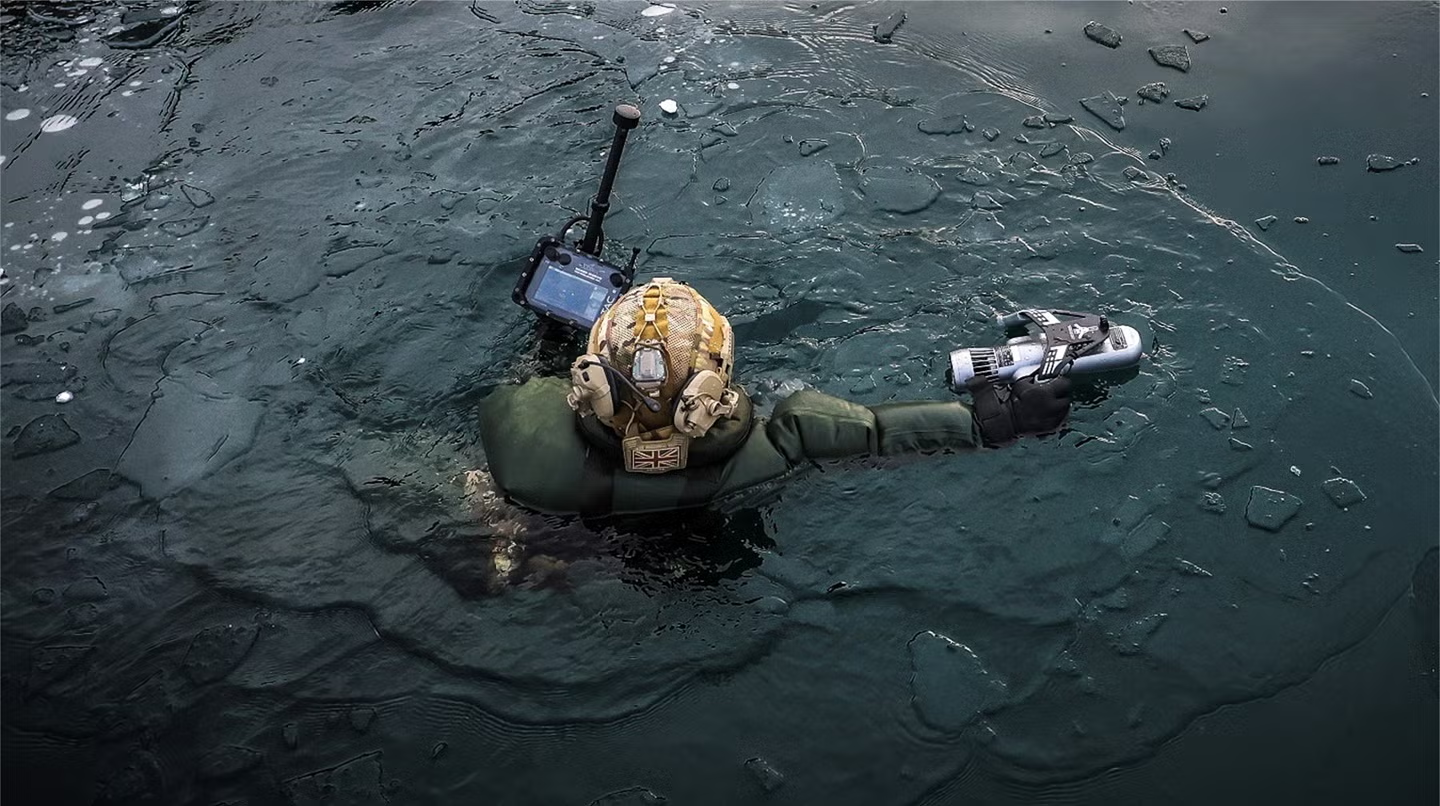
    Royal Marine uses a sub-surface Rapid Beach Profiling System to survey the seabed under the icy water of a Norwegian Fjord, 25 February 2026. Credit: Crown copyright / UK Ministry of Defence.

    • UK Defence Innovation has launched an industry competition on behalf of the British Army
    • Tenders will demonstrate sensor tech to survey river data to enable land force mobility
    • With daily breakthroughs in uncrewed systems, it is hoped the competition will deliver greater capabilities than the last endevaour in 2021

    Agencies within the UK Ministry of Defence have launched an industry competition to deliver novel sensor technologies, deployed from uncrewed aerial systems (UAS), allowing the British Army to assess the battlespace.

    In doing so, the Government aim to reduce the risk to personnel tasked with surveying sites in person.

    Discover B2B Marketing That Performs

    Combine business intelligence and editorial excellence to reach engaged professionals across 36 leading media platforms.


    Find out more

    The competition specifically addresses two areas: the ability to measure ground bearing capacity and underwater river profiling.

    Historically, this so-called “wet gap” has always posed challenges to the pace of land force mobility and logistics. But it is hoped, given recent technological advancements in autonomy, that the defence industry may enable the Army to travel faster and overcome the human risk to conventional surveying.

    In fact, the competition requires that operators conduct the mission at a range of ~3-5km for the final deployment.

    “Increasing the pace, stealth and number of viable crossing sites will increase operational agility and obfuscate tactical intent,” read the competition document.
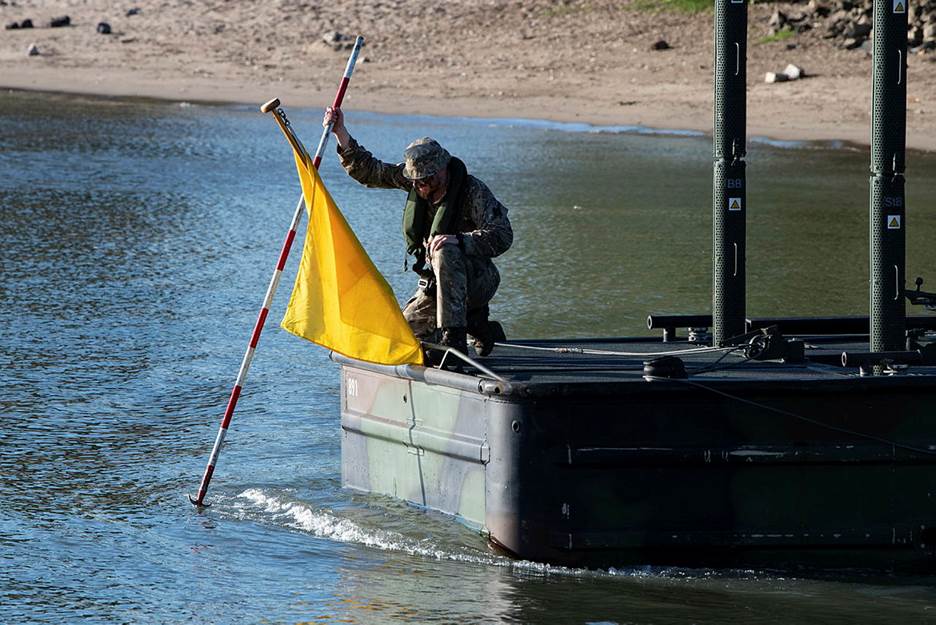
    Operators of safety boats are measuring the depth of the banks of the River Rhine, 28 June 2025. Credit: Crown copyright / UK Ministry of Defence.

    Each tender must deliver a demonstrable capability at technology readiness level six.

    No more than £2m ($2.7m) will be made available for the competition, according to the notice issued on 6 May. UK Defence Innovation expects to fund three to four proposals across both challenges for a contract period of up to 15 months with plans to begin in October.

    The submission deadline is scheduled to close midday on 16 June 2026.

    Royal Engineer reconnaissance teams are tasked with assessing whether the ground and riverine environments are suitable for the safe passage of vehicles and whether specialist gap‑crossing equipment is required for the force.

    Currently, measurements are taken in person.

    Lessons from 2021 trials

    An earlier competition took place in 2021 led by the Defence and Security Accelerator.

    The competition demonstrated the potential for remote and autonomous systems in assessing the wet gap. However, each single uncrewed platform was limited in coverage, mobility and autonomy to deliver a full high fidelity wet gap survey.
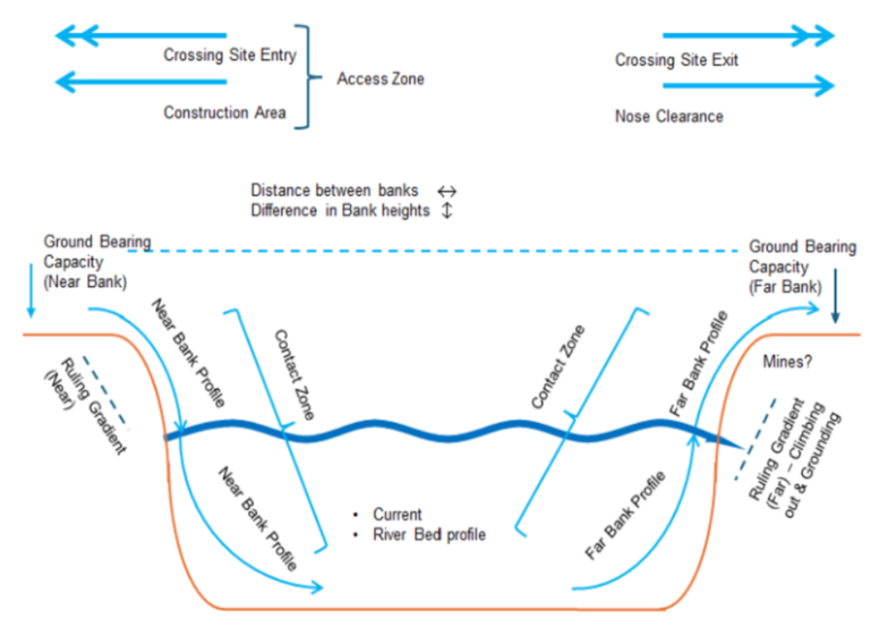
    Cross section of a wet gap annotated with measurement requirements. Credit: UK Defence Innovation.

    In the 2021 competition, Nordic Unmanned was able to ascertain the water depth and flow speed using its ball-shaped WaFlow instrument but failed to demonstrate ground-measuring capabilities.

    Ultimately, the trials exposed the penetration limits of bathymetric LiDAR in turbid conditions and revealed a need for robust UAS-deployable sensors to estimate ground bearing capacity across different sites.

    Daily breakthroughs

    A lot has changed in warfare since then. Recent conflict trends indicate a growing demand for uncrewed systems and intelligence, surveillance and reconnassance (ISR) capabilities.

    In Ukraine, it is said that the fast-moving UAS sector – demonstrated by first-person view drones and fibre optic controlled systems – is changing on a daily basis.

    In this backdrop, the data analytics firm GlobalData found that the emergence of novel technologies such as AI, LiDAR, and computer imaging are major drivers for investment in the remote sensing value chain.

    The consultancy points to the growing integration of sonars, radars, and optronics on both civilian and military uncrewed vehicles, which are seeing increased use for hydrographic surveying, asset monitoring, environmental conservation, and even commercial shipping operations.

    The Ministry of Defence likewise emphasised the need for modular, platform agnostic sensor packages that can be rapidly remounted when platforms fail or when missions require only part of the full survey.

    Email newsletter icon

    Sign up for our daily news round-up!

    Give your business an edge with our leading industry insights.


    Source link

    Share. Facebook Twitter Pinterest LinkedIn Tumblr Email
    Defenceline Webdesk

    Related Posts

    Australia receives final P-8A Poseidon aircraft from Boeing

    May 27, 2026

    Silent vanguard: inside combat air autonomy

    May 27, 2026

    Norway signs CAVS Framework Agreement to enable Patria 6×6 purchase

    May 27, 2026

    Poland’s WZE receives Patriot missile motors order from L3Harris

    May 27, 2026
    Add A Comment

    Comments are closed.

    Economy News

    India’s Third Aircraft Carrier: Strategic Necessity And Industrial Catalyst

    India Defence May 28, 2026

    India’s third aircraft carrier project, INS Vishal, is advancing through the design phase with ambitions…

    Balu Forge Secures First Aerospace Contract With US Alpha Aircraft Systems

    May 28, 2026

    How the Pentagon plans to spend $50 billion on drone warfare

    May 28, 2026
    Top Trending

    India’s Third Aircraft Carrier: Strategic Necessity And Industrial Catalyst

    India Defence May 28, 2026

    India’s third aircraft carrier project, INS Vishal, is advancing through the design…

    Balu Forge Secures First Aerospace Contract With US Alpha Aircraft Systems

    India Defence May 28, 2026

    Mumbai-based Balu Forge Industries Limited (BFIL) has officially stepped into the global…

    How the Pentagon plans to spend $50 billion on drone warfare

    Geopolitics May 28, 2026

    CAMP ATTERBURY, Indiana—A countdown began as a gaggle of defense officials, soldiers,…

    Subscribe to News

    Get the latest sports news from NewsSite about world, sports and politics.

    Facebook X (Twitter) Pinterest Vimeo WhatsApp TikTok Instagram

    News

    • World
    • US Politics
    • EU Politics
    • Business
    • Opinions
    • Connections
    • Science

    Company

    • Information
    • Advertising
    • Classified Ads
    • Contact Info
    • Do Not Sell Data
    • GDPR Policy
    • Media Kits

    Services

    • Subscriptions
    • Customer Support
    • Bulk Packages
    • Newsletters
    • Sponsored News
    • Work With Us

    Subscribe to Updates

    Get the latest creative news from FooBar about art, design and business.

    © 2026 Defenceline. Designed by Digitwebs.
    • Privacy Policy
    • Terms
    • Accessibility

    Type above and press Enter to search. Press Esc to cancel.