

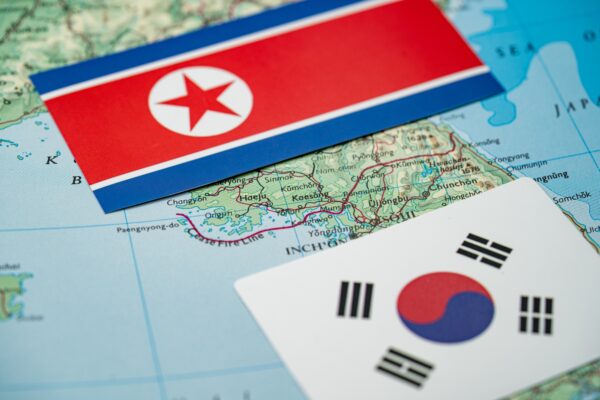
After almost two years of speculation, changes to North Korea’s constitution have been made public. Of great interest was the country’s definition of its territory, which is a key indicator of its policy toward South Korea.
The amendment reads that North Korea’s territory borders “China and Russia to the north and the Republic of Korea to the south, as well as territorial waters and airspace established on that basis.” This is the first time North Korea dropped its territorial claims against the South.
Pyongyang also scrapped references to “peaceful unification” and “imperialist aggressors” in the document. Neither does it identify Seoul as the “primary foe.”
Without a doubt, this is a textual confirmation of Pyongyang’s two-state theory vis-à-vis Seoul that it adopted in December 2023 and the country’s lack of interest in any South Korean outreach. The constitutional amendments signal a major change in how North Korea defends itself. Instead of seeking security assurances from its neighbors – whether its Russian and Chinese allies or South Korean and American enemies – Pyongyang is now giving these countries assurances of its won to avoid miscalculation and clarify the conditions that it may resort to the use of force.
Coercive diplomacy, or the use of credible and explicit threats and assurances in combination to discourage other countries from undertaking unwanted behaviors, has been the essence of North Korea’s security strategy since the end of the Korean War. Pyongyang wants to discourage a South Korean march north as well as to weaken the South Korea-U.S. alliance. The country has invested much into the threats side of coercive diplomacy by stationing long-range artillery along the inter-Korean border and developing nuclear weapons. There has been little doubt that, if South Korea and the United States were to invade North Korea, Pyongyang would swiftly launch preemptive attacks, including possible nuclear strikes.
However, the assurance side of Pyongyang’s diplomacy has not received as much attention. Without this, North Korea building arms for deterrent purposes can be misperceived as preparation for an invasion due to the security dilemma. North Korea tried to explicitly assure the South that it had no intention to invade it first under the July 4, 1972 South-North Joint Communique. But in April 1975, as the United States-backed regimes in Indochina were collapsing, North Korean President Kim Il Sung adopted a militant unification policy and asked China for help with “liberating” the South. China demurred.
In 1991, Kim again assured Seoul of his peaceful intention under the Agreement on Reconciliation, Non-Aggression, and Exchanges and Cooperation. However, such an assurance was not credible. In March 1994, North Korea threatened war against South Korea and the United States over IAEA inspections of its nuclear program.
Joint North-South statements at the 2000, 2007, 2018 summits mentioned “peaceful unification,” but they were not enough to fully dissipate Seoul’s skepticism of a North Korean invasion because Pyongyang still laid claims over the entire Korean Peninsula. North Korea’s new territorial clause significantly changes the assurance dynamic. By renouncing its territorial claims over South Korea and officially calling its neighbor the “Republic of Korea” in the constitution, North Korea got rid of a legal pretext to attack South Korea.
A stronger assurance contributes to North Korea’s effort to deter a foreign attack in two ways. First, it complements North Korea’s red line in using nuclear and conventional forces. Currently, Pyongyang’s red line against U.S. and South Korean provocations covers the Korean Peninsula, but such a red line is not credible. Neither Washington nor Seoul believes Pyongyang has the resolve to turn Seoul into “a sea of fire.” Limiting the scope to areas north of the 38th parallel means that Pyongyang has aligned its resolve with its capability in defending North Korea’s territorial integrity and regime survival. North Korea’s threats will become more credible.
The assurance also allows North Korea to bolster the deterrent side of coercion by delegitimizing a U.S. or South Korean preventive attack against its nuclear program as an invasion of a sovereign state. It is not a coincidence that North Korea’s constitution emphasizes its nuclear-weapon state status and specifies Chairman Kim Jong Un’s delegative command and control of nuclear forces alongside the territorial clause.
Second, renouncing an attack against the South strengthens North Korea’s ties with Russia and China. Mutual defense clauses in North Korea’s alliance treaties with both do not require Russian and Chinese assistance if North Korea attacks the South first. However, the territorial scope of the clauses is vague because before the constitutional amendments, North Korea’s territory covered the entire peninsula, and it didn’t recognize the Republic of Korea. North Korea aligning its de jure territorial claims with its de facto control removes this uncertainty in the scope of Russia’s and China’s security commitment.
At the same time, Moscow and Beijing can be assured that they will not be entangled in a North Korean effort to recover lost territory south of the 38th parallel, as was the case in 1950. Stabilizing relations with South Korea also allows North Korea to continue sending troops and weapons to Russia without fear of a South Korean attack.
There is still ambiguity in the status of the disputed Northern Limit Line, the de facto North-South maritime border, in the amended constitution. In the past, Pyongyang and Seoul clashed in this area. However, a maritime crisis is less likely to spill over on land if the land border has been demarcated. North Korea has fortified its side of the demilitarized zone in the past few years, which means that it doesn’t challenge the status quo of the land border. North Korea cannot unilaterally give up its maritime claims in the new constitution, but it also doesn’t seek to provoke Seoul and undermine its assurance policy. Leaving the issue open means Pyongyang can peacefully resolve the maritime disputes with Seoul as separate states if the two Koreas sign a peace treaty.
The long timeline between North Korea debating this clause in October 2024 and adopting it in March 2026 indicates that this is a deliberate shift. The amendment has also been accompanied with massive domestic adjustments of organizations handling inter-Korean affairs and public messaging. As such, North Korea will not abandon its two-state theory anytime soon, unlike its past ephemeral embraces of outreach from liberal South Korean presidents.
North Korea’s assurances toward South Korea also signal that Pyongyang doesn’t have a hostile policy toward the South. Notably, it dropped all references to the South as an enemy in the constitution. North-South relations aren’t hostile. They are in a state of peaceful, if uneasy, coexistence as neither side threatens to absorb the other with force.
Most importantly, the constitutional change also shows that North Korea has devalued a hypothetical U.S. and a South Korean security assurance, in line with its growing confidence in the trend of the inter-Korean balance of power. This is the utmost expression of its Juche (“self-reliance”) ideology.
