

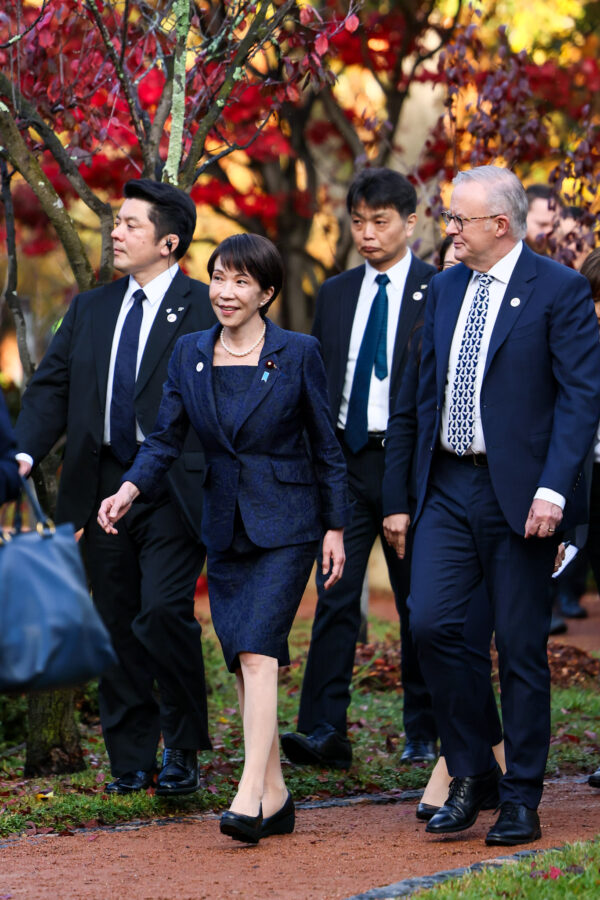
In early May 2026, during Japan’s extended holiday period known as “Golden Week,” Prime Minister Takaichi Sanae paid official visits to Vietnam and Australia. Takaichi’s trip to Australia – her first since assuming office – coincided with the fiftieth anniversary of the 1976 Basic Treaty of Friendship and Cooperation between Japan and Australia and was at the invitation of Australian Prime Minister Anthony Albanese.
Takaichi’s visit to Australia took place against a backdrop of unprecedentedly acute international tensions surrounding both countries. In particular, the growing instability in the Middle East has created a situation of grave concern for Japan and Australia, both of which depend heavily on imported energy resources. Moreover, the Trump administration’s policies toward the Middle East have raised concerns that a potential vacuum of power could emerge in the Indo-Pacific region, thereby calling into question the security of Japan and Australia, which have long relied upon the U.S. military presence.
At a summit meeting held in Canberra, the two leaders issued a series of forward-looking documents, including a joint declaration on economic security cooperation, as well as statements advancing partnerships in energy security, critical minerals, and cyber domains, alongside an enhanced framework for defense and security cooperation. They further instructed their respective ministers to explore concrete measures to institutionalize “comprehensive security cooperation” between Japan and Australia by the time of their next summit.
During the meeting, Takaichi characterized Japan and Australia as “frontrunners in cooperation among like-minded countries.” Although the Japanese government has thus far refrained from providing a rigid definition of “like-minded countries,” a survey of those states that have been so designated reveals several common attributes.
First, many of these countries share concerns regarding the rise of China. While the degree of perceived threat naturally varies depending on geographical and economic circumstances, they are united in their reluctance to see their strategic autonomy constrained by military coercion or excessive economic dependence. Consequently, they share an interest in maintaining a stable balance of power in the region. Even as they broadly welcome the continued presence of the United States, the resurgence of “America First” under a second Trump administration has underscored the imperative of strengthening their own autonomous defense and economic capabilities.
Second, these countries tend to occupy locations of critical geographical importance to Japan. The sea lanes extending from the East China Sea through the South China Sea and the Strait of Malacca to the Indian Ocean and the Middle East constitute vital lifelines for Japan’s security and prosperity. Strengthening ties with states situated along these routes has become increasingly important, particularly as uncertainties surrounding U.S. regional engagement grow.
Third, many of these countries demonstrate an affinity with the fundamental principles underpinning Japan’s vision of a Free and Open Indo-Pacific – namely openness, inclusiveness, and the rule of law. In this sense, like-minded partnerships are not merely instrumental alignments of security interests but are also grounded in a shared normative framework.
Few countries embody these characteristics as clearly as Australia does. While remaining a close ally of the United States, Australia is also deeply economically intertwined with China, and thus faces the delicate challenge of managing economic coercion while maintaining a stable bilateral relationship with Beijing. Like Japan, Australia has sought to enhance its strategic autonomy through the diversification and strengthening of trade and supply chains. In the security domain, particularly following the re-emergence of the Trump administration, Canberra has shown an increasing emphasis on reducing excessive dependence on the United States and bolstering its capacity for self-reliant defense.
Australia is not a littoral state along Japan’s principal sea lanes, but it is nonetheless a critical partner in ensuring the security and resilience of Indo-Pacific maritime routes. Above all, it is among the few countries that almost entirely shares Japan’s commitment to preserving a free and open international order. This shared vision of order has long underpinned the broad-based cooperation between the two countries since the Cold War era.
It is therefore hardly surprising that economic security featured prominently on the summit agenda. The diversification of critical resource supply chains and the strengthening of energy security provide a foundation on which the two nations can pursue autonomous policy choices without undue vulnerability to great-power rivalry. The prospective transfer of Japanese frigates to Australia would not only enhance Australia’s self-reliant defense capabilities but also signal deeper cooperation in safeguarding sea lanes in the future.
Moreover, Australia’s acquisition of Japanese-built destroyers could contribute to revitalizing Japan’s defense industrial base. Should this project – potentially including local production in Australia – be successfully realized, it would mark a significant step forward for Japan’s defense export sector.
Naturally, there are limits to what Japan and Australia alone can achieve. The central challenge moving forward lies in broadening the network of such like-minded partnerships. For many middle and smaller powers in the region, neither great-power conflict nor the division of spheres of influence constitutes an acceptable outcome.
Even if these states cannot fundamentally alter the structure of great-power competition, by strengthening their cooperation they can constrain the extent to which major powers disregard their interests. To this end, it is essential that each country maximize its own autonomous capabilities while simultaneously deepening networked forms of cooperation, thereby building a minimum level of resilience and capacity for resistance.
In this regard, Takaichi’s visit to Canberra may be seen as emblematic of the emergence of a new era in regional order-building, one anchored in an expanding web of partnerships among like-minded countries.
