

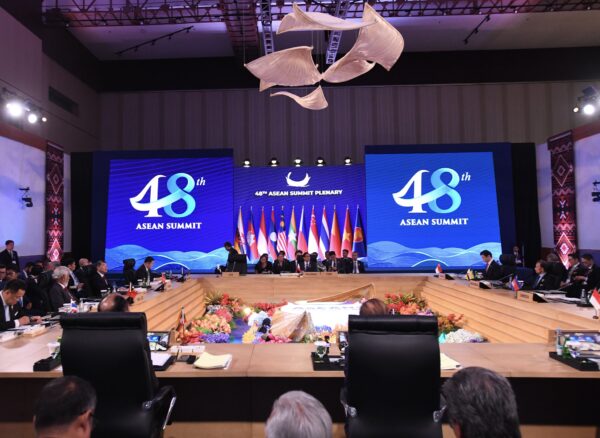
Southeast Asian leaders have called for an immediate cessation of conflict in the Middle East and reopening of the Strait of Hormuz, as well as the ratification of a joint oil-sharing pact within the 11-nation ASEAN bloc.
In a statement issued on Friday, at the close of the 48th ASEAN Summit in Cebu, the region’s leaders “expressed serious concern over the rapidly evolving situation in the Middle East” and its impacts on “regional and global peace and stability.”
“We urged all parties involved to maintain conducive conditions for the full and effective implementation of the ceasefire, by exercising utmost restraint, ceasing all hostilities, and avoiding any acts that may aggravate the situation,” it stated.
The bloc’s statement also affirmed “the importance of maintaining maritime safety and security” and freedom of navigation, and “called for the restoration of the safe, unimpeded, and continuous transit passage of vessels and aircraft in the Strait of Hormuz.”
The closure of the Strait has led to a sudden spike in the price of oil and gas from the Middle East. This has had particularly serious impacts in Asia, which sources around 60 percent of its crude oil imports from the Gulf. Most Southeast Asian nations are now facing a significant rise in fuel and energy costs that is likely to force up the prices of food and other essential goods.
ASEAN’s leaders discussed the economic ramifications of the conflict, stressing “the need to preserve the unimpeded flow of energy and essential goods, including food, agricultural inputs, pharmaceutical products, and transport fuels.”
They also pledged to coordinate more closely to safeguard the region’s energy and food security. This included “the expeditious completion of national processes towards ratification of the ASEAN Framework Agreement on Petroleum Security (APSA) to ensure its earliest possible entry into force.” The APSA is a voluntary, commercial-based framework that would enable “coordinated emergency fuel sharing and collective responses to supply disruption,” Philippine Trade Secretary Cristina Roque said last month.
The Philippines, as this year’s chair of ASEAN, has been particularly active in pushing the APSA. The country also has a strong incentive of its own to conclude the agreement. In late March, President Ferdinand Marcos Jr. declared a “national energy emergency,” citing the “imminent danger” posed by the disruption in oil supplies from the Middle East, and the country has seen the sharpest rise in the price of petrol and diesel of any nation in ASEAN.
ASEAN member states have varying degrees of exposure to the Hormuz oil supply shock, but have so far taken a number of steps to counter its impact, including measures for conserving energy, absorbing supply shocks, and/or depressing demand for petrol and other fuels.
Speaking to reporters on Friday, Marcos expressed optimism that member states would soon ratify the APSA, but that the exact mechanisms of the agreement still needed to be worked out.
“We’re trying to examine everything we can do,” he said. “How is the sharing? Who gets what? How do you pay for it? Do you pay for it? Is it an exchange? … We haven’t done it before. And what do we do about the others who are also in need? Who comes first? Those are the questions that still need to be decided.”
Aside from the APSA, yesterday’s statement did not advance much beyond the previous statements issued by ASEAN, expressing concerns about the Iran conflict and calling for greater regional coordination in response.
While the bloc’s economic ministers on Thursday said that they had identified “practical, concrete response measures on strengthening energy security, safeguarding food security, and coordinating humanitarian responses.” But as Reuters noted, these proposals “lacked specific details and it was unclear what, if any, action might be taken.”
To be sure, coordinating energy supply measures among 11 nations of varying degrees of economic development and dependence on energy imports will not be easy – especially when nations feel pressure to deal with the issue on their own. Still, if the crisis continues beyond the short term, it could well be an important test of ASEAN’s ability to act in the collective interests of its member states.
