

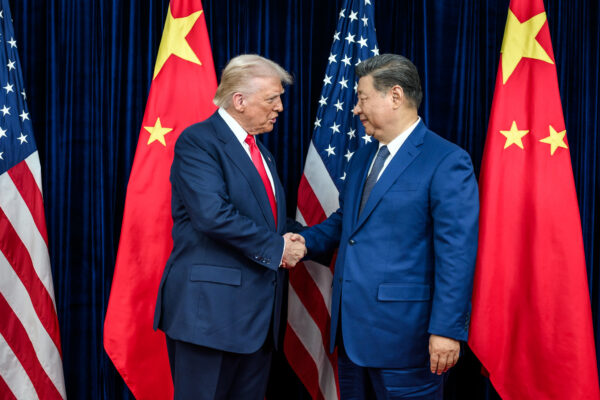
On May 11, Beijing announced that U.S. President Donald Trump would visit China from May 13 to 15 – just two days before his summit with President Xi Jinping was due to begin.
Trump had publicly confirmed his visit dates back in March. For months, Beijing’s public response remained deliberately noncommittal: “China and the United States are in communication regarding U.S. President Donald Trump’s proposed visit.” Preparatory diplomacy continued in the background, including a bipartisan congressional visit to Beijing that raised issues likely to feature in Trump’s agenda: market access for U.S. firms, Boeing aircraft sales, tariff relief and agricultural purchases.
Beijing’s delayed confirmation was a calibrated response to a transactional president who treats diplomacy less as institutional statecraft than as deal-making theater. Trump had floated a two-day visit; China announced three days. Whether driven by protocol, bargaining or both, the extra 24 hours carried political meaning: if Trump was coming to Beijing, he would do so on China’s agenda.
That choreography reflects Beijing’s broader approach to Washington under Trump’s second administration: do not initiate, do not refuse, and do not compromise. Do not initiate, because Beijing has no interest in rewarding Trump’s instinct for diplomatic theater and agenda-setting spectacle. Do not refuse, because shutting the door on a guest is not China’s style, and keeping the door open preserves diplomatic flexibility. Do not compromise, because national security, the One China principle, and technological sovereignty remain non-negotiable.
The summit agenda will be packed. Taiwan, trade, nuclear safety, Iran, artificial intelligence, and rare earths may all feature. On the surface, the meeting will be all handshakes and protocol. Underneath, it will be a test of strength across three connected fronts, determining which side can better convert leverage into diplomatic advantage.
Taiwan: The Core of the Core
Taiwan will be the Trump-Xi summit’s underlying political issue. For Beijing, it is not one item among many. It is the issue that defines the political boundary of the relationship. During the preparatory congressional visit, Chinese officials again stressed that the United States must adhere to the One China principle if it wants stable relations with China.
This is where Trump’s transactional instincts create both opportunity and risk. His instinct is to turn every issue into a deal. But Taiwan is not a soybean contract or a Boeing order. Any attempt to use Taiwan as a pressure card would meet Beijing’s strongest resistance. Conversely, any hint that Washington might dilute its commitments to Taiwan in exchange for Chinese purchases or trade concessions would alarm U.S. allies and partners across the Indo-Pacific.
The most likely outcome is therefore not a grand bargain over Taiwan, but a struggle over language. Beijing will press for stronger U.S. reassurance on the One China principle and opposition to Taiwan independence. Washington will seek to avoid any visible retreat from existing policy. The danger lies in ambiguity. Trump may prefer a formulation that sounds like a breakthrough but creates uncertainty among allies.
For Australia, Japan, South Korea, and Southeast Asian states, this may be the most consequential part of the summit. The question is not only what Trump and Xi say about Taiwan, but whether the meeting alters perceptions of U.S. reliability. In the Indo-Pacific, deterrence depends not merely on military capability, but also on confidence in political commitments.
Trade: Trump Wants Numbers; China Wants Optionality
The second thread is trade. Trump needs visible economic wins. His domestic audience understands aircraft orders, farm purchases, tariff reductions, and investment pledges more easily than abstract language about strategic stabilization. That is why Boeing aircraft and agricultural contracts are likely to return to the center of summit expectations.
This resembles managed trade. It is not about rules-based liberalization. It is about numbers that can be announced, photographed, and sold politically. For Trump, expanded purchases of soybeans, corn, beef, or other agricultural goods would reassure rural constituencies hurt by years of tariff volatility. A Boeing order would support his manufacturing narrative. Limited tariff adjustments would allow him to claim that China moves first.
China may accept some of this. It has incentives to stabilize the relationship. Its economy still benefits from reduced tariff uncertainty, U.S. investment, and access to the U.S. market. Chinese firms and consumers may also benefit from selected imports. Beijing may calculate that carefully chosen purchases are a manageable price for reducing short-term tensions.
But China will resist any framework that gives Washington open-ended leverage. Beijing has learned from the Phase One trade deal that large purchase commitments are politically useful but structurally fragile. It has also diversified trade away from U.S. imports and the U.S. market, giving it more room to absorb pressure.
Technology: AI Versus Rare Earths
The third thread is technology. Trump and Xi may not resolve export controls or rare earth restrictions in detail. Yet technology will sit beneath the talks as the most consequential form of asymmetric interdependence: U.S. strength in frontier AI, chips, software ecosystems, and cloud infrastructure versus Chinese leverage in rare earths, critical minerals processing, industrial supply chains, and fast-moving application ecosystems.
Washington’s pressure points are clear. The United States has imposed export controls on advanced semiconductors, AI chips, and related technologies, although Trump has shown since December 2025 a willingness to trade this leverage for tariffs. Nevertheless, Washington’s strategic objective remains to slow China’s progress in frontier AI and prevent Chinese firms from accessing the most advanced parts of the U.S.-led technology stack.
Beijing’s counter-leverage lies upstream. China dominates many of the physical foundations of the clean energy and defense industrial economy, including rare earth processing and magnet manufacturing. These materials are essential for defense systems, robotics, wind turbines, electric vehicles, and advanced manufacturing.
Neither side can fully decouple without imposing serious costs on itself. The United States can restrict chips, but doing so encourages China to accelerate its pursuit of technological autonomy. China can use rare earth restrictions as leverage, but doing so will strengthen efforts to build China-free alternative supply chains. This is the paradox of weaponized interdependence: each coercive action gives the other side stronger incentives to reduce its vulnerability, thereby weakening the coercive power of the original move.
That makes the Trump-Xi summit both dangerous and necessary. Dangerous, because each side is tempted to use its chokepoints coercively. Necessary, because unmanaged technology competition can quickly spill into industrial disruption, supply chain shocks and military tensions.
Who Is Time’s Real Ally?
Trump is in a hurry. Domestic political pressures, economic uncertainty, and instability in the Middle East all make visible diplomatic wins more valuable. Beijing, by contrast, can afford to slow the tempo when it suits China’s interests. It appears that time is increasingly on its side.
That is the unforgiving logic of great power bargaining: the side most desperate for an outcome usually starts from a position of weakness.
This is why the summit’s choreography matters. Trump’s diplomacy depends on converting pressure into visible concessions. If the other side refuses to panic, refuses to accept Trump’s agenda, and refuses to pay for de-escalation with core interests, the pressure campaign loses force.
Beijing’s late announcement was therefore not a minor protocol choice. It was an early test of agenda-setting power in great power diplomacy. China did not reject the visit, nor did it rush to confirm it. It will receive Trump on terms that signal courtesy without concession.
What to Watch
Trump will arrive in Beijing, and China will receive him with ceremony. But the summit’s success should not be judged by whether Trump announces a large deal, though he almost certainly will seek one. The more important questions are these: Does the summit produce language on Taiwan that reassures the region or unsettles it? Are trade commitments framed as reciprocal stabilization or as one-sided Chinese concessions? Does any rare earth arrangement come with movement on U.S. technology restrictions?
The answers matter. Trump needs the performance of success. Xi needs the management of power.
For middle powers such as Australia, the lesson is sobering. The China-U.S. relationship is not returning to the old world of engagement, nor is it moving neatly toward full decoupling. It is entering a phase of selective bargaining across security, trade and technology. Taiwan, tariffs, AI, and rare earths are no longer separate files. They are now part of the same strategic ledger.
China’s diplomatic posture – receiving Trump, but on Xi’s schedule – indicates that time is no longer only Washington’s ally. Beijing is increasingly confident in setting the agenda rather than being pulled along by the United States’ domestic political cycle.
