

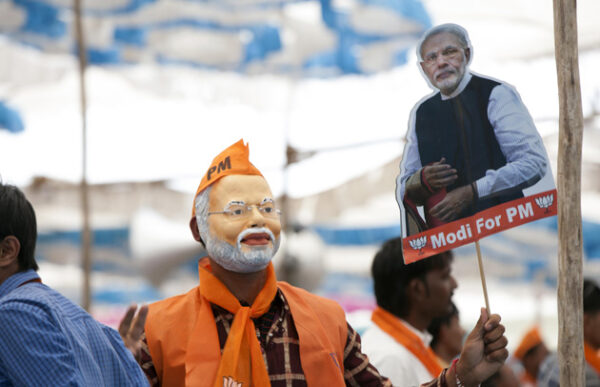
Indian elections are no longer just battles between political parties. They are becoming contests between larger-than-life personalities — and no leader has reshaped this political culture more profoundly than Prime Minister Narendra Modi.
Over the past decade, Modi has fundamentally altered the grammar of Indian electioneering. Parliamentary elections, assembly elections, and even municipal contests are increasingly framed around his personality, credibility, and leadership rather than around party organization or ideological debate. Bharatiya Janata Party (BJP) campaigns today are rarely fought in the name of local candidates alone; they are fought as referendums on Modi himself.
The recent assembly elections, especially in West Bengal, once again demonstrated this phenomenon. Throughout the campaign, it often appeared that Modi himself was contesting the elections. Posters carried his image more prominently than state leaders. Speeches revolved around “Modi ki guarantee” (Modi’s guarantee). Welfare schemes were projected not as institutional state interventions but as personal assurances from the Prime Minister.
In effect, Modi has presidentialized Indian politics without formally changing the Constitution.
Political scientist Pratap Bhanu Mehta has argued that the rise of personality-centric politics represents one of the defining transformations of contemporary Indian democracy. According to Mehta, the BJP under Modi has perfected a model where political legitimacy increasingly revolves around a single charismatic leader, turning politics into an emotionally charged civilizational project rather than a conventional ideological contest.
This is not merely a campaign strategy. It reflects a deeper structural shift in Indian democracy itself.
There was a time when Indian politics was driven primarily by ideology and organization. The Congress represented secular nationalism, the Left mobilized around class politics, and the BJP expanded through cadre-based Hindutva. Elections were contests of competing political visions.
Today, that landscape is changing rapidly.
India remains constitutionally parliamentary, but electorally it increasingly resembles a presidential democracy. Voters are no longer simply choosing legislators or parties; they are choosing personalities who symbolize aspiration, nationalism, welfare, governance, or regional identity.
The BJP under Modi has mastered this model more effectively than any political party in contemporary India. Through centralized branding, direct communication, mass rallies, social media dominance, and welfare personalization, Modi has become larger than the party itself. Many voters distinguish between the BJP organization and Modi as an individual political force.
Yet the BJP is not alone in this transformation.
In West Bengal, Mamata Banerjee has transformed the Trinamool Congress into an extension of her own political identity. “Didi” (sister) is not merely a political slogan but an emotional symbol of Bengali sub-nationalism and welfare politics.
In Assam, Himanta Biswa Sarma has personalized governance around administrative authority and strongman leadership. In Delhi and Punjab, Arvind Kejriwal became synonymous with the Aam Aadmi Party itself, presenting governance through the prism of one individual’s image.
Regional parties, once rooted in ideology or caste mobilization, are also becoming increasingly personality-driven. The Samajwadi Party is identified primarily with Akhilesh Yadav rather than the socialist politics of Ram Manohar Lohia. The Rashtriya Janata Dal still draws heavily on the symbolic charisma of Lalu Prasad Yadav, now transitioning toward the leadership of his son, Tejashwi Yadav.
Even Tamil Nadu, historically shaped by the Dravidian ideology and cinema-politics, is witnessing the rise of charismatic actor-turned-politician C. Joseph Vijay, the state’s new chief minister. In many ways, Tamil Nadu anticipated this trend long before the rest of India, where film stars evolved into larger-than-life political figures.
The rise of personality politics is deeply connected to transformations in media and political communication. Television rewards spectacle, social media rewards emotion, and digital campaigns thrive on simplified narratives centered around faces rather than ideas. Ideology is often too complex for viral politics; personality is immediate, visual, and emotionally resonant.
At the same time, welfare politics has become increasingly personalized. Citizens often associate government schemes directly with leaders rather than institutions. Benefits are politically branded, creating a direct emotional relationship between voter and politician while weakening the visibility of the state itself.
But this transformation carries serious consequences for democracy.
Mehta argues that the Prime Minister’s Office has emerged as the most powerful institution in the country, gradually overshadowing traditional democratic checks and balances such as parliament, the judiciary, and the Election Commission. In his view, a cult of personality has emerged around Modi that echoes the Emergency-era slogan associated with Indira Gandhi — “India is Indira, Indira is India.”
When parties become dependent on one individual, internal democracy weakens. Organizational structures become subordinate to personal authority. Leadership transitions become uncertain, and dissent within parties is increasingly discouraged.
More importantly, elections risk turning into emotional plebiscites on leaders rather than informed debates on policy. Political discourse becomes polarized because criticism of the government is interpreted as criticism of a beloved leader — something that is particularly visible in contemporary Indian politics surrounding Modi.
This does not mean charisma itself is inherently anti-democratic. Democracies across the world have always produced charismatic leaders. Strong personalities can energize participation, mobilize aspirations, and create emotional connections with citizens in ways that institutions often fail to achieve.
The challenge, however, is whether democratic institutions, ideological debate, and internal party democracy can survive alongside overwhelming personal authority.
India today stands at an important political crossroads. Elections are no longer merely contests between party manifestos or ideological visions. They are becoming contests between carefully constructed political personalities.
And in that transformation, Narendra Modi has not only dominated Indian politics — he has fundamentally redefined how politics itself is practiced in contemporary India.
