

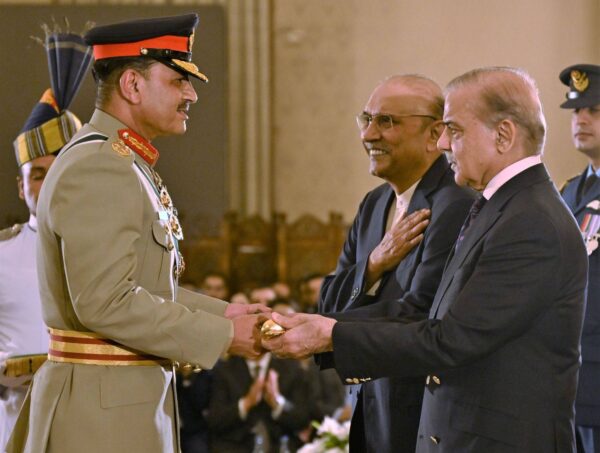
On May 10 this year, Pakistan’s Army Chief and Field Marshal Asim Munir addressed a high-profile ceremony at the General Headquarters (GHQ) in Rawalpindi to mark the first anniversary of Pakistan’s Marka-e-Haq, its response to India’s Operation Sindoor in May 2025.
In a speech that combined his reflection on the conflict, doctrinal changes on the future of warfare, and the country’s ambitions, Munir offered one of the most comprehensive official assessments yet of what Pakistan believes it achieved in last year’s confrontation with India and how it sees the future of warfare in the region.
Following a terrorist attack in Pahalgam in the Kashmir Valley on April 22 last year, India launched air and missile strikes on Pakistani targets on the night of May 6-7, which quickly escalated into a brief but intense four-day conflict. This was a multi-domain clash that involved fighter jets, drones, and missile exchanges between the two nuclear-armed neighbors.
Pakistan claimed to have shot down eight Indian aircraft, including four Rafale jets, while effectively repulsing ground incursions. India, for its part, has never publicly confirmed the losses and maintained that it achieved its objectives during the conflict. The fighting eventually de-escalated through backchannel diplomacy and mediation by U.S. President Donald Trump.
However, the episode has left a lasting imprint on the strategic thinking of both India and Pakistan.
At the start of his speech, Munir delivered a warning to the country’s potential adversaries. “Our enemies should know that if any attempt is made in the future to carry out a misadventure against Pakistan, then the impact of war would not be limited, but extremely widespread, dangerous, far-reaching and painful,” he said.
This was clearly more than rhetoric. Munir meant to send a message to India that the next conflict will not remain limited and could see the whole of India becoming a battleground. Moreover, the wording also reinforced Pakistan’s long-standing Full Spectrum Deterrence doctrine and stressed that Islamabad will not entertain the idea of any form of limited war or surgical strikes on its territory in the future. This essentially meant that any future Indian action could risk triggering a response that could quickly cross conventional thresholds.
Second, the army chief spoke at length about the changing character of warfare in the wake of lessons learned from the 2025 conflict. “Traditional wars are a thing of the past,” he noted, stressing that modern and future conflicts will revolve around multi-domain operations that integrate cyber and electronic warfare, drones, long-range precision vectors, and artificial intelligence.
The remarks point to the ongoing transformation within Pakistan’s military that was also visible in the Pakistan Air Force’s performance in the war, and the subsequent changes that have taken place in the restructuring of the military. It has set up a Defense Forces Headquarters and Army Rocket Force Command to consolidate joint operational readiness. These changes point toward an army that is moving away from purely manpower-heavy conventional defense toward a more integrated, technology-driven force.
Moreover, Munir also framed the 2025 conflict in distinctly ideological terms. He described Marka-e-Haq not merely as a military engagement between two states, but as “a battle between two ideologies, in which truth ultimately prevailed and falsehood was met with defeat.”
This narrative not only reinforces the idea of Pakistan and India as ideological adversaries but is aimed at strengthening internal cohesion by linking the military’s performance to the foundational ideas of Pakistani identity. The idea arguably positions the country’s armed forces as guardians not just of physical borders, but of the nation’s broader civilizational worldview.
On the diplomatic front, the army chief pushed back against the notion that Pakistan had been isolated. He argued that India had hoped to combine military pressure with diplomatic containment. However, Pakistan emerged with “more friends than ever before” following the conflict, Munir said. The view reflects Islamabad’s perception that surviving the 2025 crisis without economic collapse or international diplomatic pressure has actually opened new doors for the country.
Moreover, Munir stated that India’s regional ambitions were far beyond its stature and capabilities. Pakistan, he said, would never allow India’s dream to materialize. This was arguably meant to tell New Delhi that India cannot grow its prominence in the region or beyond at Pakistan’s expense and that diplomacy to resolve all pending issues was the only way forward.
Particularly interesting was Munir’s emphasis on Pakistan’s diplomatic activism following the war. He highlighted the country’s current role in hosting sensitive peace talks and acting as a bridge between the United States and Iran. By presenting Pakistan as a responsible actor capable of facilitating high-stakes mediation, the military leadership is clearly trying to reshape international perceptions, moving from a narrative centered on Pakistan’s instability to one emphasizing the strategic relevance of the country in global affairs.
More importantly, the army chief reiterated Pakistan’s unchanged position on Kashmir.
“No story of Pakistan is complete without Kashmir,” Munir said as he promised continued political, diplomatic, and moral support for the Kashmiri people.
The timing of this reaffirmation, which comes on the anniversary of a major military clash with India, signals that Islamabad remains undeterred and views the Kashmir issue as non-negotiable. The current situation leaves the Indian leadership with critical questions about whether the military engagement of 2025 brought them any closer to their strategic objectives vis-à-vis Pakistan or ultimately pushed them further from their goals than they were before the conflict began.
From Pakistan’s perspective, Munir’s speech marks a subtle but important shift in the country’s strategic thinking. The country’s leadership seems to have moved beyond a purely defensive posture to project a Pakistan that is more confident in both its military capabilities and its diplomatic space regionally and beyond.
For instance, by blending warnings of painful escalation with a vision of multi-domain modernization of the armed forces and claims of growing global relevance, the speech clearly portrays Pakistan as having emerged from the 2025 crisis not weakened, but rather strategically emboldened.
The message that Munir sent out to both domestic and international audiences is that Pakistan’s armed forces have rewritten the script vis-à-vis military parity with India. Whether this confidence translates into tangible gains in the coming years remains to be seen.
