

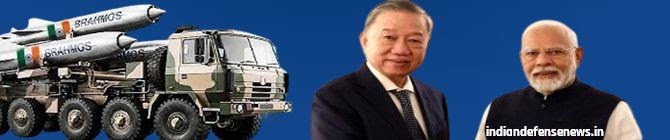
The deal, reported by multiple outlets this month, comes as tensions rise in the South China Sea and as regional states seek to counterbalance China’s expanding naval presence.
The momentum behind the negotiations accelerated during Vietnamese President To Lam’s visit to India, where he held discussions with Prime Minister Narendra Modi and Defence Minister Rajnath Singh.
Officials from both sides confirmed that talks on the Indo-Russian-developed missile system were underway, though no final agreement has yet been signed. India’s foreign ministry acknowledged that BrahMos was among the platforms under discussion, signalling the seriousness of the engagement.
The proposed package, valued between US$629 million and US$700 million, is expected to include training and logistical support. If finalised, Vietnam would become the third foreign buyer of the BrahMos after the Philippines and Indonesia.
For Vietnam, the acquisition would strengthen coastal and maritime deterrence, complementing its existing Russian-made Bastion-P systems. For India, the sale aligns with its “Act East” strategy and its push to expand defence exports, embedding its role as a regional security provider.
Negotiations have not been limited to missiles alone. They also encompass Indian-built offshore patrol vessels, patrol boats, submarine batteries, ship upgrades and maintenance support for Vietnam’s Su-30 fighters and Kilo-class submarines.
This broad spectrum of cooperation underscores the expanding strategic partnership between the two nations, extending beyond single-platform acquisitions to a comprehensive defence relationship.
Vietnam’s missile force structure could evolve into a high-low mix, with BrahMos serving as the high-end system to replace older Soviet and Russian-origin shore-based anti-ship missiles, while the domestically produced VSM-01A Truong Son missile provides a lower-tier capability.
The BrahMos, with its 290-kilometre range, supersonic speed and 200-kilogram warhead, is capable of striking large warships such as destroyers and amphibious assault ships. In contrast, the VSM-01A, with its shorter 80-kilometre range, subsonic flight profile and smaller warhead, is better suited for targeting frigates and corvettes.
Together, these systems could provide Vietnam with a layered anti-ship defence in the Gulf of Tonkin, posing a credible threat to Chinese warships sailing out from Hainan. Integrated into Vietnam’s broader anti-access/area-denial strategy, they form part of a layered asymmetric approach designed to counter China’s superior naval power.
Alongside Kilo-class submarines, Su-30 fighter jets and incremental island-building, these capabilities entrench Vietnam’s territorial claims in the South China Sea and raise the costs of coercion against it.
Vietnam’s decision to engage with India on high-end military equipment also reflects deeper strategic considerations. While Russia remains Vietnam’s longstanding defence partner, Western sanctions on Russian defence exports, heavy battlefield losses in Ukraine and Moscow’s need to replenish its own equipment have likely influenced Hanoi’s diversification of suppliers. India, with its growing defence industrial base, emerges as a credible alternative.
The BrahMos sale would reinforce Vietnam’s defence partnership with India, with Hanoi expected to depend on New Delhi for spares, maintenance, software updates and training. This dependency ensures that the missile system becomes a focal point for sustained cooperation.
Both countries share a non-aligned foreign policy, emphasising strategic autonomy while avoiding formal alliances with major powers, making their partnership distinctive in the Indo-Pacific security landscape.
Russia’s role remains significant, given its 49.5% stake in BrahMos Aerospace. India may effectively serve as a broker, facilitating Russian arms exports at a time when direct purchases from Moscow are politically sensitive. This arrangement sustains Russia’s revenue stream while enabling India to expand its defence diplomacy.
For India, BrahMos exports to Southeast Asia are part of a broader effort to build strategic linkages between regional security and its own interests. By enabling Southeast Asian states to implement anti-access strategies, India complicates China’s efforts to project power into the Indian Ocean.
This is particularly relevant given China’s Belt and Road Initiative, which integrates port infrastructure, maritime research and economic ties to create latent strategic options.
China’s critical interest in securing its sea lanes of communication, through which 80% of its oil imports from the Middle East pass, underscores the stakes. The March 2026 US sinking of the Iranian frigate Dena highlighted vulnerabilities in maritime trade and naval operations, reinforcing Chinese concerns that its SLOCs could be disrupted during a major conflict involving India, the US or Taiwan.
China’s military foothold in Djibouti, port investments in Gwadar and Hambantota, and undersea research activities for submarine operations all contribute to its expanding maritime footprint. This footprint threatens India with strategic encirclement, compounded by Pakistan’s role in Jammu and Kashmir and border disputes in the Himalayas.
India’s response may be seen in its emerging “Necklace of Diamonds” strategy, which mirrors China’s BRI by building diplomatic, economic and defence ties with states along China’s periphery.
Southeast Asia serves as India’s maritime front, while Central Asia forms its continental front. The BrahMos deal with Vietnam fits squarely within this framework, strengthening India’s position in the Indo-Pacific.
If finalised, Vietnam’s acquisition of BrahMos missiles could mark the emergence of a looser but increasingly coordinated Indo-Pacific security network. In this network, non-aligned middle powers cooperate to raise the costs of Chinese coercion without entering formal alliances, reshaping the strategic balance in the region.
Asia Times
