

Concurrent with the forced emigration of Rohingya Muslims from Myanmar to Bangladesh has been the silent relocation of thousands of people belonging to non-Muslim ethnic communities in the reverse direction, from the Chittagong Hill Tracts (CHT) in southeastern Bangladesh to Myanmar’s Chin and Rakhine states.
People have been fleeing violence in the CHT for decades.
The population in the CHT comprises around 850,000, who belong to 11 ethnic communities, professing Buddhism, Christianity and Hinduism.
According to members of four families from the CHT who have relocated to different areas of Myanmar’s Rakhine State and Chin State, the immigration began decades ago, triggered by various factors and during the regimes of different governments in Bangladesh.
“At Least We Will Be Safe in Myanmar”
Htwe Sein Maung was a farmer with five acres of land in Bandarban district in Bangladesh’s CHT. He resided in Lamar village, which is mostly inhabited by the Marma Buddhist community. It was sometime in early 2014 that he decided to emigrate to Myanmar with his wife and daughter and 15 other households from the same village.
The momentous decision by Htwe Sein Maung and the other families came after Muslim groups hailing from other parts of Bangladesh, who had settled near his village, threatened them and encroached upon their land. A sequence of events over six months convinced them that they had no option but to flee.
“The encroachment apart, our paddy fields were burned and many households were barred from cultivating their land. Then, restrictions were imposed on our movement. We couldn’t go to the market for fear of atrocities,” claimed Htwe Sein Maung, adding that the police were reluctant to register cases and launch an investigation despite repeated reminders and applications at Sonai Chari police station.
Subsequently, all 16 households held a meeting to firm up the plan to embark on the journey to Myanmar. Within a month, they sold off whatever possessions they had, including cattle at throw-away prices to the neighboring Muslim villages. A date was fixed for the journey to the border, which is 18 miles from their village. Then they set out with whatever belongings they could carry. The trek to the border took about seven hours before they set foot in Maungdaw in Myanmar’s Rakhine State. The Myanmar military allowed the families to settle down on small plots of land in Maungdaw district, but in areas that were far off from the Rohingya Muslim villages.
All the families are currently engaged in the cultivation of vegetables and paddy, while some members also earn their livelihood as daily wagers.
“We have a hand-to-mouth existence and our economic conditions deteriorated after the war broke out in Arakan three years ago. But at least we are safe in Myanmar. The only danger is from airstrikes by the military, which can happen anytime,” said Maung Kyaw Sin, a member of a household that had crossed over to Myanmar in 2014.
“We Did Not Want Our Children to Be Abducted or Killed”
Tan Nu Sein and her family of five also belong to the Marma community. They emigrated from Rangamati district in Bangladesh’s CHT to Maungdaw in 2013.
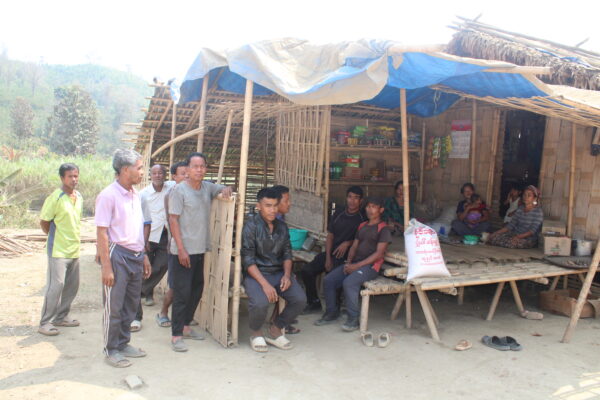
Tan Nu Sein (right) and other members of the Marma community from Bangladesh’s CHT who have settled in Myanmar’s Rakhine State. Credit – Rajeev Bhattacharyya
Between 2011 and 2013, at least six girls from the Marma community, who lived in Motipara village at Rangamati in the CHT, disappeared in a span of six months while returning home from school. Tan Nu Sein’s 16-year-old niece was among the missing. It was reported later that she was forcefully married to a Muslim man.
Eventually, residents of the village received threats from neighboring Muslim villages who were allegedly supported by local politicians of the Bangladesh Nationalist Party (BNP). There was no grabbing of land but some residents were physically assaulted in different incidents. An elderly person was mugged while returning home from the hospital.
“Our movements were severely restricted. We did not want our children to be abducted or killed,” recalled Tan Nu Sein. She explained how residents from her village relocated in different batches to Myanmar’s Rakhine State.
The first batch of residents from Motipara, comprising 14 people, including women and children, emigrated to Maungdaw early in 2012. Tan Nu Sein’s family hit the trail to Myanmar through border pillar 42 in the following year. Their journey involved a long march of six days. The Myanmar government allowed her family to settle in a place called Charadan, where residents from Motipara had already established their villages.
In 2017, Charadan and the adjacent police station were allegedly torched by a section of Rohingya residents from neighboring villages, compelling all the migrants to flee to safer locations. In 2025, they resettled in a new spot about 20 kms south of Maungdaw town. Most of the residents are currently either cultivators or daily wagers.
“There are more people from the Marma, Mro and Chakma communities in Bangladesh who would certainly relocate to Myanmar if they are assured of land and livelihood. So far, over 20,000 people from the Marma community have settled in Myanmar,” said Maung Aye Cho, who left Motipara with his family of five members a year before Tun Nu Sein’s family. “We know of ten households from Rangamati and Bandarban who have decided to relocate and are likely to cross the border very soon,” he said.
“We Were Labelled Terrorists”
In 2021, parts of CHT were further disturbed following the emergence of the Kuki Chin National Front (KCNF), which embarked on the path of armed resistance against the Bangladesh government. The outfit’s cadres were drawn from the Kuki-Chin ethnic groups, including the Bawm community in the hill districts, who are Christians by faith, provoking retribution by the government.
In the crackdown by the Bangladesh army, hundreds of people from these ethnic groups were arrested. Some villages and churches were reportedly burnt and many were killed. One village, which was among the most affected, was the Bawm-inhabited Bak Tlai in Bandarban district.
“Three people from my village of Bak Tlai were arrested, tortured and killed by the Bangladesh army for no reason. Nobody from my village had joined the KCNF. But we were labelled terrorists,” alleged Ram Ton. He claimed that as many as 24 villages in Bandarban were hit hard by the violent conflict between the KCNF and the Bangladesh government.
Ram Ton explained that he was among the first batch of 38 people, which included 10 women and 12 children from the Bawm community, to have relocated to Maw Tala village in Myanmar’s Chin State in 2022. “Residents from more villages in Bandarban arrived in Myanmar last year,” he said, of which “over a thousand households comprising more than 90 per cent of the total immigrants preferred to settle in the contiguous Indian state of Mizoram, located about 10 miles from Maw Tala.”
Saikap Thang, who was part of Ram Ton’s group, recalled how the Bangladesh army would surround Bawm-inhabited villages at night for combing operations. Residents were restricted from moving out of the villages for several days at a stretch, he said. He alleged that the army also looted cash and ornaments from many households across many villages.
The conflict between the KCNF and the Bangladesh government had a spillover effect on other ethnic groups in CHT. Last year, ten households comprising more than 50 people from the Marma community were compelled to flee from their village of Bara Toli in Rangamati district to Myanmar.
Kyaw Aye Maung is part of the group of Marma migrants, who are now settled at Maungdaw. He mentioned how the Bangladesh army and KCNF coerced residents from his village to become porters without any payment. The Bangladesh army, he alleged, killed two residents in June 2024 when they refused to obey their orders.
“We were caught in the crossfire between the two sides. Since early 2023, many outposts were built along the border with Myanmar by the BGB (Border Guards Bangladesh) and they required porters to carry rations and building materials over long distances,” Kyaw Aye Maung said. He pointed out that a “bigger danger” they faced was when Muslims from the plains began to be settled near these outposts as part of the government policy on lands belonging to the ethnic groups. Residents who opposed the policy were either threatened, tortured or had their houses burned, Kyaw Aye Maung recalled.
Bangladesh’s CHT has been reeling under violence and unrest for almost five decades. Successive governments, whether led by the Awami League, BNP or the military, never displayed any commitment to safeguard the interests of the ethnic groups. In the existing circumstances, greater displacement and forced emigration to neighboring countries could only increase.
