

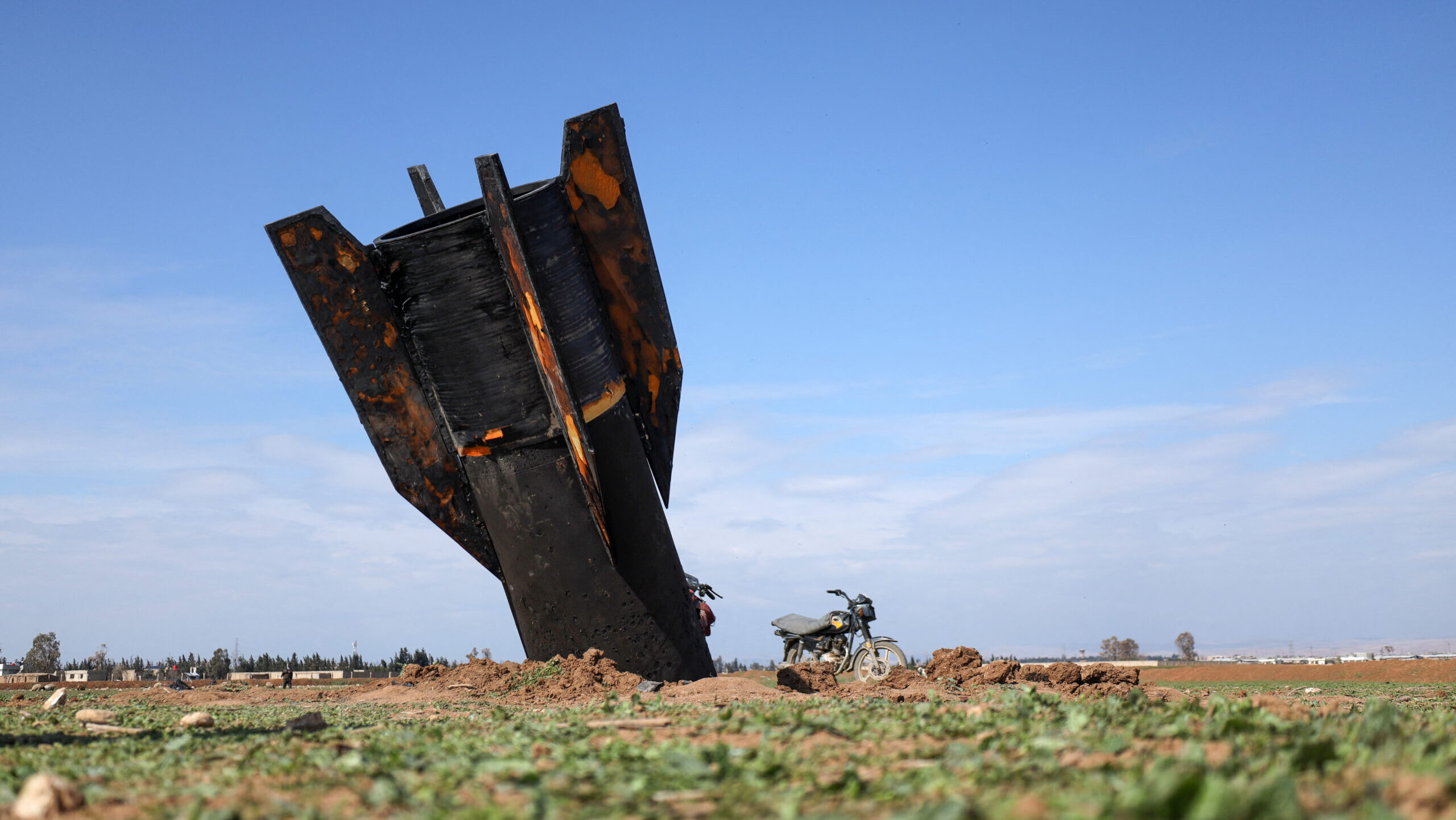
Since the Feb. 28 attack by the US and Israel kicked off the latest war in the Middle East, the conflict has ebbed and flowed. But no matter the claims of a ceasefire, the exchange of missiles and drones from Iran towards its neighbors has never truly stopped.
While that’s bad news for the region, it has provided a rare set of data: ten weeks of active warfare largely based around long-range strikes.
Iran responded to the Israeli-US attack by launching thousands of missiles and drones at Israel, the Gulf States, and US facilities in the region. Overall, missile defenses have been effective in limiting casualties. However, Iran may have exploited some weaknesses. Furthermore, defending Israel seems to have used a larger fraction of the available US interceptor missiles than of Iran’s medium-range ballistic missiles, and the numbers do not bode well if wholesale conflict were to begin again.
Here, then, are six key takeaways about Iran’s missiles, and what lessons they may portend for future conflicts.
Missile defenses were effective in preventing casualties
According to the Times of Israel, almost 90 percent of the 650 medium-range ballistic missiles launched at Israel were intercepted by Israel’s layered defensive systems.
Their outermost defense layer uses Arrow-3 missiles, which intercept their targets outside of the atmosphere. To intercept any missiles that have penetrated the outer layers, Arrow-2 missiles and an inner layer called David’s Sling are deployed. The latter intercepts missiles during their terminal descent, inside the atmosphere. The famous Iron Dome likely did not have a significant role against these attacks, since it is mainly intended against short-range missiles and one-way attack drones. Israeli defenses were bolstered by US THAAD batteries deployed to the region and by US Navy ships in the Mediterranean, armed with SM-3 missiles. The attacks resulted in only 24 civilian casualties.
Four ballistic missiles targeted Türkiye. They were intercepted, most likely by US Navy ships using SM-3 missiles. Spanish and US Patriot batteries were also deployed to Türkiye.
Because of the shorter distances involved, the Gulf States face a different threat. It mainly consists of short-range missiles and one-way attack drones. NBC News tallied at least 1,372 missile attacks against the Gulf States, as well as more than 4,415 drone attacks, just in the first month of the conflict. The United Arab Emirates (UAE) bore the brunt of them.
Bahrain, Kuwait, Qatar, Saudi Arabia and the UAE operate Patriot missiles. Saudi Arabia and the UAE also operate THAAD systems, as an outer layer. Additionally, the UAE also used South-Korean M-SAM systems. Furthermore, Israel reportedly sent an Iron Dome and a laser weapon to strengthen the UAE’s defenses. Multiple US Patriot batteries have also been deployed to the Gulf States. US Navy ships in the Gulf have a terminal ballistic missile defense capability using SM-6 missiles. The attacks resulted in relatively few casualties, but did damage the Gulf States’ oil infrastructure and caused large disruptions to the region’s airline and tourism industry.
Some Iranian missiles showed impressive accuracy
Ballistic missiles traditionally were inaccurate and largely used against large population centers as weapons of terror. However, in recent years, Iran has improved the accuracy of its arsenal.
A large fraction of its short-range ballistic missiles has control fins and navigation equipment, and many medium-range missiles now have maneuverable re-entry vehicles (MaRVs) that are similarly equipped. They can maneuver during the final part of their flight, to compensate for errors in the ballistic trajectory.
MaRVs make missile defense harder. Maneuvers complicate predicting a missile’s impact point, which may cause the defenses to not engage it. Maneuvers also force interceptors to maneuver, which can cause them to miss. Increasing the probability of an intercept likely requires more interceptors.
Iran demonstrated their effectiveness in 2020. After a US drone strike killed Qasem Soleimani, head of the Islamic Revolutionary Guard Corps (IRGC) Quds Force, Iran retaliated. They launched about a dozen ballistic missiles at US facilities on Al Asad Air Base, in Iraq. These missiles mostly struck specific buildings on the base. In June 2025, in retaliation for the US bombing Iranian nuclear facilities, Iran attacked Al Udeid Air Base, in Qatar. It was defended by Patriot missiles, but one of 14 ballistic missiles hit a communications facility.
Iran’s recent attacks again damaged US facilities, with seven US casualties. The New York Times reported damage to at least eleven US bases in the region, including Al Udeid Air Base. The US 5th Fleet headquarters in Bahrain also sustained heavy damage. NBC News reported that Iran hit more than 100 targets at US facilities. An analysis of satellite images by the Washington Post shows impacts on specific buildings. Not all this damage was done by missiles; one-way attack drones were also involved.
Other Iranian attacks caused damage spread over surprisingly large areas
Several Iranian missiles that penetrated Israel’s defenses hit civilian targets. At least sixteen of these had unitary warheads, while roughly 50 had cluster warheads. All but two of the resulting 24 fatalities were not inside bomb shelters, with cluster munitions killing 10 and conventional missiles killing 14 people.
A cluster warhead disperses submunitions, usually to overcome the poor accuracy of the missile. An individual submunition causes less damage than a unitary warhead. Spreading multiple munitions over a larger area, though, increases the probability of one of them landing close enough to the target. The dispersal usually occurs at an altitude of 1-2 kilometers, so that the area covered matches the uncertainty in the missile’s impact position. Such warheads are particularly effective against relatively soft targets, such as parked aircraft or air-defense radars.
The Iranian missiles seem to disperse their submunitions at much higher altitudes, though, spreading them over larger areas. CNN investigated two attacks on Tel Aviv and found multiple impacts spread out across areas seven and eight miles long, respectively. Thus, while the submunitions are unlikely to damage any specific targets, when used against a city they almost always hit something. That they caused few fatalities is likely because Israel’s passive defenses, such as shelters and safe rooms, offered reasonable protection from the relatively small submunitions.
However, that these missiles were able to get to the point where they dispersed their submunitions, shows that the outer layers of the defenses failed to stop them. Once the submunitions were released, lower-tier defenses could not intercept all of them, because they suddenly faced dozens of targets.
Iran no longer applies their 2,000-km range limit
For years, high-ranking Iranian officials stated that Iran limited their missiles’ range to 2,000 km. For instance, in May 2017, Maj. Gen. Mohammad Ali Jafari, then the commander of Iran’s IRGC, said, “There is the capability to increase this range, but it is sufficient for now as the Americans are present within a 2,000 km radius around the country, and would get a response in the case of any invasion.”
His statement clearly left room for an increase, and Iran has longed claimed the ability to go longer. The Khorramshahr, for instance, has a claimed range of 2,000 km with a 1500 kg payload; it could potentially fly farther with a reduced payload.
The hypothetical became reality three weeks into the war, when Iran launched two ballistic missiles at Diego Garcia, an island in the Indian Ocean housing a UK/US base, 3,800 km from Iran. Neither missile reached Diego Garcia, but this attack likely resulted in missile defense assets being diverted to protect the island.
Even with a negligible payload, the Khorramshahr is unlikely able to fly that distance, so the missiles used in these attacks were most likely modified satellite launchers. The IRGC has a space program and has successfully placed satellites in orbit. Their satellite launchers, such as Qased, have the performance to deliver payloads over long distances.
Missile defenses themselves are targets
Some of the Iranian attacks, using one-way attack drones and missiles, deliberately targeted missile defenses. Iran struck an AN/FPS-132 Early Warning Radar in Qatar. At least one AN/TPY-2 radar in Jordan was also struck. Based on satellite images, more such radars in Saudi Arabia and the UAE were hit as well.
Losing a single radar may not be critical, since a missile defense system is typically layered and networked. However, in previous missile campaigns, in 2024 and 2025, Iran launched large raids, with dozens of missiles in the air simultaneously — and in that situation, losing even one or two radars could prove a challenge.
The medium-range missiles Iran uses against Israel have reentry vehicles (RVs) that separate from their boosters. Interceptors will typically be reserved for use against the RVs, since those carry the explosive payload. Ideally, interceptors are also not expended against RVs that will land where they will not cause damage, for instance in (uninhabited) desert or in the Mediterranean Sea. Therefore, the defense needs to work out how many missiles are incoming, to know how many RVs there are. It also needs to predict where they are going.
Interceptor missiles such as the Arrow-3 and SM-3 use imaging-IR sensors to classify which object is the RV, but their success rate increases if the radars (and the associated command and control systems) have already narrowed it down. This takes time, and it takes longer as more objects are in flight. If a radar is unavailable, it will become harder still. The result can be that more interceptors are fired than ideal and the probability of missiles penetrating the defenses increases.
Missile defenses degraded by having lost an early warning radar would struggle to deal with raids like those in 2024 and 2025.
The numbers do not bode well for a prolonged conflict
After the first two days of the war, Iran no longer launched large numbers of missiles simultaneously. It’s unclear why, though there may be multiple factors in play.
Due to attacks on its leadership, the IRGC may not have been able to coordinate launching raids. Launching fewer missiles also preserved them for a longer continuation of the conflict. US Defense Secretary Pete Hegseth attributed the reduction in the numbers to Iran’s missile and drone programs being “overwhelmingly destroyed,” but the US can reportedly confirm the destruction of only about a third of Iran’s missiles, with a further third possibly damaged, destroyed or buried in underground facilities.
Israel assesses that, out of a pre-war inventory of 2,500 medium-range missiles, about 1,000 are left. A week into the war, the Israeli Defense Force claimed to have destroyed 300 launchers, but roughly half of Iran’s launchers may have survived. Iran may also still have thousands of one-way attack drones.
The damage to US bases and Iranian missiles penetrating Israel’s outer defenses days into the war, despite the smaller number of missiles per attack, suggests missile defenses were strained. The destruction of early warning radars, missiles maneuvering as well as other countermeasures may have degraded their effectiveness.
Missile defense is a numbers game. Little is known about Israeli interceptor stocks, but Israel may have been rationing interceptors, particularly the Arrow-3. Based on research by the Center for Strategic & International Studies (CSIS), the US has expended more than half of its pre-war inventory of THAAD missiles and between 30-60 percent of its SM-3s. These are not intended against short-range missiles, so they will primarily have been used to defend Israel.
The math is ugly: If intercepting the 650 missiles aimed at Israel required this many interceptors, the estimated 1,000 remaining Iranian missiles would be hard to counter if the war were to continue. And while reducing the number of launchers is a good thing, it also means finding and destroying Iranian missiles on the ground would become increasingly difficult.
The situation for interceptors used against short-range missiles is hardly better. Early reporting suggested that the Gulf States were running low on interceptors and CSIS assesses that the US used roughly half of its Patriot PAC-3 missiles, and significant numbers of SM-6 missiles. What has not helped to preserve scarce and expensive interceptors is that, in some cases, they have been used to counter one-way attack drones. Short-term, this can make sense. A Patriot missile is far more expensive than a Shahed drone but may be cheaper than the damage the Shahed might cause if it is not intercepted.
However, in the longer run, this is clearly not sustainable.
Ralph Savelsberg, a member of the Breaking Defense Board of Contributors, is associate professor at the Netherlands Defence Academy in Den Helder, specializing in missile defense. This article does not reflect any official position or policy of the Government of the Netherlands. The author would like to thank James Kiessling and Frederik Coghe for their valuable comments and suggestions.
