

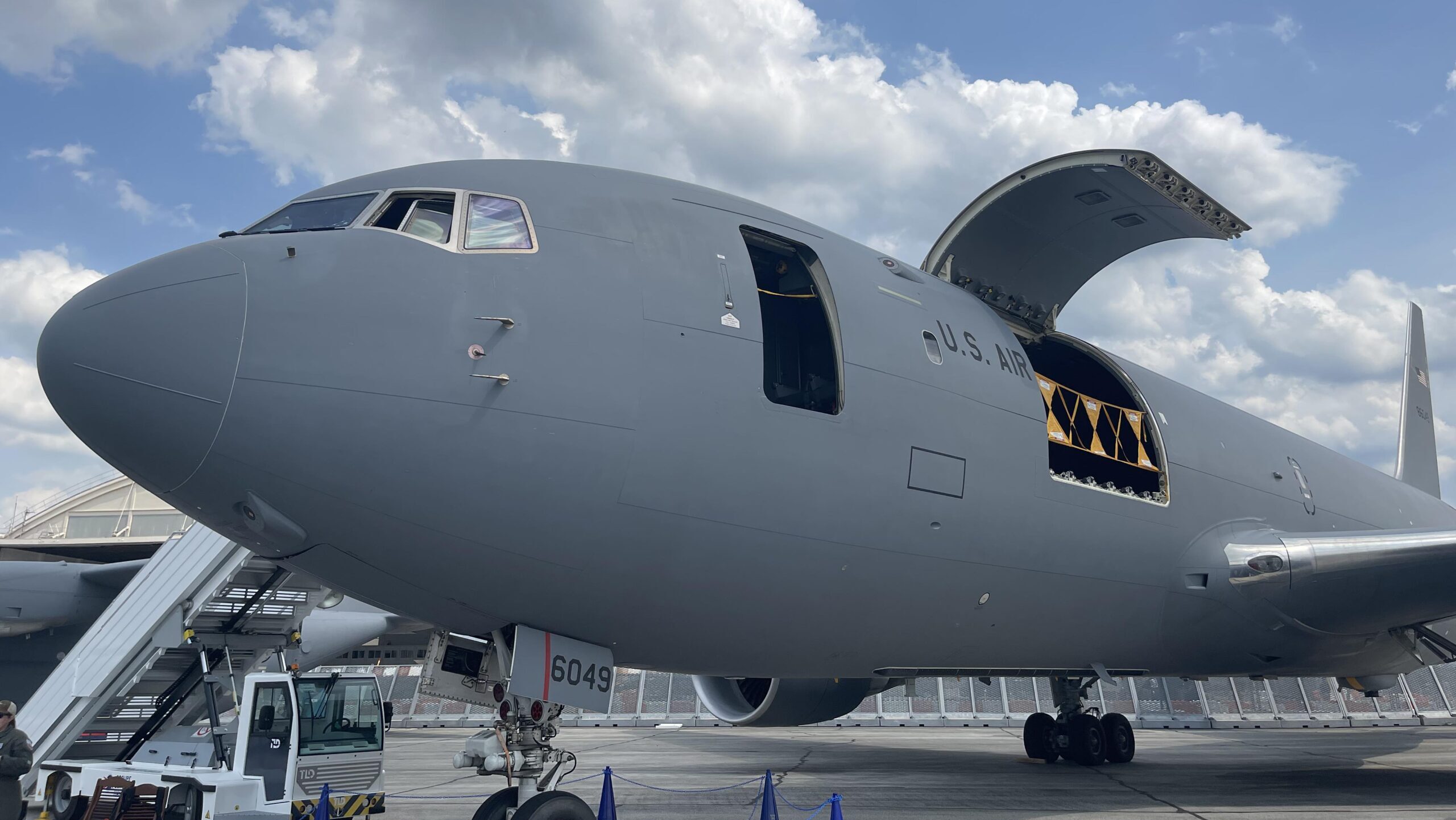
WASHINGTON — The Air Force now expects an updated vision system for the troubled KC-46 Pegasus air refueler to be ready in “early 2028” amid a broader deal with manufacturer Boeing to boost the tanker’s readiness.
According to an Air Force press release published Tuesday, the service and Boeing are pursuing a three-pronged plan to revamp the Pegasus fleet. One effort is focused on “repurposing” five earlier aircraft into “dedicated test assets,” which in turn will free up “high-value spare parts” for operational jets. Secondly, the service will implement a “temporary, performance-based logistics agreement” for the tanker’s “aerial-refueling subsystem and other key components,” which “represent the largest detractors of KC-46 availability.”
Collectively, the Air Force said these projects and new investments proposed in the service’s fiscal 2027 budget request should boost “near-term aircraft availability” by six percent that would then rise to 20 percent come 2030.
The Air Force did not respond by press time when asked for the Pegasus’ current availability rate. Last year, Air & Space Forces Magazine reported that the aircraft’s mission capability was 61 percent in fiscal 2024, a decline from 65 percent in FY23.
For the third element of the strategy, the Air Force said in the release that the service is speeding up retrofits of the jet’s vision system, where a replacement has been underway for years to correct deficiencies. By “bundl[ing]” the vision system’s installation and depot maintenance, the service said the Pegasus fleet’s retrofit timeline would be cut from 13 years to seven.
But the Air Force also appears to have disclosed a new schedule slip for the updated vision system dubbed RVS 2.0. Last year, the service expected the system would be operational in summer 2027, but the Tuesday release notes RVS 2.0 is “[s]cheduled to begin fielding in early 2028.”
Previously, officials reportedly anticipated the new vision system would initially be ready by 2023. The service in the past has attributed more recent delays to the Federal Aviation Administration’s certification process.
The KC-46 is the service’s newest air refueler, which is primarily recapitalizing an aging fleet of KC-135 Stratotankers. The jet is also exported to Israel and Japan.
‘We Need More Information For Sure’
The new agreement comes as the tanker’s price is projected to jump by approximately $100 million per copy, a cause of consternation for several lawmakers during a Senate hearing this week.
Despite the aircraft’s troubles, the Air Force is now seeking to buy as many as 75 more under a new production extension program, and is looking to raise its annual production rate from 15 to 18. Fiscal 2027 budget documents show those tankers may come at a much steeper cost, with out-year projections listing a gross unit price of roughly $334 million for jets bought in FY28, up from $235 million in FY27. The Air Force has said it will not implement a new production contract unless the jet’s lingering top issues, known as category 1 deficiencies, are resolved.
Speaking during a Senate Armed Services Airland subcommittee hearing Tuesday, Sen. Ted Budd, a North Carolina Republican, pressed Air Force officials on why the cost jumped for the aircraft “for the same capability being delivered in 2027.”
Responding to Budd, Air Force Lt. Gen. David Tabor said “the biggest thing to recognize is that the current production of aircraft that we’re buying are perhaps the cheapest tankers that we were ever going to buy. In fact, I think Boeing took those at a loss, and they would tell you that same thing, that if they were selling them at what they needed to, it would be significantly higher.”
Boeing signed a fixed-price development deal for the Pegasus along with fixed-price options for production, leading to staggering losses of over $7 billion, according to the company. The plane maker most recently disclosed a fresh $565 million charge in January.
“So you’re getting a little bit of an artificial bump, albeit a large one, regardless,” said Tabor, the Air Force’s deputy chief of staff for plans and programs. “So that’s part of this extended production that we’re looking at right now,” he continued, adding that negotiations are “ongoing that will try to drive the cost [to be] as competitive as possible.”
Boeing did not respond to a request for comment by press time.
In a scrum with reporters after the hearing, subcommittee chairman Sen. Kevin Cramer, a North Dakota Republican, said he was concerned about the cost increases.
“We need information for sure” to “see what the motive is,” Cramer said, adding that the procurement process needs to be modernized. “We’ll see what the answers are.”
