

Xi Jinping’s 2023 pledge to invite 50,000 young Americans to China over five years should be read against a China-U.S. educational exchange landscape that has become increasingly uneven and more politically visible. According to Open Doors, 265,919 Chinese students studied in the United States in 2024-25. By contrast, the latest available figure for American study abroad in China was 1,749 students in 2023-24, down from more than 11,600 in both 2017-18 and 2018-19.
The two figures are not perfect mirrors of one another because Chinese enrollment in the United States and American study abroad in China measure different kinds of mobility. Nevertheless, they point in the same direction. China and its nationals continue to have a large educational presence in the United States, while the American educational presence in China was always lower – and has recently weakened sharply.
At an initial glance, Xi’s 50,000-youth initiative looks like an effort to repair the remaining channels of contact: more travel, more exchange, and more young people meeting one another after years of pandemic disruption and geopolitical suspicion. There is truth to that. A student who travels from New York or Washington, D.C. to China may have an experience that is personally enjoyable, intellectually useful, and difficult to substitute.
However, these exchanges also serve a political function that cannot be overlooked. The most visible cases are not ordinary study programs or college semesters abroad returning under a new label. They are sponsored, carefully narrated visits attached to institutions and trumpeted in official state media accounts, often in ways that serve Chinese cultural diplomacy interests.
Yet at the same time, these exchanges preserve contact at a moment when wider exchange between China and the United States has thinned. In that sense, they have become one of the few remaining avenues for direct exposure between the two societies. They also allow Chinese officials to use American students in political messaging.
Three examples – Muscatine, Iowa; Lincoln High School in Tacoma, Washington; and the Johns Hopkins SAIS – show the same problem at different levels: a school district, a leader-linked local relationship, and a policy-facing university delegation all becoming part of a wider story about youth friendship and renewed contact.
For the students, these trips may be meaningful. For the institutions, they may be opportunities. For Chinese officials, they can also become visible proof that American youth exchange with China is still alive.
I describe this pattern as “managed contact.” I do not mean it as a replacement for terms like “sharp power” or “united front work,” which are useful when describing more coercive or organized influence. The phrase “managed contact” is narrower and more awkward in the way these trips are awkward: organized cross-border interaction can remain educational for participants while simultaneously becoming useful for political purposes. The management is often perceptible in the funding behind the trip, the sites selected for students to visit, and the sources that later retell these accounts of outwardly ordinary cultural exchange.
That is why the 50,000-youth initiative should not be judged solely as cultural diplomacy. It should also be read as a political risk signal. It tells institutions and analysts that people-to-people contact still matters in China-U.S. relations, but also that the remaining channels of contact are increasingly controlled and deserve scrutiny.
The strongest objection to this concern is that the alternative may be worse. Even sponsored, narrated, and asymmetric exchange can be more useful than a world in which American students stop encountering China directly at all. A short trip can complicate stereotypes, create language interest, and give students a first human impression of a country otherwise encountered through headlines and congressional hearings. The problem is not contact itself. The problem is what happens when the remaining contact becomes so scarce that every trip has to carry diplomatic symbolism beyond the students’ control.
The older model of exchange looked different. The Obama-era 100,000 Strong initiative rested on an almost simple premise: the United States needed more Americans with direct experience in China. The initiative was centered on study abroad, language training, institutional partnerships, and global competitiveness. The political value came from diffusion. More students would participate, more universities would structure exchanges, and more Americans would come home with some experience of China instead of only an abstract view from Washington.
That infrastructure of cross-cultural contact is weaker now. The pandemic explains part of the collapse, but not all of it. American students and universities also weigh academic freedom, geopolitical tension, travel warnings, and the possibility that experience in China itself may become politically complicated. American-backed channels for exchanges with China narrowed at the same time. The Fulbright program with China and Hong Kong was terminated for future exchanges under Executive Order 13936, and the Peace Corps ended its China program after evacuating volunteers in 2020. That American-side narrowing matters. It helped make Chinese-backed short visits more prominent by removing some of the alternatives.
As the pandemic loosened its grip on daily life and the gears of globalization began to start back up, China-U.S. educational contact returned in a more burdened form. A semester in China had become rare. That made a weeklong sponsored visit more politically load-bearing, and sometimes more attractive because state sponsorship made travel possible. A trip that might once have been one small channel among many can start to step forward.
Lincoln High School in Tacoma, Washington, shows that this kind of friendship diplomacy did not begin with the 50,000-youth initiative. Xi visited the school in 2015 during his first state visit to the United States as Chinese president, during a less openly confrontational phase of China-U.S. relations. The following year, Lincoln students traveled to China at Xi’s invitation, and Chinese state media reported an 11-day trip through Hong Kong, Fuzhou, Chengdu, and Beijing.
This existing template for civic exchange has become more politically loaded under today’s conditions of scarcity and suspicion. Enter the case of Muscatine, Iowa.
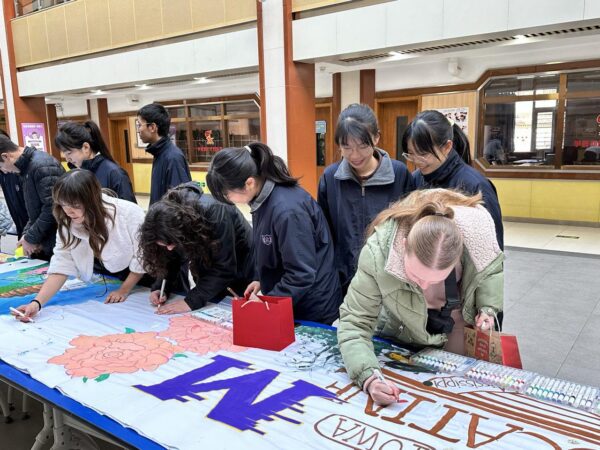
In 1985, Xi Jinping, then 31 years old, visited rural Iowa as part of an agricultural delegation. Nearly 40 years later, Muscatine students took part in a Chinese-funded visit just months after Xi’s 50,000-youth pledge.
In January 2024, the Muscatine Community School District announced that students would travel to China as guests of China’s minister of education and that the trip was fully funded by the Chinese government. That funding detail is exactly the kind of fact that shapes how an exchange is interpreted.
The Muscatine case offers a goldmine of narrative, at least for Xi and the officials around him. Chinese sources tied the visit directly to Xi’s personal diplomacy. Xi replied to “his friend” in Iowa, Sarah Lande, after she wrote to him about the youth initiative and the hope that Muscatine High School students could participate. Soon after, Chinese Embassy coverage described more than 20 Muscatine students visiting Chinese cities and placed them among the first American student groups under the program.
For a Muscatine student, the trip may have been exciting and valuable. For the school district, it offered access to a country most American teenagers will never visit, but many might dream of seeing. For Chinese officials, it produced something else entirely: American youth from a symbolically useful Iowa city traveling through a Chinese-funded program soon after Xi’s pledge.
That visibility created risk. In Iowa, the Muscatine study tour became controversial enough that one state lawmaker called for future trips to be canceled, while defenders described the exchange as educational and transparent. There is merit to both reactions. The same trip could be read locally as a student opportunity and politically as a foreign influence operation. A school administrator is then pulled into questions that are no longer abstract: Who paid? Who designed the itinerary? Would names, photographs, or quotes appear in official media?
The same structure appears at the university level, but it works differently. The Young Envoys Scholarship (YES) program shows how a leader-announced pledge can become a menu of real programs, including seasonal exchanges, youth forums, and school-to-school initiatives. One example is the Johns Hopkins SAIS delegation described in the first YES newsletter. In March 2024, 17 student representatives from SAIS visited Beijing and Kunming for a weeklong program titled “China’s Economy and the World.” The itinerary included development agencies, business organizations, universities, and historical memory sites that fit the version of China the hosts wanted to present.
Unlike the trips involving Muscatine and Tacoma, this example is less about high school friendship and more about advanced policy access. A graduate student studying China’s economy may benefit from seeing institutions directly rather than only reading about them from Washington. SAIS students are presumably able to read an itinerary skeptically. Many may benefit precisely because they can observe how Chinese institutions present themselves to foreign policy audiences. Still, the itinerary itself is part of the message. Students saw a concentrated version of how China wanted to present its development, international commerce, and global position.
Yet calling all of this simply an influence operation is too crude. There is serious educational value in such trips, and it is important not to flatten students’ lived experiences. A young American can have a meaningful, even life-changing experience in China, even while that same experience later becomes useful to someone else’s diplomatic narrative.
The practical lesson for academic institutions is not to avoid China entirely. That would deepen the very ignorance that exchange is supposed to reduce. The first line of defense is transparency. Funding should be clear, and itineraries should be scrutinized, while parents and administrators should know what public use may be made of student participation. The Muscatine controversy shows why those questions matter before, not after, a trip becomes politically visible. Students should understand whether their presence may appear in official coverage and who would be responsible for that publicity.
For think tanks, firms, and China analysts, the risk lies in misreading the symbolism. Short youth visits cannot substitute for slow, difficult forms of expertise on China. A company should not see images of American students in China and assume that the human infrastructure of China-U.S. understanding has recovered. On the other hand, those images should not be treated as proof of a malevolent Chinese agenda to build international rapport. The more likely future is uneven: more sponsored delegations and more scrutiny.
The United States and China both lose something if young people stop meeting each other directly. A few delegations can keep a door from closing, but preserving contact is still not the same as restoring reciprocity. A weeklong visit can give students a first encounter with China, but it cannot replace the slower work that once made exchange meaningful: living there long enough to study the language (badly at first), argue with classmates, learn which institutions are open and which are not, and return home with knowledge that was earned rather than staged. That kind of reciprocity depends on trust that no short itinerary can manufacture.
The question is not whether China-U.S. contact should continue. It should. The harder question is what kind of contact survives when distrust surrounds the room before the students even enter it.
