

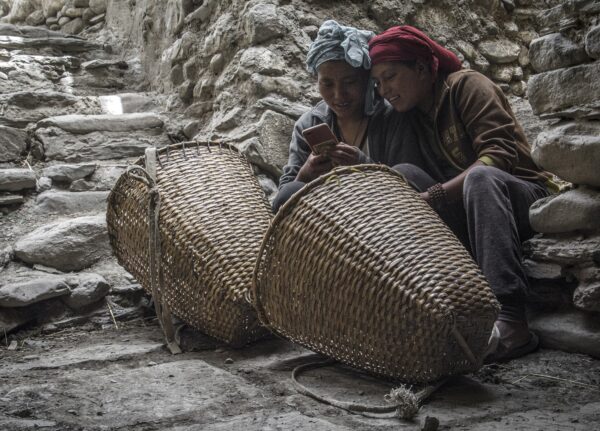
For 23-year-old law student Narayan Rokaya, staying connected in his village of Lha means stepping back in time. While Nepal’s cities have long moved past the sluggish “E” networks that plague his phone, Rokaya must walk to the local ward office and wait in line with neighbors just to access the internet. “Even for basic studying, we have to wait our turn,” he said, noting that daily queues are a reality for anyone hoping to communicate with family abroad.
Laxmi Joshi, 21, a student from Dogadakedar Rural Municipality–2 in Baitadi, technically has internet access, but the connection shifts unpredictably between 2G, 3G, and occasionally 4G, disappearing altogether during power cuts or bad weather. “I have to walk 30–35 minutes just to get a proper signal. The internet is unreliable here – not indoors, not in the rain, not when the electricity goes out,” Joshi explained.
Their experiences reflect a broader pattern: for many Nepalis, access to the internet is either unavailable or too inconsistent to rely on.
This gap stands in sharp contrast to Nepal’s ambitious IT Decade (2024–2034), which targets 3,000 billion Nepali rupees in ICT exports and 500,000 direct jobs. While the vision looks outward, millions within the country continue to navigate a digital landscape that was never built with them in mind.
The Illusion of Connectivity
In early 2026, the Nepal Telecommunications Authority (NTA) reported a broadband penetration rate of 145.69 percent – more subscriptions than people. The figure overstates access; many users hold both a mobile SIM and a fixed-line connection, each counted separately.
Other data points tell a different story. DataReportal’s Digital 2026 Nepal report estimated that only 56 percent of the population was online as of late 2025, leaving roughly 13 million people offline. The Nepal Living Standards Survey 2022/23 similarly found that only about 40 percent of households have internet access at home – far below what coverage maps suggest.
The divide is sharper among low-income households. Just 9.5 percent of households below the poverty line have internet access, in a country where 20.27 percent of the population falls into that category. For many, the digital economy is not merely slow or unequal – it remains out of reach.
The challenge is compounded by geography. About 77 percent of Nepalis live in rural areas, where connectivity is either unavailable or prohibitively expensive. While the Kathmandu Valley reports an internet penetration rate of 79.3 percent, Karnali Province lags at just 14 percent, underscoring the gap between policy commitments and lived reality.
Industry leaders recognize that momentum has slowed. Sudhir Parajuli, president of the Internet Service Providers Association of Nepal and Subisu, a Nepal-based internet service provider, explained that while Nepal remains among South Asia’s leaders in fiber internet penetration – with around 42 percent of households connected – the rapid growth seen during the COVID-19 pandemic has since leveled off and, in some areas, begun to decline.
For students like Rokaya and Joshi, this is not an abstract trend – it defines their daily experience.
“Students in urban areas learn through daily access to information, but in remote villages like mine, these opportunities are scarce. I have yet to see the impact the internet could make,” Rokaya said.
The Affordability Gap: Price, Policy, and Value
Affordability remains another constraint. According to the ITU’s Facts and Figures 2025, users in lower-middle-income economies spend roughly seven times more of their income on mobile broadband than those in high-income countries.
On paper, Nepal’s internet appears affordable, a view often reinforced by industry leaders who argue that the cost is reasonable when averaged over daily use. However, this framing overlooks a more critical question: affordable for whom, and at what level of reliability?
Fixed broadband costs about 7.28 percent of average per capita income – more than three times the international affordability benchmark of 2 percent. Access remains limited, with only 4.8 fixed broadband subscriptions per 100 people, far below the global average. Mobile data is more widespread, but not necessarily more accessible. At an average of 57.38 rupees per gigabyte, it remains out of reach for many, particularly the 20 percent of Nepalis living below the poverty line.
Even regionally, Nepal compares poorly. Users spend a significantly higher share of their income on internet services than those in neighboring South Asian countries, where costs remain below 1 percent of gross annual income. The issue, then, is not just pricing in isolation, but the relative burden that it imposes on users.
Industry stakeholders often frame this as a perception gap. Parajuli argued that Nepal has some of the cheapest internet in the world, noting that people readily spend 25 rupees on a cup of tea yet consider 24/7 internet expensive. He emphasized that the comparison is misleading: tea is a one-time expense, while internet service is continuous. When the cost is calculated on a daily usage basis, he suggested, internet access becomes even more affordable – making the issue less about price and more about perception.
But perception breaks down in places like Baitadi.
In Baitadi, Laxmi Joshi pays 1,000–1,500 rupees a month for a connection too weak to support basic services. Digital payments fail, educational content does not load, and even simple applications remain inaccessible. The issue is not just cost, but value.
“Transaction failures occur frequently due to network instability. Many apps won’t open, and streaming services like YouTube often struggle to load. Despite paying monthly, I can’t access online education or download study materials like students in cities can,” Joshi said.
This gap between price and usability reflects deeper structural constraints. High taxation and regulatory costs continue to shape the market. Internet service providers face a cumulative tax burden exceeding 40 percent, alongside multiple levies on revenue, infrastructure, and equipment. Global institutions, including the World Bank, have identified such taxation as a key driver of unaffordable broadband in developing markets.
Geography adds another constraint. Nepal routes over 90 percent of international internet traffic through India, primarily via Airtel (70 percent) and Tata Communications (20 percent). This reliance limits Nepal’s ability to negotiate bandwidth prices.
“Nepal depends on bandwidth from India and China,” Parajuli said. “Costs are shaped by geography – China’s terrain affects stability, while limited competition in India leads to higher pricing despite cheaper wholesale rates there.”
In terrain like Dolpa’s or Baitadi’s hills, routing costs alone make commercial expansion unviable without sustained government commitment. Prakash Raj Bhatta, office chief for Mahendranagar at Nepal Telecom, put it bluntly: “From the customer side, the internet is not expensive. But infrastructure development requires a very large investment.”
The sector is also structurally fragmented.
According to Parajuli, “Despite having over 100 ISPs in Nepal, input costs don’t decrease with competition, and high taxation can encourage grey markets – where in some cases, services are offered up to 30 percent cheaper through illegal sharing.”
Understanding the Digital Divide in Nepal
Nepal’s digital divide extends beyond geography. It is shaped by gender, caste, education, and language – the factors that determine not just access, but the ability to use the internet meaningfully.
Subscription figures obscure these gaps. In Nepal, mobile broadband makes up 93.84 percent of total subscriptions, yet digital literacy stands at only 31 percent.
Education is one of the strongest predictors of connectivity. Research from the Nepal Administrative Staff College showed that 90 percent of individuals with master’s degrees are online, compared to just 23 percent of those with secondary education or below. Social hierarchy further deepens this divide: 37 percent of higher-caste households have internet access, versus only 21 percent of Dalit households. A 2024 study in the Journal of Economic Concerns found that individuals with higher socioeconomic status are nearly four times more likely to be connected.
Even where infrastructure exists, usage is not guaranteed. Limited digital literacy and weak supporting infrastructure continue to constrain adoption. “In rural areas, providing internet is not enough; digital literacy is equally important. Where roads and electricity have not reached, expanding the internet becomes a major challenge,” said Parajuli.
Kanchanpur reflects both progress and its limits. Despite near-complete 4G coverage and expanding fiber networks, connectivity remains inconsistent in practice. “Many internet problems are caused by router placement or internal wiring, not by the network itself,” noted Bhatta, pointing to gaps in user awareness and technical support.
Gender and language further shape exclusion. Only 41 percent of Nepali women use the internet, despite widespread mobile ownership. At the same time, most online content is concentrated in Nepali or English, leaving speakers of indigenous languages with limited access to relevant information.
Parajuli summarizes the challenge through what he calls the AAS principle: Affordability, Accessibility, and Stability. While access and pricing have improved in some areas, stability remains inconsistent, and long-term infrastructure development continues to lack coordinated policy direction.
Closing the Gap Between Access and Use
Nepal’s digital infrastructure is expanding, supported by growing investment. In 2025, the International Finance Corporation invested $29 million in WorldLink, while the World Bank committed $140 million to the Digital Nepal Acceleration Project. Nepal Telecom has extended fiber connectivity to all 77 districts, and the Rural Telecommunications Development Fund has connected over 16,000 public sites, including schools and health facilities.
But expansion has not ensured equitable access. Network growth remains commercially driven, leaving low-demand and remote areas underserved. “We generally plan expansion only when there is demand from 100 to 200 potential users… otherwise we do not proceed,” said Bhatta, highlighting how market logic excludes entire communities.
Even where infrastructure exists, sustainability is a constraint. High operating costs and limited user bases make rural networks difficult to maintain. Parajuli noted that services often become unviable after initial project support ends, arguing that infrastructure funding must be complemented by usage-based subsidies to make access meaningful.
Policy frameworks acknowledge these gaps. The FY 2024/25 budget allocated 7.25 billion rupees to ICT, and the Digital Nepal Framework 2.0 recognizes persistent inequalities. Yet progress remains uneven. Coverage is expanding, but for many – especially in remote regions– the internet is still unreliable, unaffordable, or absent.
“Connectivity alone is not enough. Without digital literacy and proper usage, even the best networks fail to deliver value,” Bhatta emphasized. For others, the challenge is more basic. “Internet access should be simple, affordable, and within everyone’s reach,” said Rokaya.
Nepal’s digital divide is no longer just about building networks. It is about ensuring those networks work, reach the underserved, and can be used in practice. Until that gap is closed, digital progress will remain incomplete – shaping who participates in the country’s future and who does not.
