

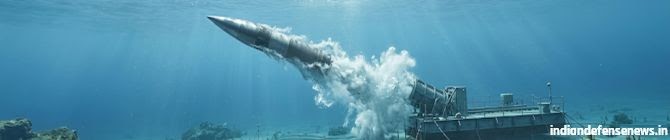
India has achieved a significant milestone in its strategic weapons program with the successful completion of the “pop-up” ejection trial of the K-5 Submarine-Launched Ballistic Missile (SLBM).
This test, conducted in the final week of March, represents a crucial step forward in strengthening the maritime component of the nation’s nuclear triad, according to India Today defence journalist Sandeep Unnithan.
By advancing towards longer-range and more sophisticated sea-based deterrence systems, India is steadily reinforcing its second-strike capability, a cornerstone of credible nuclear deterrence.
The pop-up or ejection trial is a fundamental engineering validation conducted prior to live-fire testing. In this process, a dummy missile is expelled from a submerged launcher to confirm that the canister ejection mechanism functions reliably.
The objective is to ensure that the missile can safely clear the submarine’s launch tube and breach the water’s surface before its rocket motors ignite. Perfecting this cold-launch technique is essential for nuclear-powered ballistic missile submarines, which must operate safely and securely in deep waters.
Reports confirm that the March trial successfully validated the K-5’s newly designed canister and gas-ejection systems, marking a decisive breakthrough in its development.
The K-5 missile, weighing approximately 20 tonnes, is set to become the most powerful submarine-launched ballistic missile developed under India’s indigenous strategic weapons program. It is strategically positioned as the underwater counterpart to the land-based Agni-V intercontinental ballistic
missile. With an estimated range of 5,000 to 6,000 kilometres, the K-5 will enable India to strike deep inside adversarial territory, including critical industrial and military hubs, while launching from secure patrol zones in the Indian Ocean or Bay of Bengal.
This capability ensures that Indian submarines can remain far removed from hostile anti-submarine warfare networks while maintaining credible deterrence.
A defining feature of the K-5 is its integration of Multiple Independently Targetable Re-entry Vehicle (MIRV) technology. This allows a single missile to carry and deploy multiple nuclear warheads against distinct targets, significantly enhancing the effectiveness of India’s deterrent posture.
MIRV capability ensures that adversary missile defence systems can be saturated and overwhelmed, thereby guaranteeing a high probability of successful strikes. The inclusion of MIRV technology in the K-5 represents a major leap in India’s strategic arsenal, aligning with recent advancements demonstrated in land-based systems under Mission Divyastra.
To accommodate such a formidable missile, the Indian Navy is developing the next-generation S-5 class of nuclear-powered ballistic missile submarines. These vessels, with a submerged displacement exceeding 13,500 tonnes, will be substantially larger than the current Arihant-class fleet, which includes INS Arihant and INS Arighaat.
The S-5 submarines are purpose-built to carry heavier and longer-range systems such as the K-5 and, eventually, the planned K-6 variants. Their expanded size and structural design will provide the necessary depth and support for housing these advanced intercontinental-range weapons.
Clearing the underwater ejection phase is widely regarded as one of the most challenging engineering hurdles in SLBM development. With this obstacle now overcome, the program is expected to progress to developmental flight trials from submerged pontoons later this year.
These trials will rigorously test the missile’s propulsion systems, underwater trajectory sequencing, navigation accuracy, and maximum range capabilities. Defence analysts anticipate that the K-5 will undergo extensive testing over the next several years to ensure reliability and operational readiness.
The final induction of the K-5 into active service is projected to coincide with the commissioning of the first S-5 class submarine, expected around 2032. This timeline underscores the complexity of integrating such a sophisticated strategic asset into India’s deterrence architecture.
Once operational, the K-5 will elevate India’s maritime nuclear forces to a truly intercontinental level, ensuring that the nation’s second-strike capability remains credible, survivable, and technologically advanced for decades to come.
Agencies
