

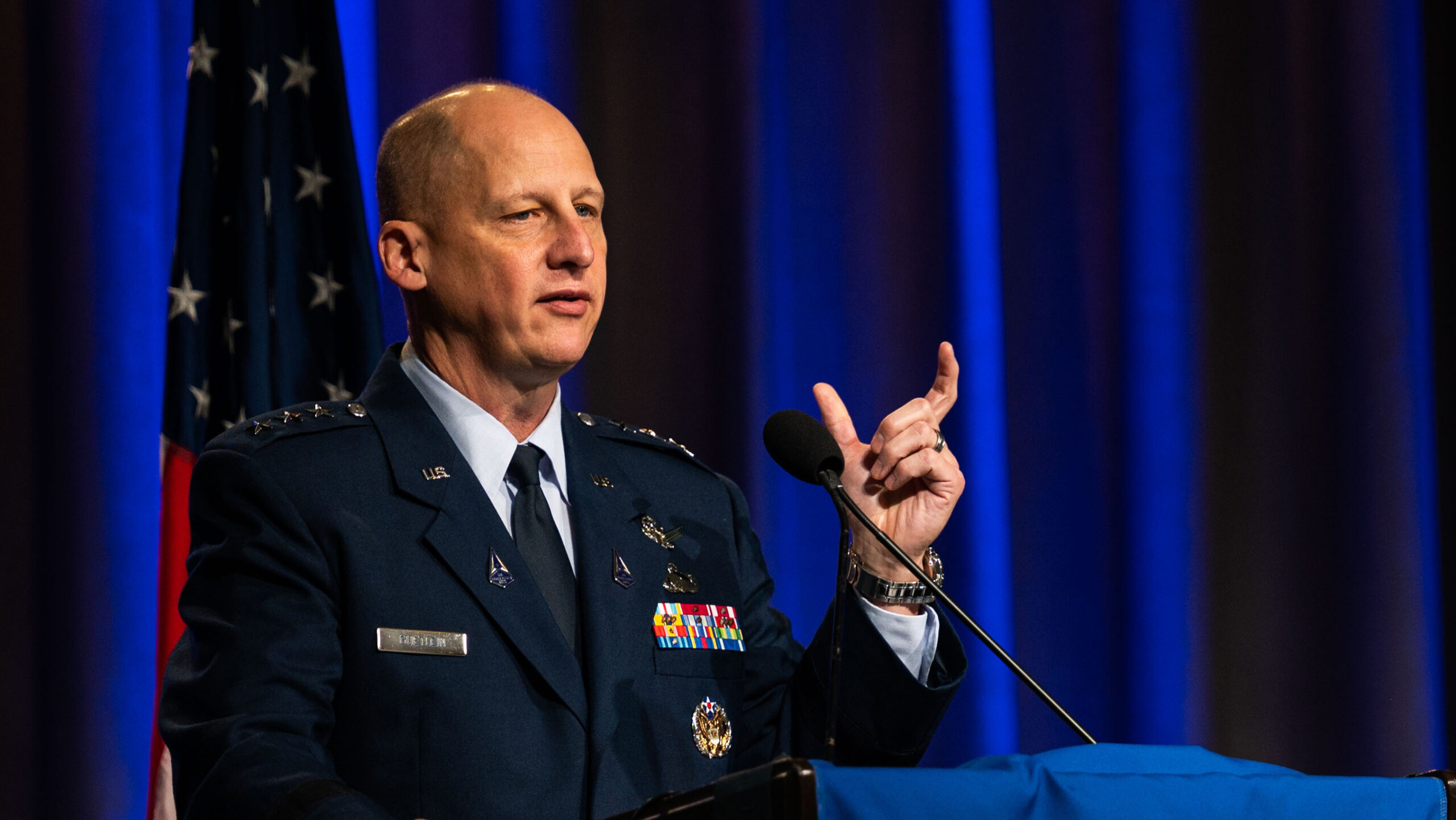
WASHINGTON ― The Pentagon’s Golden Dome czar Gen. Michael Guetlein today pushed back at the Congressional Budget Office’s estimate that the program could cost up to $1.2 trillion over 20 years ― asserting that the assessment was based on old technology and incorrect assumptions about the planned architecture.
“They’re not estimating what we’re building. It’s as simple as that,” he said. “They’re not necessarily wrong, but they take legacy capabilities, they take technology from the two early 2000-2004 reports, etc., and then they just multiply that forward by the geography of the [homeland],”
Last month, Guetlein told lawmakers the cost to stand up Golden Dome would come in around $185 billion.
He told the Inside the Dome conference here today the trouble with the CBO’s approach is that the “exquisite” and “manpower-dependent” tech he said it used as a baseline was optimized for a different purpose ― “for an away fight, for a point defense type fight” ― rather than being designed for homeland defense.
“That is not what we need for the homeland. You need a regional defense with a different architecture,” he stressed.
He elaborated that in particular the CBO’s estimates for the costs of space-based interceptors (SBIs), which the congressional watchdog found would account for about 70 percent of the total, did not take into account technological progress over the past 20 years.
Guetlein foot-stomped that he believes SBIs are technically feasible ― citing his earlier arguments in congressional testimony that all the underlying technology already exists.
“I have proven I can close the fire control loop with an object in space. I have proven over and over I can re-enter an object into the atmosphere. And I have proven over and over I can maneuver an object once it’s in the atmosphere,” he said.
But what has not been done is to connect all those capabilities into one weapon system, Guetlein explained, acknowleding the cost was unknown as well.
“I’ve never done it end-to-end in a space-based-interceptor-type platform. Nor have I proven it’s affordable at scale,” he said. “So, when it comes to SBI, whether that be boost phase or midcourse, I believe the physics are there. We just got to prove that we can do it affordably and at scale,” Guetlein said. “This is not a physics-based problem. This is an economics and scalability problem, and an organizational behavior, social engineering challenge.”
While Guetlein reiterated his April testimony to the House Armed Services Strategic Forces subcommittee that the Defense Department would not pursue SBIs if the price tag is too high, he also voiced optimism that that would not be the case.
The trick, he said, will be for the Pentagon’s 12 industry partners to “simplify the solution” and “think innovatively about the requirements.
“I think they’re going to figure out how to do it,” he added.
In its report Wednesday CBO said that DoD hadn’t released enough details about the Golden Dome plan to allow a precise cost estimate, so the office based its calculations on what it would take to stand up a “notional” national missile defense shield in line with President Donald Trump’s January 2025 executive order (EO) calling for an Iron Dome for America — since rebranded as Golden Dome. The DoD’s public cost estimate, the report says, “appears to cover a shorter time frame than CBO’s analysis and may reflect a different scope of activities and budget categories.” Even then, it said, the cost is “far lower” than the EO would suggest is necessary.
Despite his criticism of the report, Guetlein said he welcomed the CBO’s attention and acknowledged that the Pentagon hasn’t been “putting a lot of information out in the public exactly what we’re doing” ― information that would allow a more accurate, independent assessment ― due to the unprecedented “intelligence threat” the program faces.
“[T]he good news about the CBO report,” he said, “is it is putting the discussion in front of the American people about the need for national missile defense and just how bad the threat is. It’s not just about nuclear-based ICBMs. It’s about the conventional threats that the adversary can bring to bear on the United States.”
Guetlein further insisted that Golden Dome would be able to protect the entire US homeland from those threats by 2028.
“We are focused on protecting the entire homeland, not just pieces and parts of it,” he said. “And what we did deliver in the summer of ’28 will be operational. It will not be aspirational, it will not be a prototype. It will not be a demonstration. It will be operational capability.”
A more skeptical CBO said in its report that some key defense shield components, like SBIs, “will probably take several years to develop.”
