

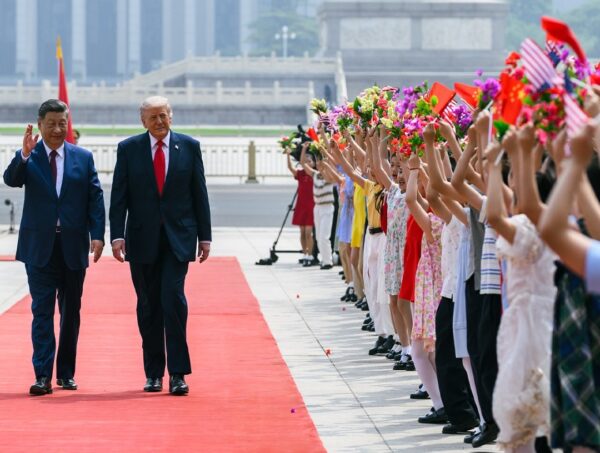
Buried in the Chinese readout of the meeting between Presidents Donald Trump and Xi Jinping in Beijing is what may be the single most consequential line of the summit. Xi announced that the two leaders had agreed to make “a constructive China-U.S. relationship of strategic stability” the new positioning of the relationship, a framework meant to “provide strategic guidance for the next three years and beyond,” according to the official Xinhua readout.
A colleague’s reaction when the readout dropped caught the implied meaning: “So it means – fighting with rhythm, fighting controllably, fighting step by step?” It was a joke. It was also not wrong.
Beijing does not toss out tifa – authoritative official formulations – casually. Each one is a load-bearing wall. And on the first meeting of the day, with global attention concentrated on Beijing and the U.S. side briefing with far less conceptual density, Xinhua’s early readout did more than report a meeting. It supplied the first authoritative vocabulary through which the summit would be understood. The side that names the relationship is trying to set the terms on which it is read.
A Pattern, Not a Novelty
The instinct in Washington will be to treat this as one-off summit atmospherics. It is not. It is the latest move in a sequence that runs back nearly three decades. The 1997 joint statement between Jiang Zemin and Bill Clinton committed both sides to build toward a “constructive strategic partnership.” By 2005, the vocabulary was American – Robert Zoellick’s “responsible stakeholder” mantra. Later came the economists’ G-2, shorthand for a China-U.S. condominium in global economic governance that Beijing never accepted as its own preferred label.
Then, in 2012-13, Beijing supplied its own label: the “new model of major-country relations.” In a 2013 speech at the Brookings Institution in Washington, D.C., Foreign Minister Wang Yi described that formula as “strategic, constructive and path-breaking,” and said it had “charted the future course” for China-U.S. relations. The formula, however, never caught on with the United States.
During the Biden years, the two sides talked past each other: Beijing offered its own principles for managing the relationship, while Washington organized its China strategy around “invest, align, compete.”
The pattern held across the past several months. Ahead of his meeting with Xi in Busan, South Korea in October 2025, Trump revived the G-2 imagination with his Truth Social post stating: “THE G2 WILL BE CONVENING SHORTLY!” The formulation that reactivated the older idea of a China-U.S. “Group of Two” capable of steering global affairs.
Beijing did not take up that vocabulary. In March 2026, Wang Yi made the rejection explicit at his Two Sessions press conference, saying China did not subscribe to the logic of “major power co-governance.” The sequence matters. Trump attempted to define the relationship first; Beijing declined. Two months later, in Beijing, China provided its own rhetorical formula.
Two things recur across this brief history. First, the drift in who names the relationship tracks the change in relative confidence. Second, the American response to a Chinese formulation has often been just as revealing as the formulation itself. A Chinese framework is usually proposed at high points and erodes when the relationship does.
What is different this time is the speed of consolidation. Within hours, Chinese state media and party-theory outlets began reorganizing Xi’s four phrases into a layered structure of premise, pathway, key, and goal. That is what locking in a formulation looks like in real time.
What the Formulation Actually Does
Xi’s framework has four components: “positive stability with cooperation as the mainstay”; “sound stability with moderate competition”; “constant stability with manageable differences”; and “enduring stability with promises of peace,” as CGTN’s English-language rendering put it.
The load-bearing phrase is the second. It is one of the clearest official acknowledgements Beijing has offered that the relationship now contains a competitive dimension – the framing China spent much of the Biden years refusing. But the acknowledgement is disciplined. Competition does not come first; “cooperation as the mainstay” does. Competition is admitted only after being subordinated to stability and bounded by restraint.
That subordination is the adaptation. Beijing has become more fluent in describing a relationship containing hardened competition without either denying that reality or accepting Washington’s competition-first frame. It is not saying there is no competition. Nor is it saying competition defines the relationship. It is trying to pre-emptively define the meaning, scope, and tempo of that rivalry.
The irony is that the positions have partly flipped. During the Biden years, Washington named competition and sought to build “guardrails.” Now Beijing offers the more operational language for managed rivalry, while the Trump side looks comparatively empty-handed on the basic question of what the relationship is.
This is why “stability” should not be read as a concession. A relationship you have stabilized is one you can compete inside, for a long time, without it breaking. Stability is not the opposite of rivalry. It is the container that makes a long rivalry survivable.
One Phrase, Two Languages
Here is the part most likely to be missed in Washington, and the most important.
In English, “strategic stability” is a Cold War term of art. It belongs to the analysis of superpower nuclear competition and crisis management. It points to a specific machinery: mutual vulnerability, secure second strike, hotlines, verification, arms control treaties, and now wider problems involving missile defense, space, cyber, and AI. The American side can pick the concept up easily because it has a settled place in U.S. policy tradition. It reads as an engineering problem: build the channels, define the thresholds, sign the agreements.
In the Chinese political lexicon, the phrase resonates differently. There is a developed Chinese official and expert discourse that has broadened “strategic stability” from a nuclear concept into a wider condition of interstate relations. Brookings’ study of “Chinese perspectives on strategic stability engagement” notes precisely this divergence: some Chinese experts define the term in narrower nuclear terms, while others extend it to the overall stability of major-power relations.
But beneath that lies an older register. The cadence of the four “stabilities” – bounded, calibrated, kept within limits – echoes the Maoist formula of 有理、有利、有节: on just grounds, to one’s advantage, with restraint. The phrase comes from Mao’s March 1940 directive on united-front strategy, where it condensed principles for handling the KMT diehards one must simultaneously work with and struggle against: unite and struggle at once; never strike first, but always strike back; and – crucially – once an attack is repelled, stop. Do not fight endlessly. Do not let victory go to your head.
That last principle disciplines the reading of Xi’s latest tifa. Restraint, in the CCP’s tradition, was never the opposite of struggle; it was what made a long struggle sustainable. But it was also explicitly against forcing a decisive confrontation. It is premised on a contest with no single decisive moment – one to be paced and kept from boiling over, indefinitely.
So the two languages diverge at the root. Washington hears “strategic stability” and reaches for a checklist. Beijing says it and draws on something closer to a philosophy of tempo. One side reads an engineering blueprint; the other, statecraft as paced struggle.
The Asymmetry at the Table
This is where the mismatch becomes concrete. Trump came to Beijing seeking “the art of the deal,” and was largely unprepared to engage Beijing’s strategic proposal on its own terms. Beijing had its policy and propaganda apparatus running at full speed, flooding the zone with concepts and interpretive cues.
The U.S. summit operation, by contract, was run substantially through the Treasury Department. Washington was prepared to process transactions, not to contest Chinese political slogans. The publicly visible U.S. delegation also lacked an obvious senior China hand – the kind of official whose role is to read and decode Chinese political language.
Trump may accept the language precisely because he does not read it as Beijing does. For him it may sound like atmospherics: constructive, stable, positive, good for business. For Beijing it is a conceptual architecture for managing and judging the next phase of the rivalry.
The “three years and beyond” language is telling. It is built to outlast Trump’s term. In parts of the Chinese policy debate, Trump is read as one of the less ideologically hawkish figures in Washington – transactional, yes, but not structurally committed to alliance-driven containment. The remaining Trump years are therefore a window: a chance to lock in a framework while the White House still privileges leader-level management. “And beyond” is an attempt to turn a Trump-era opening into an inherited baseline for whoever comes next.
This adaptation will also have bureaucratic consequences. If Beijing is now more willing to acknowledge hardened competition, its policy apparatus will likely put more effort into building the infrastructure of strategic-economic statecraft: export controls, sanctions, anti-sanctions mechanisms, investment reviews, and other forms of policy leverage. The goal is to narrow the gap with the U.S. toolkit while preserving flexible areas of cooperation that can buffer the harder zones of rivalry.
That is the architecture behind the phrase. Stable cooperation where useful. Disciplined competition where necessary. Red lines where non-negotiable. Policy tools to make all three operational.
The Hard Stop Inside the Framework
The doctrine carries its hard stop inside it. The same readout delivered one of Xi’s sharpest red lines to Trump: if the Taiwan question is mishandled, it could create “an extremely dangerous situation.” Taiwan is the boundary condition of the whole framework.
The self-defense principle was always a red-line logic. Mao’s “just grounds” are a line. Calibrated, restrained competition is organized around it. Stability everywhere else is precisely what allows Beijing to hold Taiwan as the one place where restraint has a limit.
Beijing almost certainly will return to this tifa. More interestingly, the concept has already surfaced on the American side. In an interview with NBC, Secretary of State Marco Rubio said that “strategic stability” was “one of the things the Chinese emphasize – and we agree.”
That is the first move, and it must be read carefully. Rubio accepted the frame tentatively but did not adopt the full formulation. He spoke of strategic stability loosely, with the crisis management sense the term has always carried in English. He did not pick up “a constructive China-U.S. relationship of strategic stability” as a defined, four-part framework with a three-year horizon.
The gap between those two things is the whole argument here. Beijing offered an architecture; Washington, so far, has echoed a mood.
So the real question is this: Does the American side stay where Rubio left it – treating strategic stability as agreeable atmospherics – or does the full formulation migrate into places where language hardens into commitment?
If it gets there, Beijing will have done something larger than coin a summit slogan. It will have gotten Washington to agree, in writing, that the rivalry has a temperature, a range, and a mechanism for deciding when one side has pushed it too far.
If the historical pattern holds, the likelier outcome is that the relationship will again be defined by actions, not words, and the phrase will quietly fall out of the American mouth. Rubio’s quick, loose embrace is not yet evidence of the first outcome. It is exactly what the second path would also look like at the start.
The contest over the tifa – over whose vocabulary the next decade is conducted in – has opened with Beijing a step ahead, and Washington having spoken first without, perhaps, having read what it just agreed to.
