

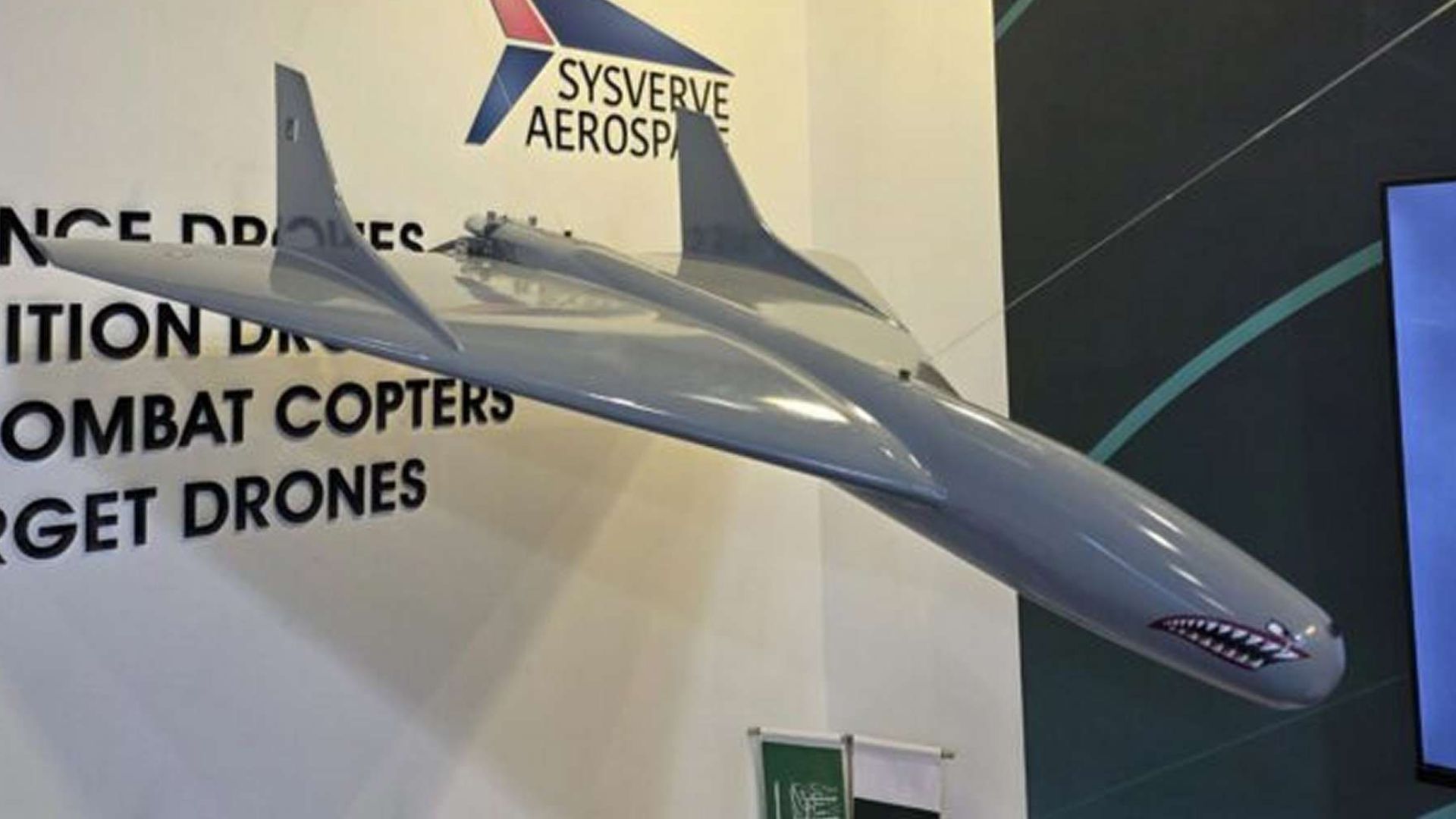
Pakistan is building what appears to be the largest and most diversified loitering munitions portfolio in the country’s procurement history, with no fewer than a half-dozen distinct designs either in development or in early-stage production across the National Engineering & Scientific Commission (NESCOM), the National Aerospace & Technology Park (NASTP), and an expanding roster of private-sector firms.
The underlying issue, however, is whether that product portfolio is organized around the right design philosophy – i.e., one that will actually produce the volumes Pakistan will need in a high-intensity conflict with India, or one that will produce small numbers of technically advanced, feature-rich systems that are operationally inconsequential.
The evidence from the May 2025 conflict, the Russia-Ukraine war, and the ongoing Iran war all converge on the same conclusion: the determining factor in the effectiveness of loitering munitions is the production scale, and production scale is a function of design simplicity, not design sophistication.
Finish the story. Get the full picture.
Unlock independent journalism and deeper analysis on Pakistan’s key defence and policy developments
The Fundamental Problem with Pakistan’s Industrial Base
The starting point for this discussion is Pakistan’s narrow industrial base.
The country lacks the depth of aerospace manufacturing capacity, advanced composite fabrication expertise, or precision electronics production needed to mass-produce advanced loitering munitions.
In other words, Pakistan cannot manufacture weapon systems with carbon-fibre airframes, AI-enabled autonomy, satellite datalinks, electro-optical/infrared (EO/IR) gimbals, and GNSS-independent navigation at scale, at least not at the rates that would matter for extracting the core utility of a loitering munition.
The entire value proposition of a Shahed-style loitering munition rests on its ability to absorb attrition, which stems from its low cost and ease of production.
These are expendable weapons designed to absorb losses in exchange for two concurrent effects: first, striking whatever percentage of targets survives the layers of enemy air defences, while also depleting the enemy’s anti-air warfare (AAW) inventory in the process.
Consider 1,000 Shahed-class drones launched over the course of a sustained campaign.
Even at a 90% loss rate – which is relatively high – 100 targets are struck, and up to 900 AAW threats are expended, a mix that almost certainly includes high-cost surface-to-air missiles (SAM) such as the Akash, MRSAM, and potentially even S-400-affiliated interceptors.
Now scale that to 10,000 drones: 1,000 targets struck, 9,000 AAW entities depleted, and – critically – progressively widening gaps in India’s air defence coverage through which higher-value assets like Fatah-series surface-to-surface missiles (SSM), Fatah-4 and Taimur ground-launched cruise missiles (GLCM), and Taimur air-launched cruise missiles (ALCM) can penetrate.
That benefit does not manifest at a production volume of 200 or 500 units per year. It works at 5,000, 10,000, or more. The question is whether Pakistan’s industrial structure can deliver those numbers (while also replenishing them during a war), and the answer depends entirely on how simple the drone’s design is – how few specialized inputs it requires, how many of those inputs can be sourced indigenously, and how widely the assembly work can be distributed.
This is a challenge with treating Baykar’s evolving portfolio as a model for Pakistan.
Baykar recently unveiled the K2 Kamikaze UAV in March 2026, an 800 kg system with a 200 kg warhead, a range exceeding 2,000 km, AI-supported swarm autonomy, visual odometry navigation for GNSS-denied environments, and a reusable airframe designed to return to base after payload delivery.
Earlier in April, the company demonstrated the Sivrisinek loitering munition (an improvement of the YIHA co-produced by Baykar and NASTP) in a mixed-class formation with K2 units, and in May, it debuted the Mızrak at SAHA 2026 with a 1,000+ km range, AI autopilot, and GPS-independent optical guidance.
Indeed, each of these systems is capable, and each represents real technical achievement.
However, each also requires runway or strip infrastructure for launch, retains landing gear for recovery, and is built with composite materials and electronics stacks that presuppose an advanced manufacturing base – one that Türkiye has spent decades building through its wider automotive and aerospace sectors.
Pakistan does not have that base, and one cannot conjure it into existence overnight.
The consequence is straightforward: if Pakistan invests its limited production capacity in advanced, Turkish-style loitering munitions, it will produce them in small numbers – perhaps hundreds per year at best – and that output is operationally insufficient for the role these systems are meant to play.
Unpacking the Inputs of a Low-Cost Drone
A Shahed-136-class loitering munition has, in essence, five categories of input: an airframe, a propulsion system, a guidance and navigation package, a warhead, and a launch mechanism.
The design philosophy of the Iranian programme – and the Russian Geran-2 program that absorbed it – was to reduce each of these to the simplest possible form, using civilian commercial off-the-shelf (COTS) components wherever possible and designing for manual assembly rather than precision automation.
The airframe is fibreglass, produced from three or four moulds – two for the fuselage and wing, two for the vertical stabilizers – using hand layup with epoxy resin. No autoclave, no computer-numerical-control (or CNC) machining, no carbon fibre.
Pakistan has a relatively substantial glass-reinforced plastic (GRP) manufacturing sector, driven by its boat-building, water tank, and automotive aftermarket industries.
Firms producing GRP hulls for the Pakistan Navy’s (PN) smaller craft and for the commercial fishing fleet already possess the moulding and layup expertise required; one could see the same workshops producing drone airframe shells with minimal retooling.
The propulsion system is a small air-cooled piston engine in the 40-50 horsepower range, driving a rear-mounted pusher propeller. Iran’s MD550 engine is a reverse-engineered derivative of a small commercial aviation powerplant.
Pakistan does not currently produce a purpose-built drone engine in this class, but it does have a deep base of small-engine manufacturing. The motorcycle sector alone produces hundreds of thousands of single-cylinder and twin-cylinder engines per year through companies like Atlas Honda and the vendor networks built around them.
Millat Tractors, which set up Pakistan’s first engine assembly line in 1982 and now machines engine blocks, sumps, transmission cases, and axle housings in-house from locally sourced castings, represents exactly the kind of industrial capacity – casting, machining, assembly – that could be redirected toward small piston-engine production for loitering munitions.
The Millat Group’s subsidiary, Bolan Castings Limited, produces precision castings for the automotive sector and could supply the forged and cast components a drone engine requires.
The guidance package is also basic: an inertial navigation system (INS) corrected by a civilian-grade GPS/GLONASS receiver, an autopilot, and a data module.
These are COTS electronics, commercially available from multiple Chinese suppliers, and Pakistan’s access to China’s commercial defence supply chain means that even if full indigenous production of these modules is not immediately feasible, the procurement channel is open and the unit costs are low.
Over time, one could see Pakistan’s own electronics sector – particularly the NESCOM ecosystem – developing indigenous equivalents, but this is a second-order priority; the immediate imperative is to get drones into serial production, even with imported guidance modules.
The warhead and fuze are also within Pakistan’s existing industrial capabilities, with many decades of experience in warhead and fuze production across its munitions industry – from NESCOM to Pakistan Ordnance Factories (POF) – and the 40-50 kg high-explosive warhead required for a Shahed-class drone is a straightforward munition by the standards of what Pakistan already manufactures at scale.
The launch mechanism is a portable multi-rail rack with a rocket-assisted takeoff (RATO) booster that can be mounted on any commercial or military truck. The booster is a simple solid-fuel unit that jettisons after engine engagement. Pakistan manufactures solid-fuel rocket motors across its missile programmes, and a small RATO booster is a comparatively trivial derivative.
The Landscape of Pakistani Designs
There is no shortage of loitering munition designs emerging from Pakistan’s defence sector.
The Mudamir-LR from Sysverve Aerospace, the GIDS Sarkash-I, the Blaze-series, the NASTP KaGeM V3, the Sarfarosh, the Highmark-25 from Woot-Tech, and the Dark Angel-II – a likely licence-built Chinese design from NORINCO or CASC – collectively represent a broad and growing portfolio.
However, the proliferation of designs does not, in itself, solve the scalability problem.
Many of these systems, particularly the jet-powered variants such as the Sarfarosh and the Highmark-25, share the same industrial overhead that makes Turkish designs difficult to scale, such as turbojet engines, advanced composite structures, and complex guidance electronics.
The risk is that Pakistan ends up with a dozen different loitering munition programmes, each producing a few hundred units per year, rather than one or two ruthlessly simplified designs produced in the tens of thousands.
Overall, the challenge is identifying which designs are genuinely optimized for mass production with indigenous inputs and concentrating production resources on them, rather than distributing effort across a fragmented portfolio that privileges variety over volume.
Where Advanced Loitering Munitions Fit
None of this is to say that Baykar’s systems – or the broader Turkish ecosystem of advanced loitering munitions – have no place in Pakistan’s operational concept. They do, but the role is narrower than what some procurement planners may envision.
Jet-powered, AI-enabled loitering munitions like the K2, the Sivrisinek, and the Mızrak are best understood as support assets in a layered strike architecture rather than the mass-attrition layer itself.
One can see several specific roles where their capabilities would add value.
In mixed salvos, they can serve as radar-signature analogues for subsonic cruise missiles, presenting a cruise-missile-like return on enemy radar screens and forcing air defences to expend interceptors on them before the actual Taimur or Fatah-4 cruise missiles follow – a tactic Russia has employed extensively in Ukraine.
As emitters, they can expose enemy radar emissions on the ground, cueing the locations of air defence batteries for follow-on targeting by Fatah-2 ballistic missiles or other strike assets.
Their EO/IR sensors, combined with AI-enabled target recognition, can serve as a validating layer for satellite-based IMINT or ESM/ELINT-derived intelligence, confirming target coordinates and building wider situational awareness for the Army Rocket Force Command (ARFC) before a salvo is committed.
These are valuable contributions, but they do not require thousands of units.
A few hundred advanced loitering munitions per year, employed selectively as the ‘eyes and decoys’ of a broader strike package, would be a sensible investment – particularly if they draw on Baykar’s subsidiary in Pakistan for local assembly and knowledge transfer.
Pakistan’s loitering munition investment, however, needs to be directed at the simple end of the spectrum, i.e., fibreglass airframes from GRP moulds, piston engines produced using the country’s existing casting, machining, and small-engine assembly infrastructure – most likely manufactured to a Chinese-supplied design in the near term, with indigenous engine development as a longer-term objective – COTS guidance and navigation electronics procured from China, conventional warheads and fuzes from POF and GIDS, and RATO launch units derived from Pakistan’s solid-fuel rocket motor sector.
The assembly model should be distributed – small, low-visibility workshops in rural and mountainous terrain capable of hand-assembling drones from pre-moulded components, drawing from Iran’s approach of decentralized production that is difficult to target and easy to sustain under wartime conditions.
Pakistan cannot replicate Iran’s underground mountain facilities, but it has vast rural hinterlands and dense urban centres where dispersed assembly sites can be hidden with relative ease.
The prize is not a clever drone; rather, the prize is 10,000+ of them – i.e., cheap enough to throw away, simple enough to build anywhere, and numerous enough to rework the cost ratio against India’s air defence architecture in Pakistan’s favour.
Quwa Plus
Make Sense of Pakistan’s Defence and Policy Shifts
Independent Pakistan-led analysis, Pulse Check audio briefings, and a decade of reporting to help you understand what changed, why it matters, and how the story fits together.
Featured & Trusted By
