

North Korea’s strategic posture has visibly shifted since the Australia-United Kingdom-United States (AUKUS) agreement was signed in 2021. Pyongyang has “irreversibly” enshrined nuclear weapons into its constitution, formalized a “Comprehensive Strategic Partnership” with Russia that contains a mutual defense clause, sent 14,000 troops to the battlefield in Ukraine, abandoned reunification with South Korea, and vowed to modernize its outdated navy.
North Korea constantly reminds its citizens about the perceived threat that AUKUS poses. The official state-run media mouthpiece, the Korean Central News Agency (KCNA), recently described AUKUS as “gravely threatening regional peace and security” after Australia transferred the first $500 million payment to the United States. It is clear that Pyongyang pays close attention to new developments in AUKUS, but how much of the shift in North Korea’s grand strategy can actually be attributed to it?
AUKUS in a Dangerous Mosaic of “Tripartite Nuclear Alliances”
The main focus of North Korean media commentary about AUKUS is the perceived role it plays in spreading nuclear weapons in the Asia-Pacific. Shortly after the deal was announced in September 2021, Pyongyang slammed AUKUS as “an irresponsible act posing danger of nuclear proliferation and triggering an arms race.” The official KCNA report portrayed AUKUS as symbolic of the United States’ “double dealing” and “Janus-faced” foreign policy. Washington was depicted as the central aggressor seeking to undermine the global proliferation regime under the ruse of protecting a rules-based international order.
From North Korea’s perspective, AUKUS is not the only “tripartite nuclear alliance” to emerge in recent years. Pyongyang is even more sharply critical of the Japan-South Korea-U.S. trilateral that first met in August 2023. Although the summit was largely focused on bringing Japan and South Korea together to balance China’s growing maritime power in Northeast Asia, a commentary piece in the Pyongyang Times viewed the trilateral as evidence of a “triangular Asian NATO” emerging. When viewed together, AUKUS and the Japan-South Korea-U.S. trilateral are, for North Korea, interconnected parts in a broader “multilayered ring of nuclear encirclement” directed against it.
Although accusations of nuclear proliferation from Pyongyang may seem bewildering, contradictory, or even amusing, its rhetoric about AUKUS reflects a deep and persistent fear of externally imposed regime change led by the United States and its allies. Pyongyang’s strategic thinking is guided by the belief that it is surrounded by larger and hostile powers that seek to dominate it. The depiction and projection of AUKUS as a threat legitimizes the necessity of developing a nuclear deterrent to equalize the power imbalance to the North Korean people, who have had to tighten their belts repeatedly to ensure the program’s success.
North Korean depictions of AUKUS have racial and colonial dimensions as well. Successive North Korean media articles have described AUKUS as an “Anglo-Saxon nuclear submarine alliance” that aims to subordinate the Korean race. However, what sparks even greater indignation against AUKUS is Japan’s deepening military cooperation with its three members. Tokyo has been traditionally depicted by North Korean sources as a dormant but inherently militaristic power intent on recovering the Korean Peninsula if its expansionist tendencies are not kept in check. In Pyongyang’s view, this further justifies its nuclear weapons program.
AUKUS and North Korea’s Naval Build-Up
While it is difficult to deny that North Korea views AUKUS as one threat among others in an emerging structure of nuclear alliances, what remains unclear from its media commentary is whether AUKUS has directly affected Pyongyang’s increasingly active military posture. More proximate threats – such as South Korea’s “kill chain strategy,” the biannual South Korea-U.S. Exercise Ssang Yong, and the Japan-South Korea-U.S. trilateral – visibly occupy more of North Korea’s strategic attention than AUKUS does.
However, where AUKUS and North Korea’s actions are most plausibly linked is by Pyongyang’s ambitions to build a blue water navy. In August 2023, Supreme Leader Kim Jong Un warned that the “waters off the Korean Peninsula” had become the “most unstable” on earth. Although Kim’s remarks were largely directed at the United States, Japan, and South Korea, strategists in Pyongyang would be familiar with Australia’s participation in multilateral sanctions enforcement in the Yellow Sea. The Virginia-class SSNs that Australia is expected to procure under AUKUS will enable Canberra to shadow North Korean ships over long distances as the Korean Peninsula sits firmly within their operational range.
Australia’s interdiction of North Korean vessels has served as a major sticking point in their non-existent diplomatic relationship. Back in 2017, Pyongyang threatened Canberra with a nuclear strike for “zealously toeing the US’s line” after then-Australian Foreign Minister Julie Bishop said that “all options were on the table” to curb its nuclear weapons program.
Two months after the announcement of AUKUS, North Korea’s Foreign Ministry accused Australia of “committing hostile acts” by routinely “deploying war equipment including maritime patrol aircraft and warships around the Korean Peninsula under the thumb of the U.S.”
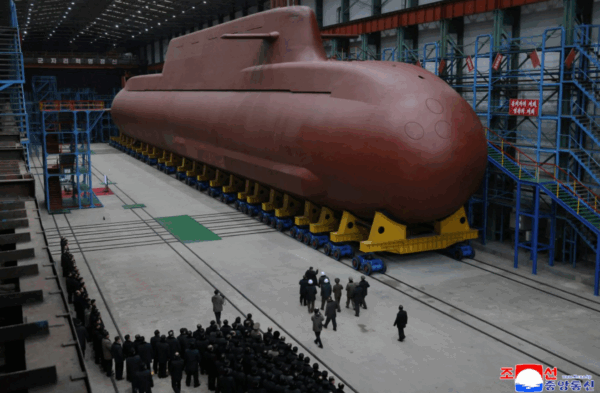
Therefore, the potential of Australia deploying nuclear submarines in the waters around the Korean Peninsula likely further motivated North Korea to begin developing its own. In December 2025, KCNA released images of Kim Jong Un and his daughter, Kim Ju Ae, inspecting an 8,700-ton unnamed nuclear submarine equal to the displacement of Australia’s proposed Virginia-class SSNs. In 2023 and 2024, Pyongyang launched the Hero Kim Kun-ok submarine, designed to carry tactical nuclear payloads for “core underwater offensive means” and a new Amnok-class Corvette armed with RBU-1,200 anti-submarine rocket launchers.
The development of nuclear submarines will allow the Korean People’s Navy (KPN) to escort North Korean vessels in the Yellow Sea and beyond, which would help deter interdiction. North Korea’s protection of its naval vessels in maritime East Asia could be further aided by its ally, China, which has previously interrupted Australia’s sanctions enforcement operations by deploying naval helicopters and destroyers in the Yellow and East China seas.
AUKUS and North Korea’s “Comprehensive Strategic Partnership” With Russia
Prior to 2025, it was unknown whether North Korea possessed the technology to develop nuclear propulsion. However, the rapid progress in the development of the unnamed 8,700-ton nuclear submarine suggests that Pyongyang may be receiving outside help. Naval experts have pointed to the likelihood that Russia has been conducting undisclosed technology transfers under the 2024 Comprehensive Strategic Partnership (CSP) agreement, which would allow North Korea to reverse engineer the reactor components to propel the submarine.
The North Korea-Russia CSP differs from traditional strategic partnership agreements by including a mutual defense clause and provisions for military technology transfers, which makes it more akin to a formal alliance. Article 4 of the CSP states that if “one of the parties falls into a state of war, the other party shall provide military and other assistance using all the means it possesses.” The “other assistance” category firmly encompasses any transfer of technology by Russia to North Korea to help it develop a blue water navy.
North Korea’s stated fear of a “multilayered ring of nuclear encirclement” provides a strong rationale for Pyongyang to enter an alliance with Russia. Although state-run media amplifies the nuclear dimension of cooperation between the United States and its allies and partners to justify its nuclear deterrent, North Korea’s rhetoric reflects a real shift in the U.S. “hub and spoke” alliance system toward a more decentralized latticework-like structure that prioritizes burden sharing. U.S. President Donald Trump’s mistreatment of Indo-Pacific allies and partners has undermined this, though, much to Pyongyang’s benefit.
North Korea’s leadership has emphasized the perceived imminency of war elicited by shifting U.S. alliances and partnerships, too. Before the North Korea-Russia CSP was signed, Kim warned at the ruling Korean Workers’ Party Plenum in December 2023 that “war is approaching us as a realistic entity, not as an abstract concept.” Therefore, Kim’s decision to send the Korean People’s Army (KPA) to the frontlines in Ukraine was not simply for financial gain, but also to establish reciprocity with Russia while providing the KPA with a modern battlefield experience to prepare for what Pyongyang sees as a looming war around the Korean Peninsula.
The Verdict
Both Pyongyang’s rhetoric and actions suggest that AUKUS has partially informed its shifting grand strategy. This is most evident in the KPN’s modernization and military cooperation with Russia. When understanding North Korea’s heightened activity, AUKUS should be viewed as operating in tandem with the Japan-South Korea-U.S. trilateral and the bilateral cooperation between Japan and the United States, Japan and South Korea, and Japan and Australia. These deepening minilaterals, alliances, and strategic partnerships are taken by Pyongyang as evidence of an emerging Asian NATO, which differs considerably from the view of the U.S. and its Indo-Pacific allies and partners.
North Korea’s view of AUKUS should also serve as a reminder to Australian strategists that Pyongyang does pay attention to Canberra’s decisions. Although North Korean propaganda portrays Australia as the United States’ “deputy sheriff,” the fact that Canberra now factors more into Pyongyang’s calculations demonstrates the agency that Australia possesses in shaping the strategic environment in the Western Pacific.
However, as deterrence increases on both sides, the room for engagement between Pyongyang and Canberra has shrunk, which heightens the potential for miscalculation if their nuclear submarines come into increased contact on the high seas.
