

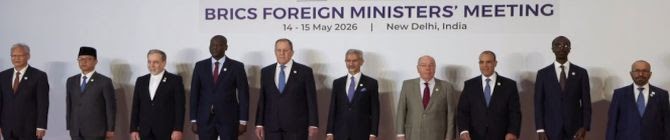
The BRICS Foreign Ministers’ Meeting has formally opened in New Delhi today, with External Affairs Minister S. Jaishankar welcoming Russian Foreign Minister Sergey Lavrov, Iranian Foreign Minister Abbas Araghchi, Indonesian Foreign Minister Sugiono and other senior leaders.
The gathering at Bharat Mandapam is a major diplomatic engagement under India’s 2026 chairship, focusing on global conflicts, economic cooperation, and multilateral reforms.
The meeting began with Jaishankar receiving Lavrov at Bharat Mandapam, marking a key bilateral and multilateral moment. He also welcomed Araghchi, Sugiono, South Africa’s Ronald Lamola, Ethiopia’s Gedion Timothewos Hessebon, and UAE’s Minister of State Khalifa Shaheen Al Marar.
China was represented by Ambassador Xu Feihong, as Foreign Minister Wang Yi remained in Beijing during US President Donald Trump’s state visit. The family photograph taken earlier in the day symbolised unity and collective purpose among the participating nations.
The expanded BRICS bloc now includes eleven members: Brazil, Russia, India, China, South Africa, Egypt, Ethiopia, Iran, Saudi Arabia, the UAE, and Indonesia. Partner nations such as Malaysia, Thailand, Cuba, Vietnam, Belarus and Kazakhstan also sent delegations, underscoring the grouping’s growing reach and influence. The ministers are scheduled to call on Prime Minister Narendra Modi during the course of the summit, further elevating the significance of the gathering.
Jaishankar, in his opening remarks, emphasised the importance of dialogue and diplomacy amid global uncertainty. He noted that the meeting comes at a time of considerable flux in international relations, with ongoing conflicts, economic disruptions, and climate challenges shaping the global landscape.
He underlined the need for resilient supply chains, diversified markets, and equitable climate action, stressing that BRICS must play a constructive and stabilising role for emerging economies. He also highlighted the urgency of addressing energy, food, fertiliser and health security, all of which are pressing concerns for the Global South.
Iranian Foreign Minister Abbas Araghchi used the platform to call upon BRICS to condemn US and Israeli actions, urging the bloc to act against “warmongering and impunity.” His intervention reflected the deepening divisions within the grouping over the ongoing war in Iran and broader tensions in West Asia.
The crisis in the Strait of Hormuz, which has disrupted global energy flows, is expected to dominate deliberations, with India attempting to balance its ties between Iran, the UAE and other stakeholders.
Russian Foreign Minister Sergey Lavrov reaffirmed Moscow’s commitment to fulfilling energy supply agreements with India, highlighting the strategic depth of the bilateral partnership. He also stressed the importance of BRICS as a counterbalance to Western-led institutions such as the G7, noting that the bloc must continue to strengthen cooperation and strategic partnerships.
The meeting is taking place under India’s theme of “Building for Resilience, Innovation, Cooperation and Sustainability,” which reflects a people-centric and humanity-first approach. This is India’s fourth presidency of BRICS, having previously hosted summits in 2012, 2016 and 2021.
The New Delhi ministerial serves as a precursor to the 18th BRICS Summit scheduled for September 2026, where leaders are expected to take forward the discussions initiated at this gathering.
New Delhi has thus become the focal point of international diplomacy from 14 to 15 May, with the BRICS Foreign Ministers’ Meeting providing a platform for emerging economies to articulate their perspectives on global governance, security, trade and development challenges.
The symbolic family photograph and the substantive agenda together underscore the bloc’s ambition to consolidate its role as a voice of the Global South in an increasingly fragmented world.
ANI
