

WASHINGTON — Under the Defense Department’s nearly $1.5 trillion fiscal 2027 budget request, the Army would have almost $1 billion in procurement funding to spend on small counter unmanned aerial system technology (cUAS) capabilities — nearly double the amount the service was granted in its enacted budget for FY26.
Should Congress approve it, the FY27 budget would set aside $994 million in total for small cUAS, with all of that sum coming from discretionary funding. The FY26 enacted budget included $596 million for the same line item with $336 deriving from discretionary spending and $260 coming from mandatory, or reconciliation, funding.
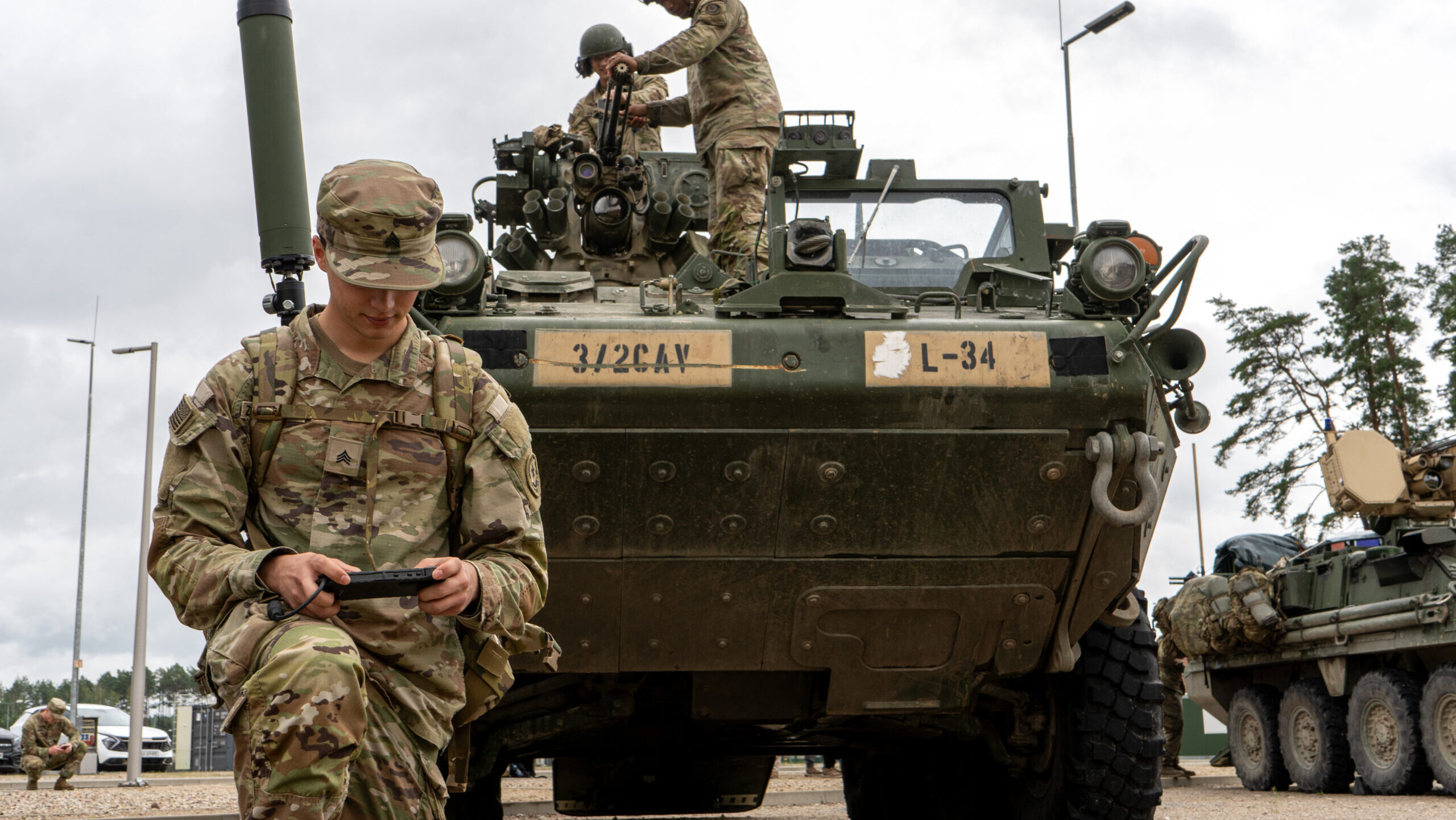
The Army is taking the approach of having a “systems of systems” architecture for its small counter-drone capabilities, per budget justification books. Such an architecture will include expeditionary and mobile platforms, sensors, effectors, electronic warfare components and more to make up an interoperable fire control system.
There are eight areas where the Army plans to spend the almost $1 billion. The largest chunk is for “operational” small cUAS capabilities at $414 million. This includes broad funding for c-UAS batteries and “expeditionary” mobile platforms and sensors.
Next, the Army plans to spend $165 million on “fixed” capabilities, which, according to the justification books, are any “additional” joint force and Army counter-drone capabilities needed for homeland defense and specified fixed sites defense, also known as base or installation defense. This line also includes funding for logistics support efforts for small cUAS.
The topic of using counter-drone measures to protect bases and installations has been a hot one in recent months as the Defense Department has struggled to find common ground with other federal agencies, such as the Federal Aviation Administration, on what capabilities can be used to shoot down drones that appear to act as a security threat to such locations.
The service plans to spend $132 million on what it calls “effectors,” and though there are sparse details in the justification books on what such capabilities really are, the Army states it is planning to procure 800 kinetic capabilities, 29 non-kinetic capabilities and 24 of the Next Generation cUAS Missile (NGCM). The NGCM, also known as the Freedom Eagle-1, is a kinetic platform made by Aerovironment.
Next, the Army plans to spend $108 million on squad- and individual soldier-level small cUAS capabilities. These include “dismounted, handheld, and wearable systems” for protection against Group 1 and Group 2 UAS threats, per the books. The service also plans to spend $80 million on small cUAS for brigade and below elements, which similar to the squad- and individual soldier-level line, includes capabilities for fighting off Group 1 and 2 drones.
Directed energy, a growing cUAS capability within the service, is set to receive $66 million, to include two Enduring High Energy Laser (E-HEL) systems. This line item is a “rapid prototyping effort” and will be interoperable with the Army’s Integrated Battle Command System-Maneuver, the books read.
The service is also looking to spend $24 million on expeditionary launcher systems and mobile launcher systems. Though details for the effort were scant in the justification documents, they noted the service is looking to acquire 12 expeditionary launcher systems and 10 mobile launcher systems for one service cUAS battery.
Lastly, the Army is looking to spend almost $5 million for the small cUAS “ground readiness” lines which provides funding for logistics support for the Army’s Family of Counter Unmanned Aircraft Systems (FoCUS) program that was procured in prior years. The program oversees the Army’s development of an agnostic, medium-range small cUAS system.
The uptick in small counter-drone funding comes as the world continues to see inexpensive, small first-person-view drones taking out muti-million-dollar tanks on the modern battlefield, such as in the Ukraine-Russia war. The Iran conflict has also shown the importance of emerging, cheap cUAS capabilities. For example, interceptors, like the Patriot Advanced Capability-3 (PAC-3) Missile Segment Enhancement, can cost between $3 million and $4 million, but are reportedly being used to shoot down Iranian-made Shahed drones that cost just $4,000 in Operation Epic Fury.
