

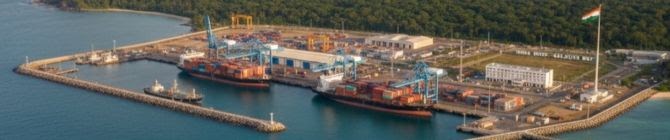
India’s ₹90,000‑crore Great Nicobar Island Project is being positioned as one of the most ambitious maritime and economic undertakings in recent decades, combining strategic military imperatives with long‑term commercial benefits.
Spread across 166 square kilometres in the Andaman and Nicobar Islands, the initiative encompasses the development of a major transhipment port, an international airport, and supporting logistics and urban infrastructure. Its location near the Strait of Malacca, one of the busiest maritime trade corridors in the world, makes it central to India’s Indo‑Pacific strategy.
The transhipment port is planned with an eventual handling capacity of 16 million containers annually, with the first phase expected to be commissioned by 2028 at a cost of ₹18,000 crore.
This initial stage is projected to handle more than 4 million containers per year, reducing India’s reliance on foreign hubs such as Colombo, Singapore and Dubai. By strengthening supply chain resilience and cutting logistical inefficiencies, the port will enhance India’s role in global shipping networks and trade flows.
The strategic importance of the project is closely tied to the Malacca Strait’s role in global energy and trade. According to the US Energy Information Administration, the strait is the world’s largest oil transit chokepoint by volume, with around 23.2 million barrels per day passing through in the first half of 2025, accounting for nearly 29% of global maritime oil flows.
Crude oil makes up more than 70% of shipments, with China alone accounting for 48% of import volumes. India’s proximity to this chokepoint provides a critical vantage point for monitoring maritime trade and naval movements, reinforcing its ability to safeguard national interests.
Defence veterans have strongly backed the project, emphasising its dual military and economic significance. Former Air Chief Marshal RKS Bhadauria described Great Nicobar as vital for national security, economic growth and military presence, noting that nearly 80% of China’s oil imports and a large share of its cargo pass through the Malacca Strait.
He compared its importance to the Strait of Hormuz, highlighting the need for India to establish a strong base in the region. Major General (Retd.) GS Rawat echoed this view, stressing the operational and strategic positioning of the island, while Lt Gen (Retd.) Rajeev Chaudhry warned that delays caused by environmental opposition or international pressure could benefit China.
He pointed to Beijing’s “String of Pearls” strategy, involving ports such as Gwadar, Hambantota and Kyaukpyu, and argued that a strong hub at Campbell Bay and Galathea Bay would counterbalance these efforts.
Economically, the project represents a decisive shift in India’s maritime strategy, which has historically underutilised island territories while focusing on continental security. By creating a self‑reliant transshipment hub, India aims to reduce dependence on foreign ports, strengthen its trade infrastructure, and reinforce its position as a strategic bridge between South Asia and Southeast Asia.
The integration of advanced logistics systems, AI‑driven supply chains, smart port infrastructure and sustainable energy solutions is expected to modernise India’s maritime capabilities and enhance connectivity across the Indo‑Pacific.
At the same time, the initiative has sparked concerns over environmental sustainability and the impact on indigenous communities. Great Nicobar is home to ecologically sensitive habitats and rich biodiversity, raising questions about balancing infrastructure development with conservation.
Experts have stressed the importance of transparent environmental assessments, mitigation measures and meaningful engagement with local communities to ensure sustainable planning and the preservation of tribal heritage.
The project’s success will depend heavily on execution, governance and cost management. While proponents argue that delays in strengthening India’s maritime infrastructure could carry strategic consequences in a rapidly changing global order, critics highlight the risks of rising costs and environmental damage.
If implemented effectively, however, the Great Nicobar Project could emerge as a symbol of India’s maritime expansion, reinforcing its strategic role in the Indo‑Pacific and providing both military leverage and economic resilience.
Agencies
