

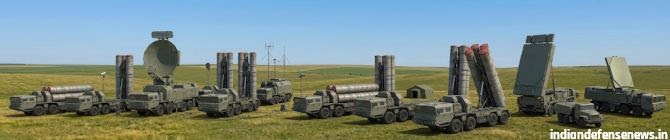
Russia has made an unprecedented offer to India: joint production of the S‑500 Prometheus air defence system with technology transfer and re‑export rights.
This would give India access to a capability unmatched by its current arsenal, but New Delhi’s hesitation reflects its parallel investment in Project Kusha, an indigenous long‑range air defence system designed to reach 350–400 km.
Russia’s S‑500 Prometheus represents the most advanced evolution of air and missile defence technology in Moscow’s arsenal. It offers an engagement range of 600 km, nearly double that of the S‑400 Triumf, and an altitude coverage of 200 km, extending into near‑space.
The system is designed to intercept hypersonic missiles travelling at Mach 7, stealth aircraft, and even low‑Earth‑orbit satellites. Its reaction time of 3–4 seconds is a dramatic improvement over the S‑400’s 9–10 seconds, enabling faster neutralisation of threats.
Using advanced Gallium Nitride radars and hit‑to‑kill interceptors such as the 77N6‑N, the S‑500 can track and engage multiple targets simultaneously across all categories, from drones to intercontinental ballistic missiles.
Russia’s offer to India is unique. No other country has been extended joint production rights, technology transfer, and re‑export privileges for the S‑500. This reflects Moscow’s intent to deepen strategic defence ties with New Delhi, counterbalance India’s growing partnership with the United States, and secure its market share in South Asia.
Joint production would also align with India’s ‘Make in India’ and ‘Atmanirbhar Bharat’ initiatives, potentially involving Bharat Electronics Limited and Bharat Dynamics Limited in manufacturing, creating jobs and strengthening India’s defence industrial base.
Yet India has not accepted the offer. The hesitation is deliberate and strategic. India is advancing Project Kusha, officially known as the Extended Range Air Defence System (ERADS), being developed by the Defence Research and Development Organisation. Project Kusha is designed to provide a multi‑layered shield with three interceptor variants: one engaging targets at 150 km, another at 250 km, and the longest‑range interceptor neutralising threats at 350–400 km.
It will be capable of intercepting fighter aircraft, cruise missiles, drones, loitering munitions, and certain ballistic missile threats. The system will integrate with the Indian Air Force’s Integrated Air Command and Control System (IACCS), ensuring seamless coordination with existing radar networks and enabling automated threat prioritisation and simultaneous tracking of multiple targets. A naval version is also planned, capable of intercepting anti‑ship ballistic missiles at speeds up to Mach 7.
India’s caution stems from several factors. First, CAATSA sanctions risk looms large, as deeper engagement with Russian defence technology could trigger American diplomatic pressure.
Second, the cost and sensitivity of technology transfer remain uncertain, with Russia unlikely to share its most advanced secrets fully.
Third, India’s long‑term strategy is to reduce dependence on foreign systems and achieve strategic autonomy through indigenous platforms like Project Kusha, which promises lower lifecycle costs and domestic control over upgrades and maintenance.
The decision thus reflects a balancing act. Accepting Russia’s offer would give India immediate access to near‑space defence and hypersonic interception capabilities, strengthening deterrence against China’s DF‑series missiles and Pakistan’s evolving arsenal.
But prioritising Project Kusha would consolidate India’s self‑reliance, reduce vulnerability to external pressures, and establish India as a future exporter of advanced air defence systems.
Agencies
