

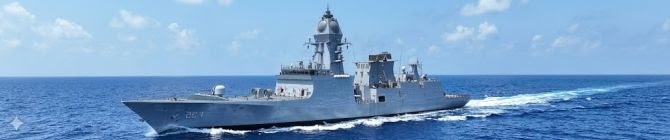
India is set to commission three indigenous naval vessels – INS Dunagiri, INS Agray and INS Sanshodhak – built by Garden Reach Shipbuilders & Engineers (GRSE), marking a significant boost to its maritime edge in the Indian Ocean Region amid China’s expanding presence. Dunagiri, a stealth frigate under Project 17A, will be commissioned within a month, while Agray and Sanshodhak will join simultaneously.
The Indian Navy’s latest induction drive underscores its determination to strengthen operational readiness and self-reliance in warship construction. The three vessels, delivered recently by GRSE, represent different mission profiles: a stealth frigate for multirole combat, an anti-submarine warfare shallow water craft for coastal defence, and a survey ship for hydrographic operations.
Together, they enhance India’s ability to secure sea lanes, conduct surveillance, and project power across the Indian Ocean.
INS Dunagiri is the fifth stealth frigate under the ₹45,000‑crore Project 17A program, which is delivering seven Nilgiri-class warships as successors to the Shivalik-class. With around 75% indigenous content, these frigates are equipped with BrahMos supersonic cruise missiles, Barak‑8 surface-to-air missiles, MF‑STAR radar, and advanced anti-submarine warfare systems.
The 149‑metre vessel displaces 6,670 tons, reaches speeds of 28 knots, and carries a crew of 225. It inherits the legacy of the earlier Leander-class INS Dunagiri, decommissioned in 2010, and is expected to be commissioned within weeks. The remaining two frigates, Mahendragiri and Vindhyagiri, will follow later this year, completing the Project 17A series.
INS Agray is the fourth of eight anti-submarine warfare shallow water craft (ASW‑SWC) being built by GRSE. Designed for operations in coastal waters and littoral zones, the 77‑metre vessel is capable of sub-surface surveillance, search and attack missions, and can coordinate with aircraft for extended reach. Its role is critical in countering submarine threats close to India’s shores, particularly given the increasing deployment of Chinese submarines in the Indian Ocean.
INS Sanshodhak is a large survey vessel designed to conduct hydrographic surveys, chart coastal and deep-sea waters, and support navigation safety. It will also assist in oceanographic research and provide logistical support for naval operations. The induction of Sanshodhak strengthens India’s hydrographic fleet, which is vital for both military planning and civilian maritime activities.
The commissioning of these vessels comes at a time when China has steadily expanded its maritime presence in the Indian Ocean, deploying patrol vessels, submarines, and research ships. India’s response has been to accelerate its naval modernisation, focusing on indigenous platforms that combine advanced technology with self-reliance.
Project 17A frigates, with modular construction and stealth features, represent a generational leap in warship design, while the ASW‑SWCs and survey vessels add depth to coastal defence and maritime domain awareness.
Together, Dunagiri, Agray and Sanshodhak reflect India’s comprehensive approach to naval capability – combining blue-water combat readiness, coastal defence, and hydrographic expertise. Their induction not only enhances operational versatility but also demonstrates the growing maturity of India’s shipbuilding industry, with GRSE and Mazagon Dock Shipbuilders playing pivotal roles.
This expansion ensures the Navy remains prepared for a contested maritime environment and capable of safeguarding national interests across the Indian Ocean Region.
Agencies
