

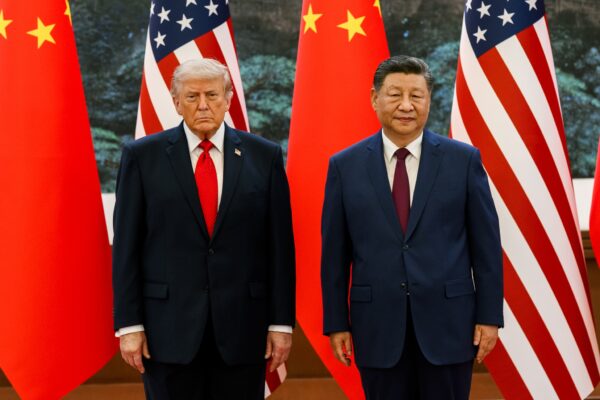
The apparent closeness between U.S. President Donald Trump and Chinese President Xi Jinping at their recent Beijing summit – along with Trump’s deferential posture toward Xi – sent shockwaves through Tokyo. This may one day be remembered in Japan as the “Trump Shock.”
For Japanese policymakers, the summit revived memories of the 1971 “Nixon Shock,” when Washington began the process of normalizing relations with Beijing and Japan learned of the rapprochement only after the fact. More than half a century later, Tokyo is once again anxiously watching the world’s two most powerful leaders redefine their relationship increasingly in G-2 terms – while Japan fears being sidelined once again.
The anxiety is especially acute for Prime Minister Takaichi Sanae.
No modern Japanese leader has adopted a more explicitly pro-Taiwan or hawkish China posture than Takaichi. Echoing the late Abe Shinzo’s famous formulation that “a Taiwan contingency is a Japanese contingency,” she argued in the Diet last November that a Chinese attack on Taiwan could constitute a “survival-threatening situation” under Japan’s security legislation.
From Beijing’s perspective, such remarks crossed a political red line, as Taiwan is regarded by China as “the core of its core interests.”
Relations deteriorated sharply in the months that followed. Beijing imposed economic countermeasures – reducing flights, suspending seafood imports, and tightening rare earth export controls – while cooling political exchanges with Tokyo.
Yet through it all, Takaichi held firm. The broader assumption underpinning her position was that Washington would continue supporting Japan’s harder line on Taiwan.
That assumption now appears increasingly uncertain.
Before departing for Beijing, Trump publicly questioned whether Japan had become too forward-leaning on Taiwan.
“It’s a little bit of a difference. But, you know, there’s a lot of support for Taiwan, from Japan and from countries from that area,” Trump said at the White House on May 11, referring to Tokyo’s increasingly robust support for Taipei, including Takaichi’s own remarks regarding a Taiwan contingency. At the same time, he downplayed the likelihood of a cross-strait conflict.
In Tokyo, the comments were widely interpreted as a sign that Trump was growing uncomfortable with Takaichi’s harder Taiwan posture. That perception was reinforced by earlier reports that, during a phone call with Takaichi on November 25, 2025, Trump privately cautioned Japan against provoking China unnecessarily.
Ahead of the summit, Trump also stated that he intended to discuss future U.S. arms sales to Taiwan with Xi. He later acknowledged the issue had been discussed “in great detail” during the talks — immediately triggering concern in both Taipei and Tokyo.
Since 1982, the “Six Assurances” have underpinned Washington’s unofficial commitment to Taiwan, including a pledge not to consult Beijing in advance on arms sales to Taipei. Together with the Taiwan Relations Act, those assurances have underpinned decades of deterrence and strategic ambiguity in the Taiwan Strait.
If Washington were to move even informally toward prior consultation with Beijing over Taiwan arms sales, many in Asia would interpret it as a significant shift in long-standing U.S. policy.
Following the summit, Trump held only a brief phone call with Takaichi during his return flight from Beijing. Although both governments publicly described the exchange positively, it did little to calm concerns inside Tokyo that Japan may not have been fully consulted regarding the substance of the summit talks. For many in Japan, the call appeared less like close alliance coordination than an exercise in political damage control.
Taiwan sits at the center of the First Island Chain – the arc stretching from Japan through Taiwan to the Philippines that has long formed the strategic backbone of U.S. maritime presence in the Western Pacific. Japan’s westernmost inhabited island, Yonaguni, lies just over 100 kilometers from Taiwan.
Were Taiwan to come under Beijing’s strategic orbit, China’s military reach would extend dramatically closer to Okinawa and Japan’s southwestern islands. Kadena Air Base would effectively sit on the front line of a transformed regional balance. Japan’s sea lanes, through which much of its energy imports flow, would also become substantially more exposed.
This explains why Japanese strategists increasingly frame Taiwan’s security as inseparable from Japan’s own national defense.
It also explains why Trump’s recent remarks reverberated so strongly inside Japan’s policy establishment.
There is a phrase that periodically resurfaces in Tokyo diplomatic circles: “Japan passing.” It refers to the recurring fear that Japan could be bypassed as Washington and Beijing negotiate the regional order over Tokyo’s head.
The defining precedent remains the Nixon administration’s opening to China in the early 1970s. Japan was not meaningfully consulted and found itself scrambling to adapt to a geopolitical realignment it had little role in shaping. Japanese strategists have long observed a recurring historical pattern: when Sino-American relations improve, Sino-Japanese relations often deteriorate.
A growing number of Japanese analysts now fear that history may be rhyming.
Trump’s diplomatic style reinforces that anxiety. Unlike alliance-focused U.S. administrations of the postwar era, Trump has consistently emphasized bilateral dealmaking, personal diplomacy with authoritarian leaders, and transactional flexibility. From Tokyo’s perspective, that creates uncertainty about whether alliance coordination remains the organizing principle of U.S. Asia policy – or whether it has become merely one variable in a broader geopolitical bargain.
Washington also has strong incentives to stabilize its relationship with Beijing. Simultaneous tensions involving Iran, Russia, global trade, and energy prices have increased pressure on the United States to avoid confrontation on multiple fronts. China, meanwhile, retains leverage through its relationships with both Moscow and Tehran, as well as through its central role in global supply chains.
In that broader geopolitical context, Taiwan risks becoming part of a much larger strategic negotiation.
Some Japanese commentators have begun using unusually blunt language. Takaichi, they argue, may have had “the ladder kicked away” by Washington.
The concern is not simply that the United States is engaging China. The deeper fear is that Japan could find itself strategically exposed after antagonizing Beijing – having hardened its Taiwan posture under the assumption of strong American backing, only to discover that Washington itself may now be pursuing a more pragmatic accommodation with Xi.
Japan remains economically dependent on China and strategically dependent on the United States. Managing that dual dependence has always required careful diplomacy. It becomes far harder if Washington and Beijing seek a more stable relationship while Japan’s own ties with China continue deteriorating.
For Takaichi personally, the stakes are especially high. Her political identity is now closely tied to a firm Taiwan stance. If Washington visibly softens toward Beijing, she faces an uncomfortable choice: reverse course and absorb the domestic political cost, or hold firm and risk strategic isolation.
Neither option is comfortable. And that, for many in Tokyo, is precisely the problem – a trap of Japan’s own making, sprung by an ally it cannot afford to doubt.
