

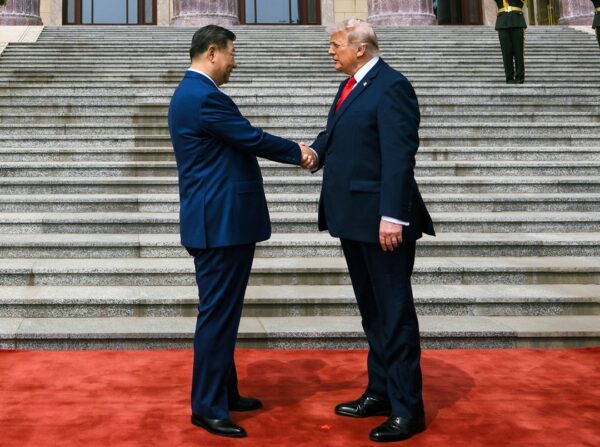
At the recently concluded China-U.S. summit in Beijing, Chinese President Xi Jinping called for building a “constructive China-U.S. relationship of strategic stability,” which would provide “strategic guidance” for bilateral ties “for the next three years and beyond.” Washington responded to this formulation positively, with the White House readout confirming that both sides agreed to build a “constructive relationship of strategic stability on the basis of fairness and reciprocity.”
So what exactly is “constructive relationship of strategic stability” and what are its implications for India, which views itself as a key player in shaping the emerging global order?
According to China’s definition, the framework has four components, namely “positive stability with cooperation as the mainstay,” “sound stability with moderate competition,” “constant stability with manageable differences,” and “enduring stability with promises of peace.” In simple terms, the framework acknowledges long-term competition is inevitable but strives to keep it manageable. This was reaffirmed in Chinese Foreign Minister Wang Yi’s description of the framework as “sound stability with moderate competition.”
Although such framework formulations to describe relations between the world’s two largest economies are not new, this version carries immense significance, especially at a time when the global order is in flux. First, by championing the idea of a “constructive China-U.S. relationship,” Beijing is decisively shifting away from the G-2 narrative — an idea originally proposed by U.S. economist C. Fred Bergsten in 2005, which advocated a China-U.S. duopoly to stabilize global markets and tackle issues of global concern. The idea witnessed a revival in October 2025, with Trump’s Truth Social post that “THE G2 WILL BE CONVENING SHORTLY!” just before his meeting with Xi in Busan, South Korea. Following the Beijing summit, Trump again referred to his meeting with Xi as a defining “G-2” moment.
Beijing, however, has consistently dismissed this idea. At a press conference on the sidelines of the National People’s Congress in Beijing on March 8, Wang Yi stated that China does not “subscribe to the logic of major power co-governance.”
Second, this framework offers a counter to the Western conceptualization of “strategic competition,” which has long dominated U.S. thinking on China. It is Beijing’s clearest official acknowledgement of the competitive dimension in bilateral relations, while carefully avoiding Washington’s competition-first frame.
For India, these dynamics have mixed implications. On the one hand, any form of China-U.S. rapprochement, framed in the G-2 language, reduces the space for strategic maneuvering for New Delhi, since countering China has always been central to the logic of the India-U.S. strategic partnership. This became explicit in the 2018 U.S. strategic framework for the Indo-Pacific document formulated under the first Trump administration, which advocated a “strong India” as a “counter balance to China” in the region. If Washington does not see China as a threat in the Indo-Pacific — instead treating it as a peer — groupings such as the Quad risk becoming completely irrelevant, leaving the Indo-Pacific security architecture in disarray.
On the other hand, a modest easing of tensions and a possible trade truce is good news for the global economy. Currently, the Indian economy is among the worst hit by the ongoing Iran war, with the rupee declining 5.5 percent since the United States and Israel attacked Iran on February 28. As the world’s two largest economies, volatility in China-U.S. ties inevitably impacts global market confidence and the stability of industrial and supply chains. Improved economic relations ensure secure supply chains and ease volatility in international commodity markets. This is especially beneficial for the Indian economy, which remains heavily reliant on the export of raw materials.
Some argue that a China-U.S. trade truce could undercut India’s appeal as an alternative manufacturing hub since Trump announced high tariffs on Chinese imports, paving the way for Apple’s decision in 2025 to manufacture most U.S.-bound iPhones in India rather than China. However, this argument overlooks a key global economic dynamic — supply chain diversification is a fundamental risk-management imperative that remains crucial regardless of China-U.S. relations. A closer look at Apple’s supply chain data reveals that Apple had been reducing exposure to Chinese manufacturing since at least 2019. In the five years to 2019, China was the primary location of 44 percent to 47 percent of its suppliers’ production sites, but that fell to 41 percent in 2020, and 36 percent in 2021. Apple’s strategic shift toward India was motivated by the competitive advantages that manufacturing in India offers, which are not tariff-dependent.
New Delhi will be closely monitoring whether this renewed China-U.S. commitment to cooperation translates to any effective resolution of the prolonged effective closure of the Strait of Hormuz, which is driving up global oil prices and placing enormous strain on the Indian economy. According to the Chinese and U.S. readouts following the meeting, both sides did discuss the Iran war, but the statements about what was said indicate subtle differences. Nevertheless, as things currently stand, China is among the few countries with significant leverage over both the United States and Iran, and the Trump-Xi meeting may be the starting point for Beijing to play a direct, constructive role in encouraging a solution to the closure of the Strait and to bring back stability of global energy supply.
For New Delhi, a less confrontational China-U.S. relationship does not fundamentally alter the dynamics of the China-India-U.S. triangle. As things currently stand, Trump’s ambitions for a G-2 remain elusive, which leaves New Delhi enough room to maneuver diplomatically.
In the near term, India will likely continue strengthening ties with Washington, while continuing to stabilize relations with Beijing. However, in the long run, it may become more important for New Delhi to expand its independent influence if it seeks to shape, rather than merely observe, the emerging new global order.
