

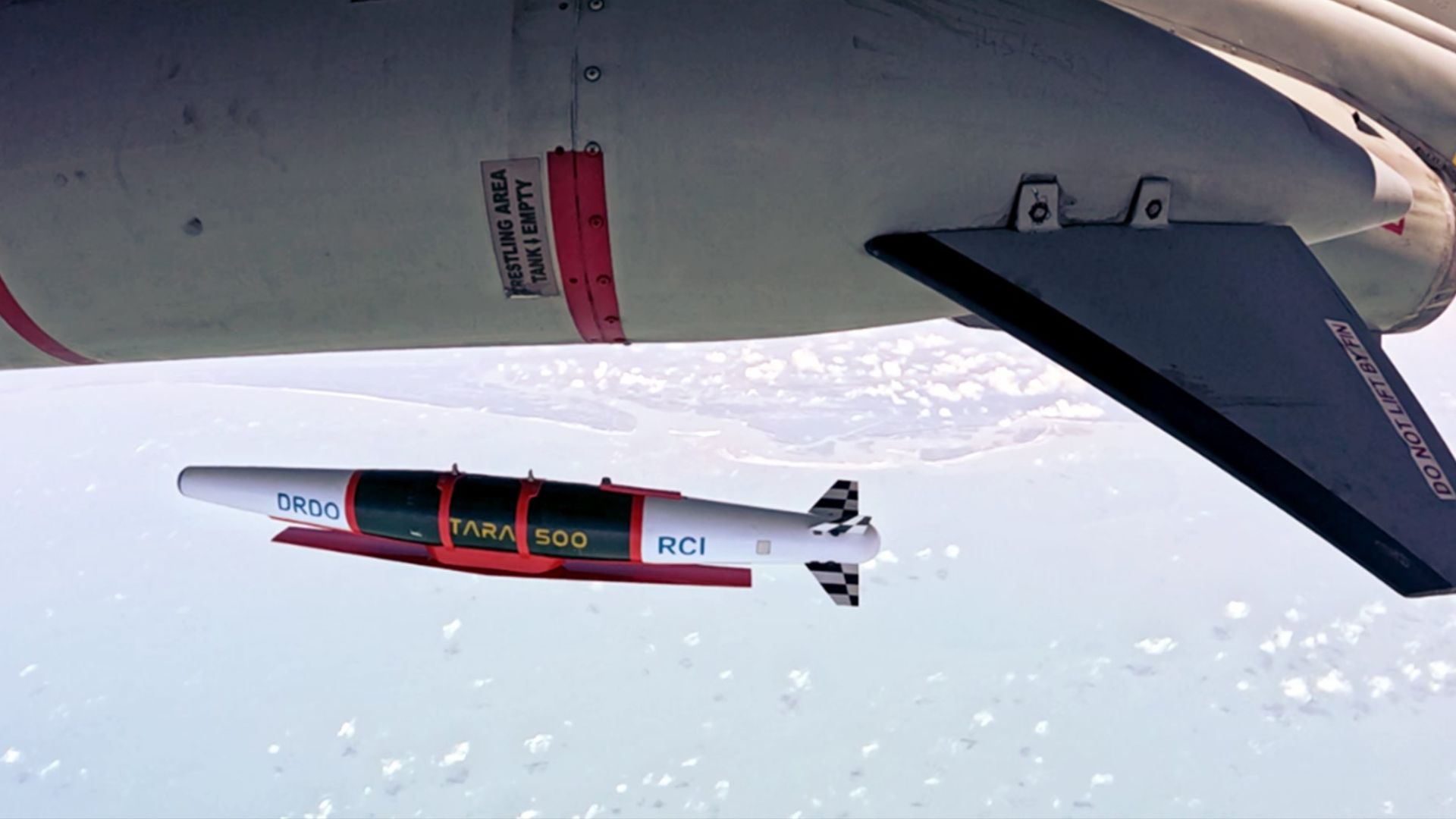
India’s Defence Research and Development Organization (DRDO) and the Indian Air Force (IAF) successfully conducted the maiden flight trial of the Tactical Advanced Range Augmentation (TARA) weapon off the coast of Odisha on 7 May, according to a Press Information Bureau (PIB) release.
The PIB described TARA as “the modular range extension kit” and “India’s first indigenous glide weapon system to convert unguided warheads into precision guided weapons.”
Defence Minister Rajnath Singh congratulated DRDO, the IAF, and the industry partners involved, describing the test as “a significant development in advancing India’s indigenous defence capabilities.”
India’s Defence Strategy, Capabilities, and Procurement Patterns
Analysis of India’s defence posture, including doctrine, acquisitions, and industrial integration.
RCI Hyderabad’s Modular Glide Weapon Kit
TARA is a bolt-on kit that converts an existing unguided bomb into a precision-guided glide weapon – extending the bomb’s range and accuracy without requiring the IAF to procure entirely new munitions.
The PIB release stated that TARA was “designed and developed by Research Centre Imarat (RCI), Hyderabad along with other DRDO laboratories to enhance the lethality and accuracy of a low-cost weapon to neutralise ground-based targets.” It added that TARA “is the first glide weapon to utilise state-of-the-art low-cost systems.”
Once attached to a standard bomb, the kit’s wings and control surfaces unfold after release, transforming the free-fall munition into a gliding smart weapon that can fly towards its target under guidance.
Janes confirmed the test involved a 500 kg bomb equipped with the TARA kit, launched from an IAF Sepecat Jaguar. Janes also reported that Adani Defence and Aerospace displayed a model of TARA at Aero India 2025, indicating the company is a Development-cum-Production Partner (DcPP) for the program.
TARA Performance Envelope and Guidance
According to data presented by Adani Defence at Aero India 2025 and confirmed by Janes and SSBCrack, the TARA kit weighs approximately 98 kg, and when attached to a 250 kg bomb, the combined assembly weighs roughly 308 kg. The system can be released from altitudes between 10,000 and 45,000 feet at speeds near Mach 0.8, and when deployed from approximately 42,000 feet at Mach 0.9, the effective standoff range reaches 80–100 km at a glide speed of around 650 km/h.
Guidance comes in two variants – a Satellite Aided Terminal (SAT) configuration using GPS/INS with a circular error probable (CEP) of less than 20 metres, and an Uncooled Imaging Infrared (UC-IIR) seeker variant with a CEP of less than 3 metres that provides a fire-and-forget capability against targets even if GPS signals are jammed.
Overt Defense reported that a DRDO source stated the trial “validated not only the aerodynamic performance of the winged glide configuration but also the navigation, guidance and control mechanism.”
Earlier reporting by IDRW noted that captive flight trials of TARA on the IAF Jaguar commenced in February 2025, and that three weight variants are planned – TARA 250, TARA 450, and TARA 500 – using existing DRDO general-purpose (GP) and high-speed low-drag (HSLD) bomb bodies already integrated with IAF Jaguars, Mirage 2000s, and Su-30MKIs.
DcPP Production With Adani Defence
The PIB release noted that “Development cum Production Partners (DcPP) & other Indian industries…have already started the production activity.” This language indicates that TARA has already entered low-rate initial production ahead of full induction, a pattern consistent with how DRDO has brought the Smart Anti-Airfield Weapon (SAAW) – a 125 kg glide bomb also developed by RCI Hyderabad – from testing through to operational service.
SAAW, TARA, and Gaurav: RCI’s Precision Strike Family
TARA joins a growing family of indigenous glide weapons developed by RCI Hyderabad and partner DRDO laboratories.
The SAAW, a 125 kg precision-guided weapon with a range of up to 100 km, was inducted into the IAF and has been integrated with the Jaguar, Su-30MKI, and Hawk, with plans for the Rafale and Tejas Mk1A. A turbojet-powered variant with a projected range exceeding 200 km is under development.
The Long Range Glide Bomb (LRGB) Gaurav, a 1,000 kg class weapon, successfully completed release trials from the Su-30MKI in April 2025, demonstrating a range of close to 100 km with what the PIB described as “pin-point accuracy.” Its DcPP partners include Adani Defence Systems & Technologies and Bharat Forge.
TARA occupies the middle of this range – heavier than SAAW, lighter than Gaurav, and designed specifically as a low-cost conversion kit for existing bomb stockpiles rather than a standalone munition.
Quwa Pro
India’s Military-Industrial Trajectory, Explained
Monitoring India’s defence planning, procurement cycles, and military technology adoption.
Featured & Trusted By
Notes and Comments
The PIB’s language on TARA is worth examining closely, particularly the repeated emphasis on “low-cost” and the confirmation that production has already started – because the combination of those two facts positions TARA as an inventory-wide conversion program for the IAF’s existing bomb stockpile, and the economics of that approach are what make it consequential.
A precision-guided bomb (PGB) kit like TARA works by bolting guidance, navigation, and aerodynamic surfaces onto an unguided bomb that the IAF already owns and stores in quantity. The bomb body, the warhead fill, and the fuzing are existing inventory – the kit supplies the intelligence that turns it into a standoff weapon. The cost of the kit is a fraction of the cost of a complete guided munition procured as a new-build item, and the production ceiling is bounded only by the kit manufacturing rate, not by the availability of bomb bodies, because those are already in stock.
This is the same logic that made the US Joint Direct Attack Munition (JDAM) transformative for the US Air Force in the late 1990s – JDAM did not replace the Mk 82 and Mk 84 bomb families but converted them from unguided gravity weapons into GPS-guided precision munitions at a unit cost of approximately $25,000 per kit, enabling the USAF to field precision strike at a scale that purpose-built guided missiles could not match. The JDAM-Extended Range (JDAM-ER) added fold-out wings for glide capability, extending standoff range to 70+ km – a direct parallel to what TARA offers.
In this vein, the IDRW reporting that TARA is planned in three weight variants – 250, 450, and 500 kg – using DRDO general-purpose (GP) and high-speed low-drag (HSLD) bomb bodies already integrated across IAF Jaguars, Mirage 2000s, and Su-30MKIs is the detail that signals scale. If TARA can be fitted to bombs the IAF already carries on three of its front-line types, the kit does not require a new weapon integration program for each platform – the bomb-to-aircraft interface already exists, and the kit modifies the bomb, not the aircraft.
The DcPP (Development-cum-Production Partner) model further supports scale. The PIB stated that DcPP partners and Indian industries “have already started the production activity,” and Janes identified Adani Defence and Aerospace as a production partner based on its Aero India 2025 display. This mirrors the production model used for the Smart Anti-Airfield Weapon (SAAW), where RCI Hyderabad handled design, HAL and Bharat Dynamics Limited handled manufacturing, and a Smart Quad Rack was developed to allow a single Su-30MKI to carry between 20 and 32 SAAW units – enabling saturation attacks on enemy airfields from a single sortie.
The SAAW’s operational history validates the approach. Wikipedia’s entry on the SAAW confirms that the IAF employed the weapon during Operation Sindoor in May 2025, targeting Pakistani airfields – the first operational use of an indigenous Indian PGB. That the IAF reached for a domestically produced glide weapon in its first major combat operation since 1999 suggests the service has confidence in the RCI Hyderabad product line, and that confidence is the foundation on which TARA’s own induction path will rest.
That said, the maiden flight trial is the first step in a process that must still include further developmental testing, user evaluation trials by the IAF, and integration clearances on each platform and bomb-body combination. The planned three-variant family – TARA 250, 450, and 500 – implies a multi-year integration effort before the full fleet-wide capability is realized.
Overall, one can see TARA as the IAF’s path toward building a scalable, domestically produced PGB capability that draws on RCI Hyderabad’s structured product family – SAAW at the light end (125 kg, inducted), TARA in the middle (250–500 kg, entering production), Gaurav at the heavy end (1,000 kg, completing trials), and a turbojet-powered SAAW variant pushing the range envelope beyond 200 km. Taken together, these programs would give the IAF a layered precision strike inventory built on kit-conversion economics and domestic production lines, reducing its dependence on imported guided munitions for sustained air-to-ground operations.
