

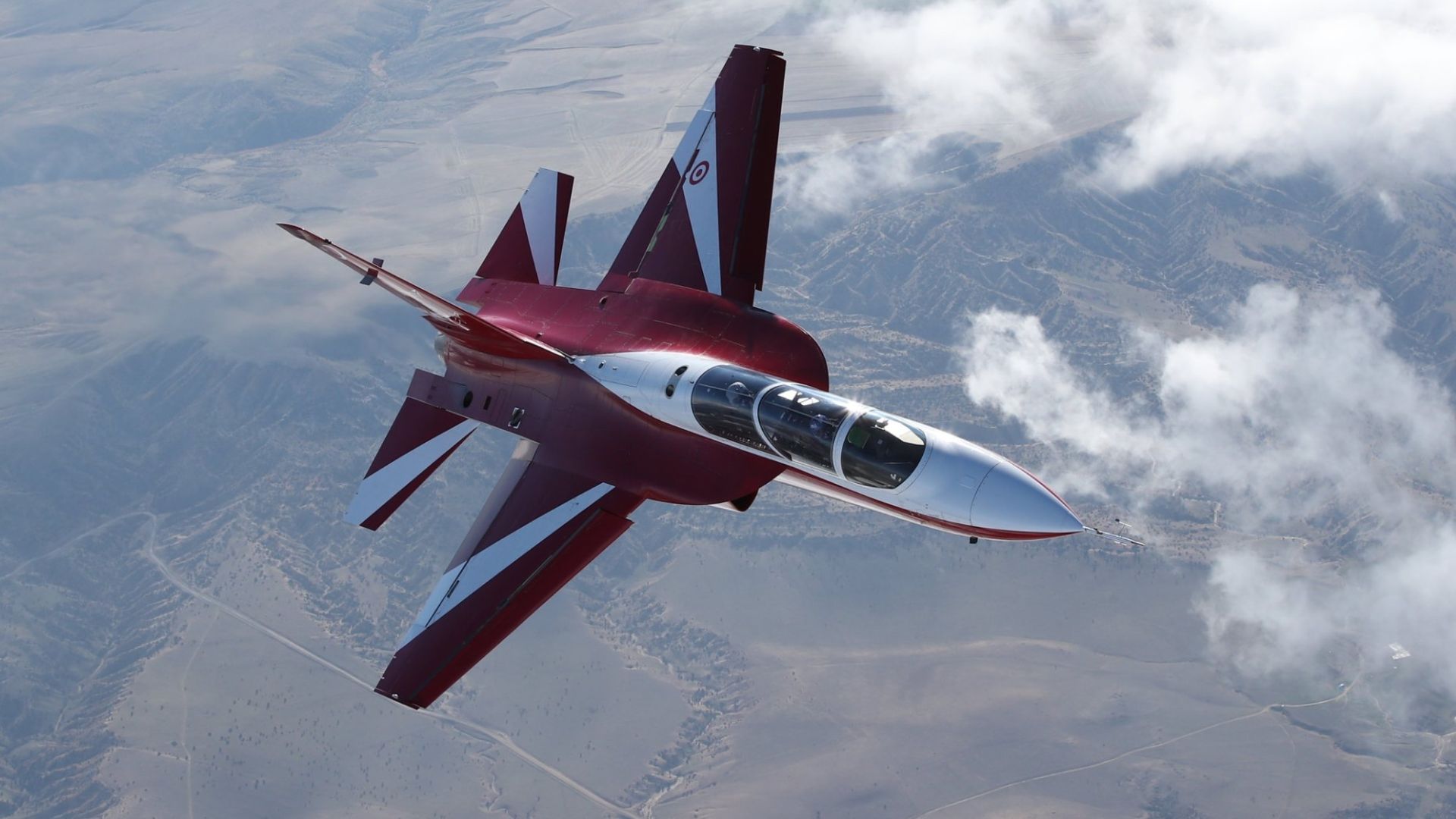
TAI has begun development of a carrier-capable Hürjet variant for the MUGEM aircraft carrier, with STOBAR/CATOBAR compatibility, reinforced landing gear, arrestor hook, and increased wing area. Spanish defence media are already examining it as an option for Madrid’s future naval air wing.
Turkish Aerospace Industries (TAI) has begun development of a carrier-capable variant of the Hürjet advanced jet trainer and light combat aircraft, with work officially starting in mid-May 2026 according to a report by Naval News citing TRT Haber.
The Naval Hürjet is being designed to operate from the flight deck of Türkiye’s MUGEM indigenous aircraft carrier – a 60,000-tonne STOBAR vessel currently under construction at the Istanbul Naval Shipyard, with a projected launch between 2027 and 2028.
According to TAI’s interactive panel at SAHA 2026, the carrier-borne Hürjet will feature STOBAR compatibility – matching MUGEM’s operating principle – with CATOBAR operation retained as a shelf upgrade in case the technology becomes available.
Key engineering modifications include a purpose-built arrestor hook system for deck landings, reinforced shock-absorbing landing gear to withstand the high-impact loads of carrier recovery, increased wing area to compensate for shorter runways and the higher base weight resulting from structural reinforcements, and full marinization of all components against saltwater corrosion and humidity.
TurDef drew a useful parallel to the differences between the F-35A and the CATOBAR-capable F-35C – noting that the changes required to allow a fighter to “regularly experience violent landing loads and need forgiving low-speed handling” are substantial and go well beyond simply adding a hook.
Track Türkiye’s Defence Expansion Across Emerging Markets
Monitor the rise of Turkish defence exports in regions traditionally dominated by Western, Russian, and Chinese suppliers.
The Naval Hürjet is envisioned as the manned component of a mixed air wing aboard MUGEM. Current plans indicate the carrier will operate up to 50 aircraft – 20 on the flight deck and 30 in the hangar – comprising the Bayraktar TB-3 UCAV, TAI Anka-3 unmanned combat aircraft, Baykar Kızılelma jet-powered unmanned fighter, and the Naval Hürjet itself.
This is a notable operational concept. Rather than pursuing a heavy carrier-borne fifth-generation fighter – a programme that would require decades of development and enormous funding – Türkiye appears to be structuring MUGEM’s air wing around a light manned platform supported by multiple unmanned tiers. The Naval Hürjet would handle training, air defence, and light strike roles, while the Kızılelma and Anka-3 provide the heavier autonomous strike capability.
Spanish defence media have already taken notice. TurDef reported that Spain-based outlet Defensa y Seguridad published an analysis examining the Naval Hürjet as a potential option for Spain’s own naval aviation plans.
Madrid is approaching the retirement of its EAV-8B Harrier II fleet from the Juan Carlos I LHD and has previously announced intentions to build a new carrier with a correspondingly new air wing.
This Spanish interest is not coincidental. The Hürjet/SAETA II trainer deal – signed on 28 April for 30 aircraft at €2.6 billion with Airbus as prime contractor and 60% Spanish industrial participation – has already established the institutional and industrial bridge between Madrid and Ankara.
A Naval Hürjet for Spain’s future carrier would represent a logical extension of that relationship.
However, the Naval Hürjet should not be compared to a stealth fighter like the F-35C. Defensa y Seguridad’s analysis, as reported by TurDef, framed it as a platform providing “light to medium combat capacity” with “instant action” rather than the deep-penetration strike role a fifth-generation naval fighter would fulfil.
The KAAN fifth-generation fighter is not currently part of the MUGEM air wing plan, though some sources have referenced a potential navalised KAAN as a longer-term possibility. For now, the Naval Hürjet is the only manned fixed-wing platform currently under active development for MUGEM.
MUGEM itself has received updated specifications at SAHA 2026. The carrier is confirmed at 285 metres in length, 72 metres beam, and over 60,000 tonnes displacement. Two propulsion options are now under evaluation: a CODAG configuration with four gas turbines and controllable-pitch propellers, or a CODLAG layout combining two gas turbines with four electric motors and two controllable-pitch propellers. Maximum speed is projected to exceed 25 knots, with an operational range exceeding 10,000 nautical miles.
Construction began on 2 January 2025 at the Istanbul Naval Shipyard. Experience from the TCG Anadolu amphibious assault ship programme is expected to reduce technical risk and support the accelerated timeline.
For Türkiye, the Naval Hürjet represents a pragmatic approach to carrier aviation – one that leverages an existing aircraft programme rather than starting from zero. TAI has already secured its first export customer for the land-based Hürjet through the SAETA II deal, and the aircraft’s development infrastructure, production tooling, and workforce are in place.
Adapting that platform for naval operations is a materially different proposition from designing a carrier-capable fighter, and the fact that Spain is already watching suggests the export potential extends beyond the land-based variant.
Quwa Pro
Turkish Defence Market Intelligence for Emerging Markets
Track Türkiye’s defence positioning across emerging markets in Asia, the Middle East, and beyond.
Featured & Trusted By
