

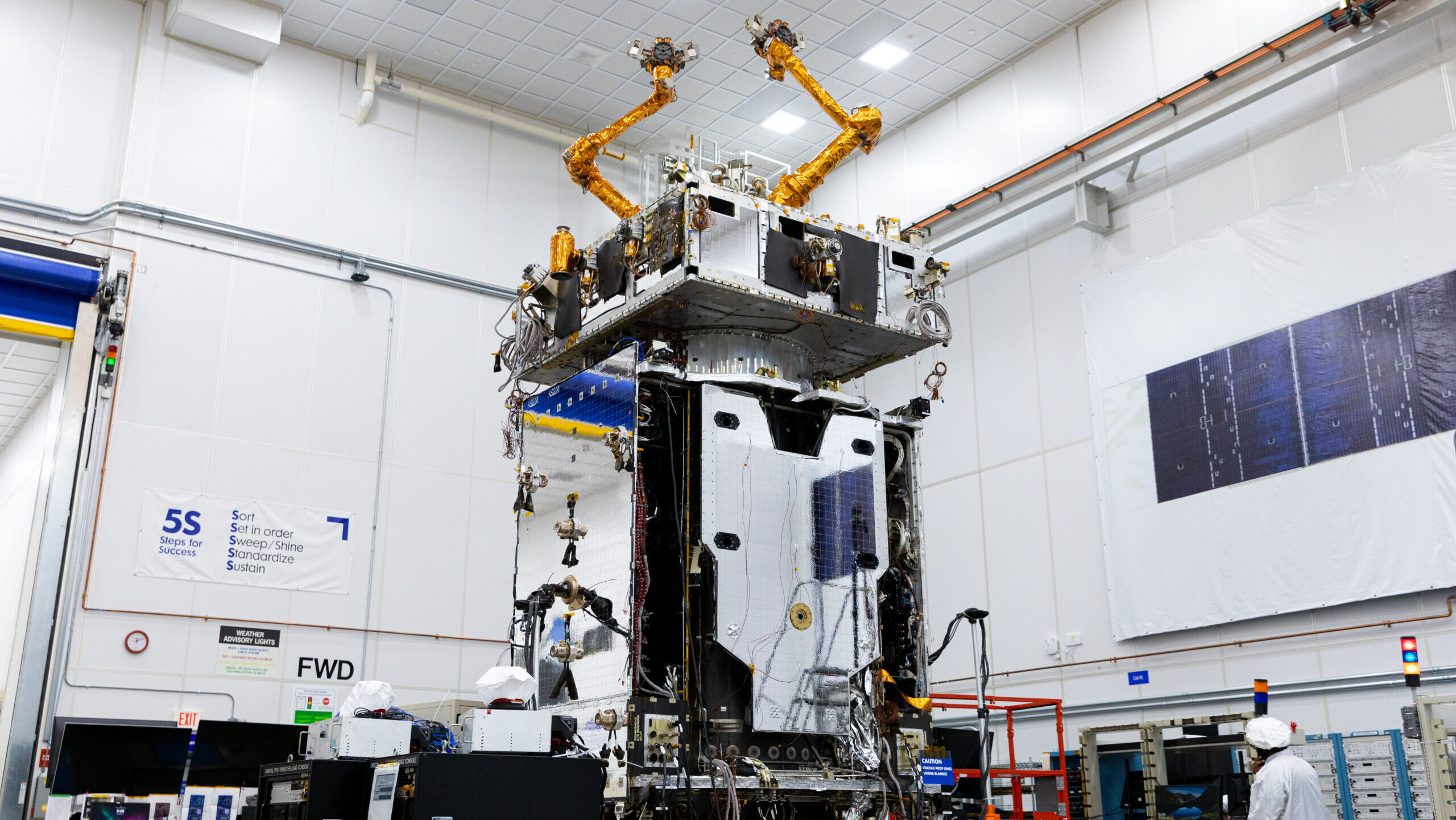
WASHINGTON ― Northrop Grumman plans to launch its robotic servicing spacecraft designed in partnership with the Defense Advanced Projects Research Agency (DARPA) later this summer, according to senior company officials.
“We are manifested. What I can say is our rocket is provided by SpaceX, and … we Northrop Grumman, have purchased the entire rocket, so we’ll be launching the Mission Robotic Vehicle, along with our three Mission Extension Pods,” Robert Hague, president of the company’s SpaceLogistics subsidiary, told reporters Tuesday at a tour of the company’s testing facility in Sterling, Va.
“When this MRV launches it will be the United States first robotic servicer,” he added.
The Robotic Servicing of Geosynchronous Satellites (RSGS) has weathered a rough road since initiated by DARPA in 2017, including an early lawsuit and the sudden abandonment of the effort by the original contractor Maxar Technologies in 2019.
Northrop Grumman, which picked up the contract in 2020, is paying for the launch on a SpaceX Falcon 9 and was originally slated to launch its MRV in 2024. (DARPA’s funding for the public-private venture technically wrapped up in 2025 according to the agency’s fiscal 2027 budget documents.)
Hague explained that there were a number of reasons for the delay.
“Both the bus, the satellite bus provided by Northrop Grumman, as well as the payload, the robotic payload provided by DARPA, are very complicated. So, it’s challenges with integrating those, as well as we need to have all the software to be able to work together to be able to do this mission and do that safely,” he said.
The RSGS’s two highly dexterous robotic arms were developed by the Naval Research Laboratory for DARPA, and handed over to Northrop Grumman for integration onto the moving-van sized MRV developed with the company’s own funds.
“We also faced challenges, as everyone in the satellite industry did post-COVID, as supply chains were stretched out. And so we faced difficulties there, just simply waiting on parts to be able to finish the integration,” Hague added.
The MRV, which sports a series of “ports” that can stow tools, or provide power and/or data, has been designed to undertake at least four types of on-orbit servicing missions: inspect anomalies that appear in a satellite’s operations; assist with adjustments to a satellite’s orbit; correct mechanical problems; and help install new payloads to upgrade capabilities.
The RSGS demonstration will get underway about a year after launch, as it will take the spacecraft’s electric propulsion system some 10 months or so to motor its way to geosynchronous Earth orbit 36,000 kilometers (about 22,000 miles) in altitude. It will involve using the MRV’s robotic arms to install the three much smaller Mission Extension Pods on client satellites.
If successful, the mission will provide an operational capability that the company then will contract to interested users, both military and commercial, according to Northrop Grumman officials.
The Mission Extension Pods, which Hague described as “jet packs,” will provide propulsion to extend the life of the client satellites that have run out of their own power. The pods, according to a Northrop Grumman’s fact sheet, are capable of powering birds weighing 2,000 kilograms (about 4,400 pounds) for up to eight years.
Finally, the MRV also is equipped with a re-fueling port, which will allow it to be refueled when its decade-long lifespan is spent.
Lauren Smith, Northrop Grumman’s in-space refueling manager, explained during the briefing that the port, called the Passive Refueling Module or PRM, was developed for the Space Force as a service-approved interface standard for docking and refueling on orbit.
The lightweight PRM will enable most spacecraft, whether large or small, to be refueled, she said.
“The addition of the PRM to the Mission Robotic Vehicle was specifically enabled by the Space Force and [the Defense Innovation Unit],” Smith added.
The PRM also will be flown as part of Northrop Grumman’s Elixir refueling payload, to be demonstrated for the Space Force under a $70 million contract granted last April. Under that demo, the PRM will be fitted to a client satellite and refueled via docking with a Northrop Grumman Active Refueling Module kitted on a fuel-carrying spacecraft.
