

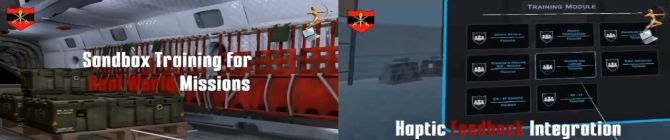
The Indian Army’s Simulator Development Division under ARTRAC has successfully handed over an indigenous Virtual Reality-based Aerial Delivery Training Simulator to the Army Airborne Training School in Agra, designed for C-17, C-130J, and Chinook platforms.
This marks a major leap in immersive training technology, strengthening airborne operations and reducing reliance on live aircraft for costly and complex training missions.
The newly developed simulator is a product of ARTRAC’s Simulator Development Division, which has been steadily advancing indigenous solutions in AR/VR for military applications.
This VR-based aerial delivery simulator is tailored to replicate the operational environment of heavy-lift aircraft such as the C-17 Globemaster III, C-130J Super Hercules, and the CH-47 Chinook.
These platforms are critical for India’s airborne forces, enabling strategic airlift, tactical transport, and precision aerial delivery of troops and equipment.
By integrating VR technology, the simulator allows paratroopers and load-masters to rehearse complex aerial delivery missions in a safe, controlled, and cost-effective environment.
The simulator provides high-fidelity replication of aircraft interiors, cargo handling systems, and aerial delivery procedures. It enables trainees to practise parachute drops, cargo release, and emergency drills without the need for live sorties.
This reduces wear and tear on operational aircraft, cuts down expenditure on fuel and logistics, and enhances training throughput by allowing multiple sessions in quick succession. The system also incorporates advanced physics modelling and realistic environmental conditions, ensuring that trainees experience scenarios akin to real-world missions.
The handover to the Army Airborne Training School in Agra is significant, as this institution is the nodal centre for airborne training in India.
The school trains paratroopers, special forces, and airborne units in combat jumps, aerial delivery, and specialised operations. With the induction of this simulator, the school now possesses a cutting-edge tool to prepare soldiers for missions involving rapid deployment and precision delivery from high-value aircraft.
This aligns with the Army’s broader vision of embedding simulation-based training into its doctrine, thereby enhancing operational readiness while conserving resources.
The development of this simulator also reflects the growing collaboration between the Indian Army and academic institutions such as IIT-Hyderabad under the VIGRAHA Centre of Excellence.
ARTRAC’s Simulator Development Division has emerged as a hub for AR/VR innovation, working on projects that combine artificial intelligence, robotics, and unmanned systems with immersive training technologies.
This initiative strengthens India’s defence ecosystem by fostering indigenous capability and reducing dependence on foreign suppliers.
Beyond immediate training benefits, the simulator contributes to India’s long-term strategic goals. It supports the Atmanirbhar Bharat initiative by showcasing indigenous design and development in advanced defence technologies.
It also enhances interoperability by standardising training across multiple aircraft types, ensuring that airborne units can seamlessly operate with different platforms during joint operations.
The system’s modular design allows future upgrades, including integration of new aircraft types or mission profiles, thereby ensuring scalability and relevance in evolving operational contexts.
The successful handover of the VR-based aerial delivery simulator underscores the Army’s commitment to modernising its training infrastructure. It represents a fusion of technology and doctrine, where simulation is no longer supplementary but central to preparing soldiers for the complexities of modern warfare.
By leveraging indigenous innovation, the Army is not only enhancing its training capabilities but also reinforcing India’s position as a leader in defence technology development.
IDN (With Agency Inputs)
