

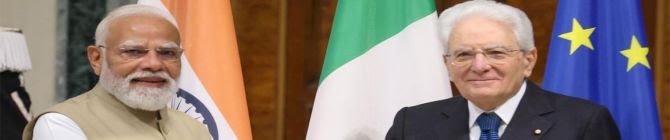
Prime Minister Narendra Modi’s visit to Italy has marked a decisive moment in India-Italy relations, with both sides reaffirming their partnership as a “special strategic” one and outlining ambitious cooperation in trade, technology, clean energy, defence, and the emerging Indo-Mediterranean corridor.
The talks with President Sergio Mattarella and Prime Minister Giorgia Meloni highlighted collaboration in AI, critical minerals, space, nuclear energy, and cultural linkages, while setting a roadmap for deeper ties through the Joint Strategic Action Plan 2025–2029.
Prime Minister Modi met Italian President Sergio Mattarella in Rome on Wednesday, where the two leaders discussed a wide range of bilateral cooperation areas. The conversation focused on trade, investment, and cultural linkages, while also emphasising collaboration in advanced sectors such as artificial intelligence, critical minerals, space exploration, and nuclear energy.
Both leaders exchanged views on regional and international developments of mutual interest, reaffirming the strong and enduring India-Italy partnership.
Soon after arriving in Rome on Tuesday evening, Modi met his Italian counterpart Giorgia Meloni over dinner. The two leaders undertook a visit to the iconic Colosseum, where they were seen in deep conversation, symbolising the warmth and depth of the relationship.
Their camaraderie has been widely noted, with social media dubbing the partnership “Melodi.” The visit was accompanied by ceremonial honours, including a military guard of honour accorded to Modi in Rome.
In a joint op-ed published across international platforms, Modi and Meloni described the India-Italy relationship as a “special strategic partnership” central to the emerging “Indo-Mediterranean” era. They noted that bilateral ties had entered a decisive stage, evolving from cordial friendship into a partnership rooted in democracy, freedom, and a shared vision for the future.
The op-ed framed the relationship as part of a broader geopolitical transformation linking the Indo-Pacific and Mediterranean into the “Indo-Mediterranean corridor,” envisioned as a growing network for trade, energy, technology, data, and strategic connectivity.
The leaders also reviewed the Joint Strategic Action Plan 2025–2029, which sets out a roadmap for cooperation in multiple sectors. Discussions included strengthening defence industrial collaboration, maritime security, clean energy, and digital infrastructure.
Italy expressed its commitment to co-develop next-generation technologies with Indian partners, while India highlighted the importance of resilient supply chains and industrial partnerships. Both sides backed the India-Middle East-Europe Economic Corridor (IMEC) as a transformative initiative to link Asia, the Middle East, and Europe.
Economic engagement between the two countries has been growing steadily. Bilateral trade reached USD 16.77 billion in 2025, with cumulative Italian foreign direct investment standing at USD 3.66 billion.
The two nations have set a target of achieving EUR 20 billion in annual trade by 2029, underlining the ambition to elevate economic cooperation. Italy is India’s fourth-largest trading partner in the European Union, and the Indian diaspora in Italy, numbering over 186,000 people, remains the largest among EU nations, further strengthening cultural and people-to-people ties.
Modi’s visit to Italy was the final leg of his five-nation European tour, which also included engagements in Nordic countries and Sweden. The meetings in Rome underscored India’s growing role in shaping global partnerships across technology, energy, and strategic connectivity, while highlighting Italy’s importance as a key European partner in this transformation.
ANI
