

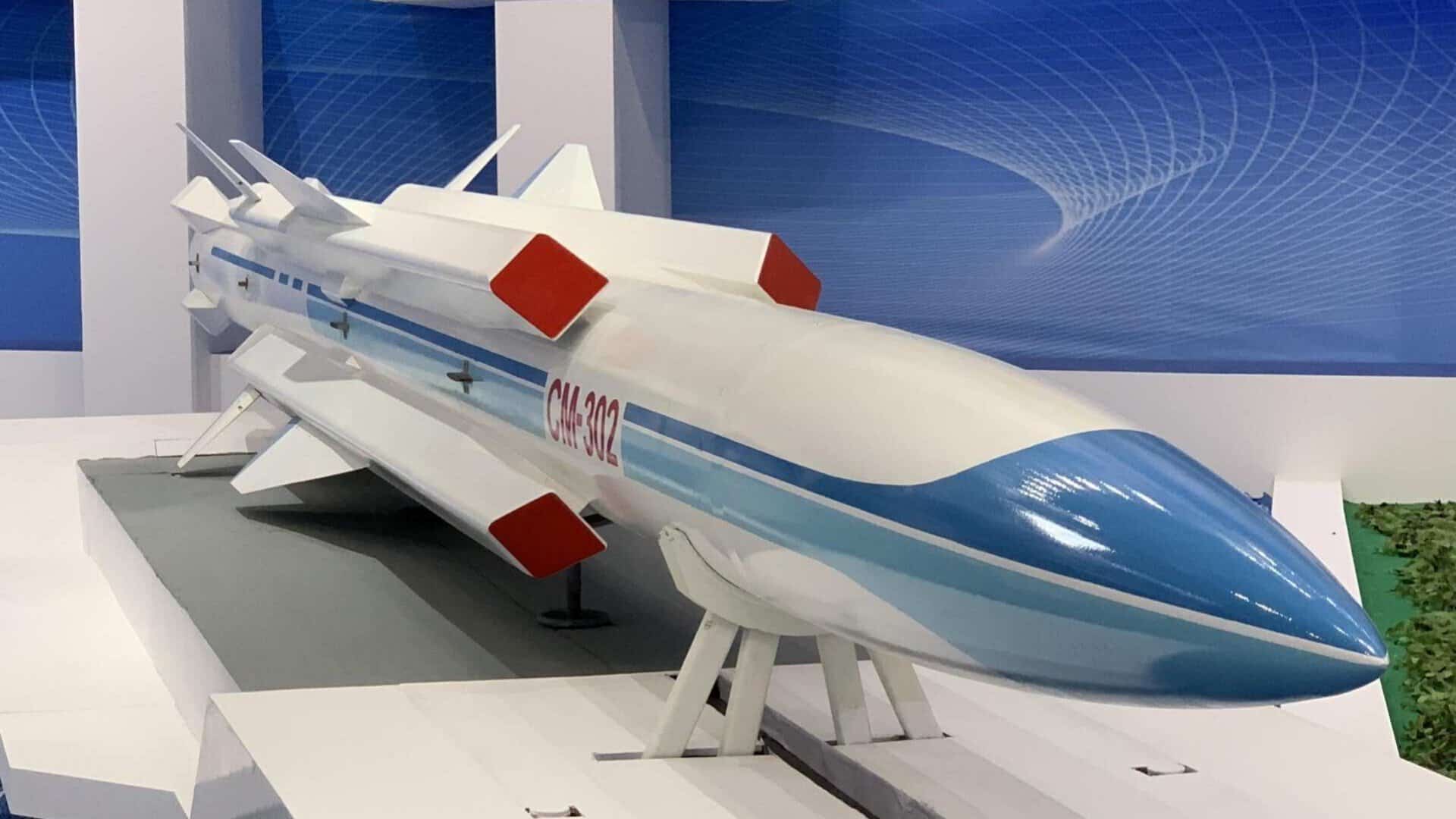
The CM-302 is a supersonic anti-ship cruise missile (ASCM) developed and manufactured by the China Aerospace Science and Industry Corporation (CASIC). It is the export variant of the YJ-12, which is in service with the People’s Liberation Army Navy (PLAN) and PLA Air Force (PLAAF). The CM-302 was publicly unveiled at Air Show China (Zhuhai) in November 2016 and has since been exported to the Pakistan Navy and Algeria.
The CM-302 utilizes an integrated ramjet/booster propulsion system – featuring a liquid direct-flow air-breathing engine fed by four air intakes – to sustain supersonic cruise speeds of approximately Mach 2.5 to 3 throughout its entire flight envelope. Speeds of up to Mach 4 have been reported at high altitude. The missile has a stated range of approximately 280 km and carries a conventional high-explosive warhead weighing approximately 250 kg.
In terms of guidance, the CM-302 is equipped with an inertial navigation system (INS) aided by China’s BeiDou satellite navigation for mid-course flight. In the terminal phase, an active radar-homing seeker activates to autonomously acquire and track the target. A data-link channel enables target data to be updated during flight, which affords the missile a degree of flexibility in engaging manoeuvring surface targets.
The CM-302 follows a sea-skimming flight profile in its terminal phase, approaching targets at extremely low altitude. This profile is designed to limit the reaction time available to a defending warship. According to War on the Rocks, a ship targeted by the YJ-12 has approximately 45 seconds to detect, track, and engage the missile after it appears over the radar horizon. CASIC has claimed a hit probability of approximately 90 percent for the CM-302.
Specifications
| Parameter | Value |
|---|---|
| Designation | CM-302 (export); YJ-12 (PLA) |
| Manufacturer | China Aerospace Science and Industry Corporation (CASIC) |
| Type | Supersonic anti-ship cruise missile / land-attack cruise missile |
| Length | ~7 m |
| Body Diameter | 0.7 m |
| Launch Weight | 2,000–2,500 kg |
| Warhead | ~250 kg conventional high-explosive (likely penetrating HE-fragmentation) |
| Range | ~280 km (export CM-302); 460–500 km (PLA YJ-12 variants) |
| Speed | Mach 2.5–3 cruising; up to Mach 4 at high altitude |
| Propulsion | Integrated ramjet/booster; liquid direct-flow air-breathing engine with four air intakes |
| Guidance | INS + BeiDou satellite mid-course + active radar terminal homing; mid-course data-link update |
| Flight Profile | Sea-skimming (terminal phase at extremely low altitude) |
| Launch Platforms | Ship-launched, ground-based transporter-erector-launcher (TEL), air-launched (PLA variants) |
| Service Entry | PLA YJ-12: c. 2011; Export CM-302: c. 2021 (Pakistan Navy) |
| Operators | Pakistan Navy, Algerian National Navy, PLA (YJ-12 variants) |
It is worth noting the capability gap between the export CM-302 and the PLA’s YJ-12 variants. The PLA’s air-launched and ship-launched YJ-12 variants have a range of 460–500 km – nearly double the CM-302’s 280 km – and can carry a heavier warhead of up to 500 kg, as per the U.S. Department of Defense’s 2023 China Military Power Report. The CM-302’s reduced range is understood to comply with China’s export control norms, which broadly align with the Missile Technology Control Regime (MTCR) Category I thresholds of 300 km and 500 kg payload.
Development History
The YJ-12 – from which the CM-302 is derived – resembles a lengthened Kh-31-type missile. According to a U.S. Joint Forces Quarterly study from 2014, the developmental lineage traces from the Soviet Kh-31P anti-radiation missile through to the Chinese YJ-91 (itself a licensed Kh-31 derivative) and then to the larger, longer-range YJ-12.
In August 2000, China unveiled a model of an air-launched missile labelled YJ-91 at a defence exhibition. A similar-looking but evidently distinct missile appeared subsequently, which was given the YJ-12 designation. The YJ-91 designation ultimately went to China’s direct Kh-31 variant, while the YJ-12 emerged as a new, substantially larger supersonic ASCM programme with an integrated ramjet propulsion system and considerably greater range.
The YJ-12 appeared at the 2015 China Victory Day Parade, confirming that the missile had entered active PLA service. All weapons showcased during the parade are, by convention, actively inducted prior to the event.
In terms of the YJ-12 family’s variant tree, there are four distinct configurations in known service or production. The air-launched YJ-12 has a range of approximately 500 km and is deployed on H-6G/K bombers and JH-7B fighter-bombers. The ship-launched YJ-12A entered PLAN service around 2020 aboard refitted Type 051B and Sovremenny-class destroyers. The land-based YJ-12B – with a range of approximately 460 km – was reportedly deployed to the Spratly Islands in the South China Sea around April 2018, where it can cover the southern half of the SCS from three Chinese-controlled islands. The CM-302, as the export variant, has the reduced range of approximately 280 km and the smaller warhead of approximately 250 kg.
CASIC unveiled the CM-302 at Air Show China (Zhuhai) in November 2016, marketing it as an anti-ship and land-attack missile with ship, land, and air launch options. Chinese media at the event were quick to call the CM-302 “the world’s best anti-ship missile.” However, Russian military analyst Vasiliy Kashin offered a more measured assessment, telling Sputnik that while China had achieved “real success” with supersonic ASCMs, its designs still adapted Russian foundations rather than breaking new ground.
At the time of the CM-302’s debut, only two comparable supersonic ASCMs were available on the global export market: Russia’s P-800 Onyx (also marketed as the Yakhont) and the joint Indo-Russian BrahMos. The CM-302 entered this space as a third option – one backed by China’s expanding defence export infrastructure and available to countries that could not access either the Russian or Indian supply chains.
It is also worth noting the distinction between CASIC and CASC (China Aerospace Science and Technology Corporation) in the Chinese ASCM market. CASIC manufactures the YJ-12/CM-302. CASC, a separate state conglomerate, developed the competing CX-1 and HD-1 supersonic cruise missiles. Both conglomerates are competing for the supersonic ASCM export market, though the CM-302 appears to have gained the greater traction to date with confirmed export sales.
Operators
Pakistan Navy
The Pakistan Navy (PN) ordered four Type 054A/P frigates from China in two batches – the first two ships in 2017 and the second two in 2018. All four frigates – PNS Tughril (F261), PNS Tabuk (F262), PNS Tipu Sultan (F263), and PNS Taimur (F264) – were built by Hudong-Zhonghua Shipbuilding and delivered to the PN between 2021 and 2023.
The Tughril-class (Type 054A/P) frigate has the distinction of being the PN’s first operational vessel armed with a supersonic-cruising ASCM. Each ship carries CM-302 missiles in a dual two-cell configuration – i.e. two launchers, each with two missiles. This is a distinct arrangement from the PLAN’s Type 054A, which uses a dual quad-cell configuration for the subsonic YJ-83.
The CM-302’s 280 km range enables the Tughril-class to engage surface targets at standoff distances that substantially outrange the C-802 ASCM (120 km), which preceded the CM-302 as the primary ship-launched anti-ship weapon on PN frigates and corvettes. In effect, the transition from the C-802 to the CM-302 represents a generational step-change in the PN’s anti-surface warfare (ASuW) capability – from subsonic to supersonic cruise, and from 120 km to 280 km of engagement range.
The Tughril-class is also armed with a 32-cell vertical launch system (VLS) loaded with LY-80N surface-to-air missiles (SAM), which have a range of 40 km and use semi-active radar-homing (SARH) guidance. This gives the Tughril-class a layered air-defence capability that, in conjunction with the CM-302 for ASuW, makes it the most comprehensively armed surface combatant currently in PN service.
In this vein, the CM-302 sits within a broader PN anti-ship architecture that has expanded significantly in recent years. The PN is concurrently developing the SMASH anti-ship ballistic missile (ASBM) – a weapon with a hypersonic terminal phase that follows a ballistic rather than sea-skimming trajectory. The PN has also deployed the Harbah land-attack cruise missile aboard its surface combatants.
Given this trajectory, one can see the PN building a multi-axis ASuW capability where the CM-302 provides the supersonic sea-skimming cruise threat and the SMASH provides a high-altitude hypersonic ballistic threat. A defending fleet would need to counter both – fundamentally different intercept geometries that require different defensive postures.
However, it is too early to determine whether the CM-302 will carry forward to the PN’s next-generation surface platforms. The Jinnah-class frigate programme is underway, and its ASuW suite has not been publicly confirmed. The Pakistan Ministry of Defence Production’s 2017–2018 yearbook disclosed work on an indigenous supersonic cruise missile, but the programme’s current status and its relationship to the CM-302 remain unclear.
Algeria
Algeria’s National Navy operates a land-based CM-302 coastal defence variant. According to the IISS Military Balance 2024 (p. 344), Algeria is the only confirmed land-based CM-302 operator outside of China. The system uses transporter-erector-launchers (TEL) for coastal anti-ship defence.
Algeria has historically procured both Russian and Chinese anti-ship systems – including the C-802 and the Russian Kh-35 – and the CM-302 acquisition represents the first Chinese supersonic ASCM to enter North African coastal defence service. However, limited public information is available regarding the scale of Algeria’s CM-302 deployment or its specific coastal defence configuration.
Iran (Pending)
In February 2026, Reuters reported – citing six sources familiar with the matter – that Iran was close to finalizing a deal with China to purchase CM-302 supersonic ASCMs. Negotiations reportedly began at least two years prior and accelerated sharply after the June 2025 Israel-Iran conflict. Senior Iranian officials, including the deputy defence minister, reportedly visited China during the final stages of negotiation.
China’s Foreign Ministry categorically denied the report.
If completed, the deal would significantly expand Iran’s anti-ship capability. The CM-302’s 280 km range would place the entire Persian Gulf, Strait of Hormuz, and Gulf of Oman within reach from Iranian coastal positions. However, analysts at Defence Express have assessed the CM-302’s primary strategic implication for Iran as an anti-access/area denial (A2/AD) capability over critical shipping chokepoints rather than a direct anti-carrier weapon against U.S. Navy strike groups with layered Aegis-class defences. In this reading, the CM-302’s value to Iran lies in its ability to threaten civilian and commercial shipping in the region, with consequent implications for oil prices and trade routes.
CM-302 vs BrahMos
The CM-302’s most direct competitor on the global ASCM export market is the BrahMos, a joint Indo-Russian supersonic cruise missile based on the P-800 Onyx/Yakhont. Both missiles fill the same tactical niche – supersonic sea-skimming ASCMs for anti-surface warfare – and they compete directly for the attention of naval forces seeking to move beyond subsonic weapons.
In terms of headline specifications, the two systems are broadly comparable. The CM-302 has a range of approximately 280 km; the original BrahMos has a range of approximately 290 km. The CM-302 cruises at Mach 2.5 to 3, while the BrahMos cruises at approximately Mach 2.8. Both carry warheads in the 200–300 kg class and use active radar terminal homing after mid-course inertial/satellite guidance.
However, there are material differences beneath the headline numbers. The BrahMos benefits from a significantly longer operational record, having entered Indian Armed Forces service in 2006. It has been integrated onto a wider range of platforms – ship, air, ground, and submarine – and has been exported to the Philippines. India’s accession to the MTCR has also enabled the development of BrahMos-ER, an extended-range variant with a range of approximately 400–450 km, which gives it a standoff advantage the CM-302 cannot currently match.
The CM-302, for its part, may hold a speed advantage at cruise – reported speeds of Mach 3+ versus the BrahMos’ Mach 2.8. At the terminal phase, particularly at high altitude, speeds of up to Mach 4 have been cited for the YJ-12 family, which would further compress the defending ship’s reaction window.
Neither missile has confirmed anti-ship combat use as of May 2026. Both have been tested against target ships and in large-scale exercises, but a proven combat engagement against a manoeuvring naval combatant remains absent from either system’s record.
From an export market perspective, the CM-302 is available to countries that cannot access the BrahMos due to Indo-Russian export restrictions or political alignment. Pakistan – which deploys the CM-302 on its Tughril-class frigates – is the clearest example. For the broader market, the CM-302 offers a third supersonic ASCM option alongside the BrahMos and the P-800, which may appeal to countries seeking supplier diversification or access to China’s competitive pricing and defence financing arrangements.
Tactical Implications
The CM-302’s combination of supersonic cruise, sea-skimming terminal flight, and active radar terminal homing creates a demanding problem for the defending ship. The approximately 45-second engagement window – from radar horizon appearance to impact – compresses the entire defensive kill chain into a very short sequence: detection, tracking, weapons allocation, missile launch, and intercept.
Modern layered naval air defences are designed to engage inbound threats sequentially – a long-range area-defence SAM followed by a medium-range point-defence SAM, then a close-in weapon system (CIWS) such as the Phalanx or RAM, supplemented by electronic warfare (EW) countermeasures and decoys. Against a supersonic sea-skimmer, each layer of this sequence must perform within the compressed timeline. If any layer fails or is delayed, the remaining layers have even less time to compensate.
In 2014, the U.S. Navy’s approach to countering air-launched YJ-12 saturation attacks envisaged destroying Chinese strike aircraft at long range before the missiles could be launched, relying on Cooperative Engagement Capability (CEC) to network targeting data across the fleet. This doctrine implicitly acknowledged that once a YJ-12-class missile is in flight at sea-skimming altitude, the defensive problem becomes markedly more difficult.
For the Pakistan Navy specifically, the CM-302 joins the emerging SMASH ASBM to create a dual-axis ASuW threat. The CM-302 attacks at sea-skimming altitude on a supersonic cruise trajectory. The SMASH attacks from a ballistic arc at hypersonic terminal speeds. A naval force facing both simultaneously would need to address two entirely different intercept geometries – one horizontal and one near-vertical – with overlapping engagement timelines. This mirrors the dual-axis approach visible in the PLA’s own force structure, where the YJ-12 (supersonic cruise) is complemented by the YJ-21 (hypersonic ASBM).
That said, SMASH remains in the testing phase, and its operational parameters – including range and guidance – have not been fully disclosed. The dual-axis concept is a prospective capability, not a fielded reality as of mid-2026.
Related Chinese Anti-Ship Missiles
The CM-302 sits within a broader family of Chinese ASCMs, each designed for a different engagement profile and market segment.
The C-802 – the export variant of the PLAN’s YJ-83 – was the Pakistan Navy’s primary ship-launched ASCM before the CM-302. A subsonic missile with a cruise speed of approximately Mach 0.9 and a range of 120 km, the C-802 represents the previous generation. The CM-302’s supersonic cruise speed and 280 km range mark a substantial advance in both threat severity and standoff capability.
The CM-400AKG is an air-launched, rocket-propelled weapon carried by the JF-17 Thunder. With a reported speed of Mach 4+ in its terminal dive and a range of approximately 240 km, the CM-400AKG offers a different attack geometry to the CM-302 – a steep, high-speed dive from altitude rather than a sea-skimming cruise approach. The two missiles can be seen as complementary within the Pakistani context: the CM-302 for ship-launched sea-skimming strikes and the CM-400AKG for air-launched high-angle attacks.
The HD-1 is a supersonic cruise missile from CASC (not CASIC) that competes with the CM-302 in the export space. Limited confirmed sales information is publicly available, and the HD-1 appears to have gained less export traction than the CM-302 to date.
The YJ-21 (with the CM-401 as its reported export variant) is a hypersonic anti-ship ballistic missile in PLA service. Operating at a fundamentally different speed and trajectory class, the YJ-21 represents the next tier of Chinese anti-ship capability above the YJ-12/CM-302. Together, the YJ-12 and YJ-21 form the PLA’s layered anti-ship architecture – supersonic cruise and hypersonic ballistic – a model that the Pakistan Navy appears to be emulating with the CM-302 and SMASH.
Outlook
The CM-302’s export footprint is expanding. With Pakistan and Algeria operating the system and Iran reportedly in advanced negotiations, the missile is entering markets where Russia’s P-800 and India’s BrahMos were previously the only supersonic ASCM options available. If the Iran deal is completed, it would represent a significant expansion of Chinese supersonic ASCM proliferation into the Middle East – a region where the naval balance of power has direct implications for global energy security and freedom of navigation.
For the Pakistan Navy, the question of whether the CM-302 will carry forward to the next generation of surface combatants – including the Jinnah-class frigate – is open. The PN’s disclosed work on an indigenous supersonic cruise missile could, in time, reduce dependence on Chinese-supplied ASCMs. However, indigenous programmes of this nature typically take years to mature from concept to operational deployment, and the CM-302 provides a proven, in-service baseline in the interim.
More broadly, China’s expanding defence export footprint – of which the CM-302 is one visible example – is reshaping the ASCM market. For decades, the supersonic ASCM segment was dominated by Russian-origin designs. The CM-302’s entry, followed potentially by the HD-1 and other Chinese systems, introduces a second major supplier ecosystem with competitive pricing and fewer political conditions on end-use.
For Quwa’s coverage, the CM-302’s trajectory offers a lens into several interconnected threads: the Pakistan Navy’s surface fleet modernization, the Indo-Pak naval balance, Chinese defence industrial competition with Russia and India on the export market, and the growing A2/AD challenge in the Gulf and broader Indo-Pacific. These threads will continue to develop as the CM-302’s operator base expands and its complementary systems – SMASH, Harbah, and potentially indigenous successors – mature.
Frequently Asked Questions
What is the CM-302 missile?
The CM-302 is a Chinese supersonic anti-ship cruise missile manufactured by CASIC. It is the export variant of the YJ-12, which serves with the PLA. The CM-302 travels at Mach 2.5 to 3, carries a 250 kg warhead, and has a range of approximately 280 km.
What is the range of the CM-302?
The CM-302 has an export range of approximately 280 km. The PLA’s own YJ-12 variants have a significantly longer range of 460–500 km. The export range is capped under China’s export control norms, broadly aligning with MTCR thresholds.
How fast is the CM-302?
The CM-302 cruises at Mach 2.5 to 3, or approximately 3,000–3,700 km/h. Speeds up to Mach 4 have been reported at high altitude. At these speeds, a defending ship has approximately 45 seconds to engage the missile after it appears over the radar horizon.
Which countries operate the CM-302?
The Pakistan Navy operates the CM-302 on its four Tughril-class (Type 054A/P) frigates. Algeria’s National Navy operates a land-based coastal defence variant. Reuters reported in February 2026 that Iran was near completion of a CM-302 procurement deal with China.
How does the CM-302 compare to BrahMos?
Both are supersonic anti-ship cruise missiles with comparable ranges (~280 km vs ~290 km). The CM-302 may hold a speed advantage at cruise (Mach 3+ vs Mach 2.8). BrahMos has broader platform integration, a longer operational record (in service since 2006), and an extended-range variant (BrahMos-ER, ~450 km). Neither has confirmed anti-ship combat use.
Is the CM-302 the same as the YJ-12?
The CM-302 is the export variant of the YJ-12 family. It has a reduced range (~280 km vs 460–500 km) and smaller warhead (~250 kg vs up to 500 kg) compared to PLA variants. The core design – ramjet propulsion, sea-skimming flight, active radar terminal homing – is shared across the family.
Does Pakistan have the CM-302?
Yes. The Pakistan Navy deploys CM-302 supersonic anti-ship missiles on all four Tughril-class (Type 054A/P) frigates. The ships were delivered between 2021 and 2023. The CM-302 is the PN’s first supersonic-cruising anti-ship cruise missile.
