

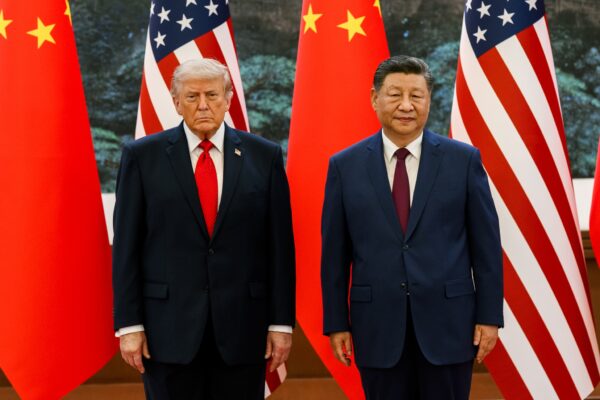
When China’s leader Xi Jinping welcomed U.S. President Donald Trump to Beijing on May 13, he framed the agreement to build “a constructive China-U.S. relationship of strategic stability” as the opening of a possible “new paradigm” in bilateral relations. Chinese commentators have embraced that framing with an enthusiasm that goes well beyond ritual endorsement of Xi Jinping Thought.
A survey of 50 Chinese-language commentaries published around the summit shows the trip being described variously as a possible “turning point in the current phase,” an “important conceptual innovation and policy breakthrough,” an event of “milestone historical significance,” and a “rewriting of the underlying logic of international relations.” Zheng Yongnian, author of that last phrase, speculated that the meeting “may prove to have more far-reaching historical significance than Nixon’s visit to China.”
State media have cautioned that “positioning is not crystallization, and planning is not arrival,” but many experts appear to treat the summit itself as a paradigmatic shift. Several authors engage openly with the G-2 concept that Beijing has formally rejected: Sun Liping, for instance, wrote that the G-2 is “taking shape” and constitutes the “thickest beam” in an emerging new world order.
The optimism is not unconditional. Some authors distinguished symbolic importance from the harder question of implementation. Others pointed to the uncertainty in U.S. domestic politics – warning that Washington could be pulled back to a more hawkish line under a future Democratic administration, or if Trump loses his nerve after the midterms.
A second group foregrounded the constrained environment that pushed Trump to the table. Sun Lijian described the summit as a “political lifeline” for Trump; Li Pinbao called it a “pressure valve.” The implication is that détente may rest as much on Trump’s immediate need for relief – from inflation, Iran, trade pressure, and the midterms – as on any deeper structural reconciliation.
Western analysis has interpreted Beijing’s goal as “buying time,” and Wu Xinbo, director of Fudan University’s Center for American Studies, gave the most direct Chinese exponent of that reading: if “constructive strategic stability” can hold for the next three years, he wrote, it will “extend our period of strategic stability and win time and space for our development.”
These caveats do not overturn the broader consensus that the structural conditions of the relationship have changed. Of the 50 authors surveyed, 17 expressed confidence in a lasting and sustainable thaw; 11 focused on the three-year window of Trump’s presidency officially flagged as the initial timeframe; 16 took a “wait and see” position. Only six primarily emphasized the fragility of the pause. Given the usual skepticism in Chinese assessments of U.S. intentions, the balance of opinion is striking.
Wu Xinbo’s analysis was especially revealing. In a pre-summit article, he described the post-Busan stabilization as a “fragile stability” resting not on bilateral consensus but on Washington’s domestic need to ease relations with China. Following the summit, his tone was markedly more optimistic: where the post-Busan stability had been fragile, “this time is different,” and the new positioning “signifies that this stability is not temporary, but rather strategic and sustainable.” Wu’s assessment carried a participant-observer quality by virtue of his attendance at Xi’s opening banquet for Trump; he cited the friendly atmosphere as further evidence that the diplomatic mood has changed.
What explains the shift from tactical relief to strategic optimism is not a belief that Trump has become benign, or that Washington’s intentions have softened. It is that the balance of power has changed. In this reading, the summit was significant precisely because it appears to make that shift visible – the moment at which a more equal relationship becomes apparent.
Wang Yong argued that a “major change in the balance of power” has forced Washington to view China as “an opponent of comparable strength.” Zheng Yongnian framed Trump’s “new realism” as recognition that “China has already risen” and that the U.S. “cannot defeat China.” A separate piece relaying a discussion among U.S. specialists recorded broad agreement that the two countries have “basically entered a stage of strategic stalemate.”
The same formulation appeared in a report by the China Institutes of Contemporary International Relations – an influential think tank affiliated with the Ministry of State Security – published on the day of Trump’s arrival. U.S.-China relations have entered a new stage of “strategic stalemate” and require a new framework of “constructive strategic stability” suited to that reality, CICIR concluded.
The summit’s language is placed within a longer lineage of failed or incomplete attempts to define the relationship. Shen Yi traced that lineage from the 1997 “constructive strategic partnership” to China’s later proposal for “a new type of major country relations,” which emerged against the backdrop of China’s rise and Obama’s Asia-Pacific rebalance. The implication is that a Chinese framing became acceptable only once the underlying power realities had caught up. Sun Liping made the point explicitly: “China proposed the idea of a new type of major country relations many years ago… looking back now, perhaps it was proposed a little too early; the conditions were not yet in place.”
In this reading, Beijing’s response to Trump’s aggressive China policy in 2025 was decisive. Several authors stressed that the détente was not the product of U.S. goodwill but was “hard-won.” Zhou Li wrote that the new positioning was “by no means accidental”; Wu Xinbo was more explicit, arguing that the current stabilization did not come from U.S. goodwill but was won by China through “arduous effort and struggle.” Beijing has not been rewarded for restraint, in this view; it has forced Washington to adjust by demonstrating that coercive pressure no longer works.
None of this should be read naively. Chinese public debate on a summit of this kind is shaped by the imperative to project confidence, consensus, and “positive energy,” and there is always a risk of mistaking performative optimism for private conviction. Yet the consistency of the position across authors, the detail of the causal arguments advanced both before and after the summit, and the willingness to spell out risks and implementation problems suggest the optimism is not merely performative, even if it is politically amplified.
Taiwan, predictably, emerged across the corpus as the central variable in whether the new framework can hold. Authors broadly followed Xi’s maximalist line that “Taiwan independence” and peace in the strait are “as incompatible as fire and water,” treating U.S. restraint on Taiwan – and especially opposition to “Taiwan independence” – as the principal test of the détente.
Trump’s post-summit remarks, that he did not want to see “Taiwan independence” and then have to travel “9,500 miles to fight a war,” received separate treatment in a small cluster of later pieces. Of the five authors who passed judgment on them, four read them as a meaningful concession, or at least as a warning to “Taiwan independence” forces. Yu Donghui went furthest, calling them “the most comprehensive and favorable statement to Beijing made by a U.S. president on Taiwan in more than 20 years.” Wang Yong even speculated that, in the long run, Washington may reach a consensus with Beijing on supporting peaceful reunification. The main dissenting voice was Liu Lanchang, who argued that Washington’s basic position has not changed.
These readings of Trump’s Taiwan comments underline the broader point. Chinese commentators are treating Washington’s acceptance of the language of “a constructive China-U.S. relationship of strategic stability” as a major structural concession – and, more than that, as confirmation that the balance of power has shifted enough for Beijing’s preferred framing of the relationship finally to be accepted.
This article is adapted from an analysis published by Sinification, a newsletter translating and analysing Chinese public intellectual commentary for policymakers and researchers.
