

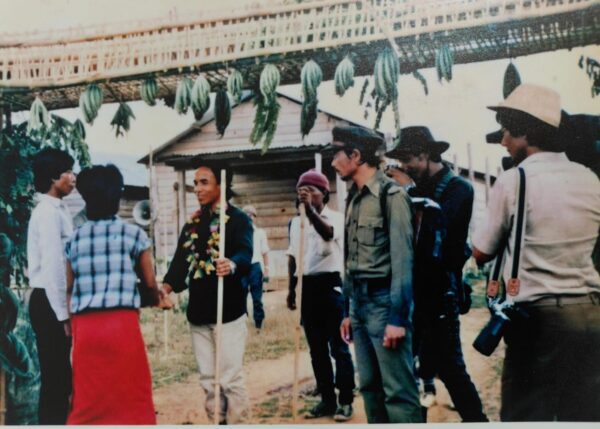
From the archives of insurgent outfits in India’s northeastern region has emerged an autobiography of Zoramthanga, which provides fascinating insights into how erstwhile Mizo separatist rebels hoodwinked Indian and Pakistani intelligence agencies on many occasions and under different circumstances.
The rebels belonged to the Mizo National Front (MNF), which had launched an armed rebellion demanding Mizoram’s independence from India in 1966. Mizoram was then a district of Assam, similar to the other hill states in the region.
Zoramthanga, who was second-in-command to Laldenga, the legendary chief of the secessionist Mizo National Front, subsequently became president of the MNF party, and then went on to become Mizoram’s chief minister between 2018 and 2023. In his autobiography, “From Guerrilla Fighter to Chief Minister” (Penguin Random House, 2026), Zoramthanga recounted that from the very outset of the Mizo movement, the MNF leadership was certain that the campaign for Mizoram’s independence would not succeed without the support of foreign governments.
The MNF approached Pakistan and China for assistance owing to their adversarial relationship with India and proximity to the Northeast. At the time, Bangladesh was under Pakistan’s rule and had not yet been liberated.
The MNF’s tryst with Pakistan began in 1963 when a three-member delegation led by Laldenga crossed over to East Pakistan’s Chittagong Hill Tracts (CHT), which was contiguous to Mizoram. A series of meetings with the Inter-Services Intelligence (ISI) — Pakistan’s external intelligence agency — resulted in the supply of several consignments of weapons and establishment of training camps for the MNF in East Pakistan.
The scenario changed after the Bangladesh Liberation War in 1971, which culminated in the emergence of Bangladesh as an independent country.
The MNF was compelled to shift its bases out of Bangladesh to Arakan in Myanmar with the assistance of the Communist Party of Burma (CPB). Subsequently, MNF leaders led by Laldenga managed to slip out of Myanmar to Pakistan on a chartered flight sponsored by the Pakistan government for refugees from East Pakistan.
The rebel leaders successfully disguised themselves as members of the Bawm community from CHT, who were fleeing for fear of persecution by the new government in Bangladesh. They were apprehensive of being identified by the Myanmar government authorities, which could have landed them in jail or even a death sentence. The Myanmar government knew about the MNF’s presence in Arakan and their participation in battles against the Myanmar army as an ally of the CPB.
Travelling With Multiple Pakistani Passports
Within a few days of being provided safehouses by the ISI in Pakistan’s Rawalpindi, the Mizo leaders began to explore the possibility of contacting the Indian government to kick-start talks. They attempted to enter India from Firozepur in Pakistan but failed as they could not locate the correct route. The failure prompted them to embark upon a clandestine journey to Kabul to contact the Indian embassy there. That operation had to be accomplished in absolute stealth without the ISI’s knowledge.
Soon, they obtained Pakistani passports with the help of touts in Rawalpindi. A decision was taken to travel to Kabul via Peshawar to avoid detection. However, owing to Pakistan’s low foreign currency reserves, a citizen who traveled abroad was permitted only $500 every two years.
“That meant we had to have new passports every time we went abroad. I had several of them, with different assumed names,” Zoramthanga recalled in the book. “One problem was that every time I had a new passport, not only did I need a new name for myself, but I also had to change the names of my parents and my address – and I had to memorize them.”
The meeting with Indian intelligence officers in Kabul paved the way for another round of talks in the same city, and the third in Bangkok. The fourth round of negotiations, which Laldenga attended, was held in Geneva. The MNF leaders obtained new Pakistani passports on every occasion they flew out of Pakistan.
At the talks in Geneva, the Indian intelligence officers decided to invite the MNF leaders to India for the subsequent negotiations, necessitating new passports again. The leaders slipped out of Pakistan without any hitches and headed to the Indian city of Kolkata for the next meeting.
At the request of the MNF leaders, the Indian government organized a five-day event, the Calcutta Convention, that began on March 26, 1976, where other MNF functionaries were required to assemble and adopt a resolution supporting the peace process.
Escape From a Safe-house in New Delhi
A ceasefire was declared between the Indian government and the MNF in 1976, but the talks did not proceed as expected by the Mizo leaders. The Indian government wanted the outfit to agree to a “mutually agreed peace camp” where “all underground forces would gather and hand over their arms and ammunition to the central government within one month.” The MNF considered this “dangerous” and rejected the Indian conditions, resulting in a stalemate.
The MNF set up camps once again in Bangladesh’s CHT. The Indian government responded by revoking the ceasefire and deploying more troops in Mizoram. Talks resumed in 1977 but further progress in the peace process became difficult. The Janata Party-led coalition government that swept to power in that year was not very inclined to take the peace process to a logical conclusion.
Indian intelligence officers threatened Laldenga that he would not be allowed to stay in the country if the MNF did not lay down arms before the agreement. Zoramthanga was detained at a safehouse in Kolkata for ten days as a pressure tactic and then flown to New Delhi to resume the talks. The security agencies also made serious efforts to engineer a split in the MNF by propping up senior leader Biakchunga against Laldenga.
As the MNF was unrelenting, three senior MNF leaders — Laldenga, Zoramthanga and Pu Tawna – were put under house arrest at a safe house in New Delhi’s Gulmohar Park. They were allowed to travel out of the residence but under escort and only with the prior approval of the higher authorities. It was under these circumstances that Zoramthanga hatched a plan to escape from New Delhi with Pu Tawna. Laldenga was not included in the plan as his wife and children were staying with him in the safe house.
On January 6, 1979, Zoramthanga and Pu Tawna scaled the walls of the safe house in the evening when the guards had gone to the kitchen for tea and snacks. They headed to the airport, purchased tickets, and landed in Kolkata later that evening. On the following day, they reached Silchar in Assam and then made their way to Mizoram in a vehicle arranged by MNF functionaries. Two days later, the two MNF leaders were back at the outfit’s headquarters in Bangladesh’s CHT.
The escape of the MNF leaders was a major embarrassment for Delhi. Laldenga was arrested and sent to Delhi’s Tihar jail for a few months on charges of committing crimes against India.
A formal ceasefire was declared again on July 31, 1980, between the Indian government and the MNF. After several rounds of talks, a final agreement was inked on June 30, 1986.
