

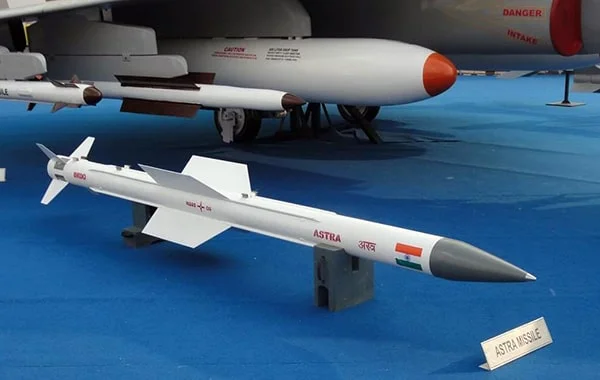
BDL issues dual tenders for over 1,000 Astra Mk1 rocket motor components across Hyderabad and Medak facilities, scaling serial production to 50–100 missiles per year as India replaces imported R-77 and MICA BVRAAMs on its Su-30MKI and Tejas Mk1A fleets.
Bharat Dynamics Limited (BDL) has issued dual tenders through the Government e-Marketplace (GeM) to procure critical rocket motor components for the Astra Mk1 beyond-visual-range air-to-air missile (BVRAAM), in a move to accelerate serial production for the Indian Air Force’s Su-30MKI and Tejas Mk1A fleets.
The tenders focus on PT Blanks — highly precise metallic forms used to build the outer casing of the Astra Mk1’s solid-propellant rocket motor. These components must meet exacting metallurgical standards to withstand the extreme pressures of flight at Mach 4.5, the missile’s maximum speed. The primary tender (GeM Reference ID 9305999) requests 907 PT Blank units for delivery within 90 days of contract finalization, while a supplementary tender (Reference ID 55434609) calls for an additional 137 units for reserve inventory or parallel assembly. Both bids closed on 21 May 2026.
The dual-tender approach is a deliberate strategy to diversify the vendor base, reduce single-supplier bottleneck risk, and manage manufacturing cycles across two production facilities: BDL’s Kanchanbagh plant in Hyderabad and the Ordnance Factory Medak in Telangana. Qualified Micro, Small, and Medium Enterprises (MSMEs) in the defence sector have been granted exemptions from standard deposit requirements to encourage local vendor participation and widen the supply chain.
The Astra Mk1 — designed by the Defence Research and Development Organization (DRDO) with a strike range of 110 km — is actively replacing imported systems on the IAF’s frontline fleet. The missile is already fully operational on the Su-30MKI, where it is displacing the Russian R-77 and the French MICA, and is being adapted for integration on the Tejas Mk1A and the Indian Navy’s carrier-based MiG-29K. BDL is targeting a production rate of 50–100 Astra missiles per year, backed by a ₹2,900 crore order from the Ministry of Defence. The scaling of Astra production is part of India’s broader push to indigenize its combat aircraft weapons suite, with implications for the 114-aircraft Rafale MRFA deal where source code access for Indian weapons integration remains a key negotiating point.
The combined procurement of over 1,000 PT Blank units — across two separate tenders, two production facilities, and a 90-day delivery window — signals that India’s Astra production pipeline has moved from prototyping and low-rate initial production into industrial-scale serial manufacturing, joining other DRDO weapons programs like the recently tested TARA precision glide weapon in the transition from development to mass production.
