

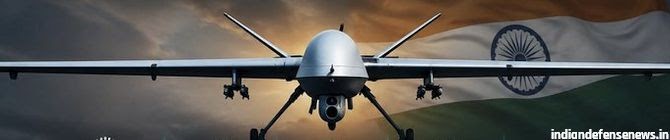
The transformation is not limited to assembling hardware but extends to owning the software backbone, which is where true autonomy and resilience lie. UAVs have moved beyond novelty to become a sunrise sector, with the global UAV market expected to compound at nearly 9% over the next five years.
While commercial drones are proliferating in agriculture, logistics, mining, infrastructure, and utilities, the more consequential movement lies in defence UAVs. Globally, the defence UAV market is projected to reach around $18 billion by 2030.
India’s defence UAV market is forecast to grow from $1.76 billion in 2024 to $4.5 billion by 2030, supported by rising defence capital expenditure, ₹1.39 lakh crore of domestic procurement in FY 2026–27, and policy frameworks such as the Drone Rules and the Production-Linked Incentive scheme.
Over the next decade, nations that control their full UAV stack, especially software, will define military superiority, making India’s move strategically significant.
Recent border tensions triggered emergency procurement worth ₹5,000 crore across multiple private firms, underscoring the urgency of capability building. More striking is the larger procurement signal: a ₹67,000 crore defence package that includes a ₹32,350 crore program for 87 Medium Altitude Long Endurance drones.
The ambition is vast. The Indian Army’s target of 8,000 to 10,000 UAVs per corps across 14 corps implies a potential requirement exceeding 100,000 units. At the same time, contested-environment trials are imposing discipline on suppliers, with reports that 46 domestic firms failed recent evaluations.
This marks a shift from brochure-led participation to one defined by demonstrable systems competence.
Three value pools now define the sector’s strategic and industrial logic. The first, and largest, is persistent intelligence, surveillance, target acquisition, and reconnaissance. India’s geography demands continuity of watch across active borders, inhospitable terrain, long coastlines, and expanding maritime surveillance responsibilities.
The airframe is only the outer layer of value; the real advantage lies in electro-optical payloads, EO/IR sensors, secure data links, SATCOM connectivity, onboard analytics, and mission software capable of operating in contested electromagnetic conditions.
The estimated ₹1.4 lakh crore demand for ISR over the next eight to ten years matters not only for its scale but also for the advanced technology envisaged. It is the mission system that confers persistence, transmission, exploitation, and therefore advantage.
The second value pool lies in strike capability through loitering munitions. Recent conflicts have demonstrated their utility beyond debate. These systems compress the chain between sensing and strike, expand tactical flexibility, and deliver precision at far lower cost than many manned alternatives. In India, disclosed domestic orders exceed a thousand units across platforms such as Nagastra, SkyStriker, ALS-50, and swarm systems.
More important than the headline figure is the change in procurement logic. A sector built on trials and demonstrations behaves differently from one built on replenishment. Once replenishment institutionalises, vendor qualification, explosives handling, production planning, testing, quality assurance, and sortie generation scale around recurring demand. That is the moment when a market begins to assume the discipline of an industry.
The third pool is cargo, logistics, and tactical resupply. High-altitude posts, island territories, exposed last-mile routes, and theatre-level mobility requirements create a mission set for unmanned cargo systems.
The Indian cargo and resupply opportunity, estimated at ₹5,000 to ₹7,000 crore over eight to ten years, is strategically significant not only for the defence demand it represents but also because it bridges into civilian UAVs.
A platform proven in moving payloads through dangerous, remote, or congested military environments has a clear migration path into medical delivery, industrial logistics, and difficult-terrain transport.
Defence UAVs are not merely another vertical within the drone economy; they are the laboratory in which the hardest advances in autonomy, ruggedization, payload integration, and secure communications are forged before diffusing outward.
As defence drones scale, spill over into civilian markets will be structural. It will be driven by talent migration from DRDO, armed forces, and defence start-ups into the private sector, dual-use technology transfer in autonomy, navigation, and secure communications, and regulatory enablers such as dual-spectrum licensing and evolving drone policies.
The wider ecosystem effect will follow from start-ups building defence-grade software platforms, allowing military-hardened capabilities to diffuse into commercial logistics, inspection, mapping, and public-safety applications.
The future battlespace will not be defined by a binary choice between manned and unmanned platforms but by their integration. Programs such as HAL’s CATS Warrior indicate a doctrinal shift in which crewed aircraft function as command nodes while unmanned wingmen extend reach, persistence, decoy value, and strike capacity.
Software-defined systems enable autonomy, resilience against electronic warfare, and faster adaptation in conflict scenarios. Control over algorithms, autonomy, and mission logic determines battlefield effectiveness, not just the physical drone.
This distinction is crucial, because scale alone does not amount to sovereignty. India has travelled this path before in aerospace and defence: assembly first, then local integration, and only thereafter genuine control over the value chain.
The decisive contest lies in the deeper stack – trusted electronics, propulsion, secure data links, navigation resilience in jammed or GNSS-denied environments, mission software, testing infrastructure, certification, qualification, maintenance, repair, overhaul, and lifecycle support.
The new rule requiring critical sub-components to be sourced from non-border-sharing countries matters not only because it reduces foreign dependence but also because it imposes discipline on provenance and trust.
Reports that technical committees are disassembling inducted UAVs to verify component origin and audit embedded firmware suggest the early contours of a sovereign certification and assurance regime.
Ultimately, India must now build credible military-UAV certification, rigorous shared test infrastructure, procurement practices that reward reliability over theatre, trusted components as well as mission software, and supply chains resilient enough for wartime rather than demonstration.
TOI
