

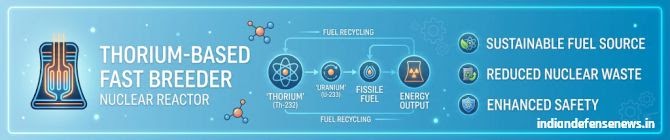
India’s nuclear journey began with Dr Homi Bhabha’s ambitious three-stage program in the 1950s, designed to move from natural uranium in pressurised heavy water reactors, to plutonium in fast breeder reactors, and finally to thorium-based reactors.
The ultimate goal was a self-sustaining thorium–uranium fuel cycle that would secure energy independence and reduce crude oil imports. For decades, this vision remained aspirational, but in April 2026 India achieved a milestone when its prototype fast breeder reactor at Kalpakkam reached criticality, making India only the second nation after Russia to do so.
This marked entry into Stage 2 of the program. India’s current nuclear capacity stands at 8.8 GW, just 2% of its energy mix, with targets of 22 GW by 2032 and 100 GW by 2047.
Energy security has become more urgent due to the West Asia conflict and the global push for clean energy. Thorium, of which India has abundant reserves, is seen as crucial for the penultimate stage of the programme.
Yet technological complexities mean commercial deployment could take decades. Uranium availability is another bottleneck, with India importing 70% of its annual requirement of 1,800–2,000 tonnes, mainly from Kazakhstan and Canada. Demand is projected to rise to over 5,000 tonnes annually by 2047, increasing reliance on imports.
Experts such as former Atomic Energy Commission chairman Anil Kakodkar argue that India cannot achieve 100 GW capacity by 2047 if it rigidly follows the three-stage sequence. He advocates accelerating thorium usage by introducing thorium–uranium fuel blends earlier, even in Stage 1 reactors.
Clean Core Thorium Energy, a US-based start-up, has developed a blended fuel combining thorium with HALEU, which can be used in India’s PHWRs. NTPC has partnered with CCTE to indigenise fuel manufacturing. Kakodkar suggests this interim measure could generate power while simultaneously producing Uranium-233, the critical fuel for Stage 3 reactors.
India’s dependence on uranium imports underscores the urgency of innovation. Private players are entering the nuclear sector following the SHANTI Act of 2025, which opened the field to regulated private participation.
Reliance, Adani, and others are exploring advanced technologies, including fusion energy, which promises cleaner power without uranium or plutonium. Venture capital investment in fusion has reached $11 billion globally, with Indian start-ups such as Pranos, Anubal Fusion, Hylenr Technologies, and ASPL Fusion aiming for breakthroughs by 2035.
Fusion–Fission hybrid technology, which uses fusion neutrons to drive thorium blankets, could potentially shorten the wait for thorium deployment by decades.
India is also contributing to international efforts, investing ₹745 crore in ITER, the global fusion project in France. Domestically, private companies are exploring Bharat Modular Reactors and Small Modular Reactors, with L&T partnering Holtec International. JSW Energy, Adani Atomic Energy, TATA Power, and Reliance are all moving into nuclear projects, signalling a civil nuclear race among private players.
The Union Budget 2025–26 allocated ₹20,000 crore for the Nuclear Energy Mission, with SMRs envisioned for diverse uses including replacing coal plants and enabling hydrogen production.
Achieving the 100 GW target will require an estimated ₹19,000 lakh crore investment, creating opportunities across the nuclear value chain, from EPC contractors to component manufacturers.
The entry of private capital is seen as complementary to government funding, supporting technology demonstration stages that public R&D budgets cannot fully sustain. India’s nuclear ecosystem now spans power developers, engineering firms, and heavy industry, all gearing up for a long but determined journey towards energy independence.
Agencies
