

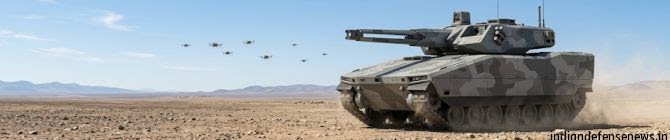
India is currently orchestrating the most profound transformation of its mechanised warfare doctrine since the 1980s, a pivotal era when Soviet-origin BMP infantry combat vehicles were first inducted.
At the very nucleus of this military evolution is the Future Infantry Combat Vehicle program, an ambitious, multi-crore venture valued at approximately 60,000 crore rupees.
This massive project stands out as one of the largest “Make in India” initiatives ever undertaken by the Indian Army, designed specifically to transition the military away from Cold War-era mass-armoured tactics and move decisively toward a modern, network-centric, and highly survivable battlefield ecosystem.
The core motivation behind this gargantuan program is the urgent need to phase out the Indian Army’s ageing fleet of thousands of Soviet-style BMP-2 and BMP-2K “Sarath” Infantry Fighting Vehicles.
While these legacy platforms have received numerous piecemeal upgrades over the decades, they are increasingly vulnerable to the lethal realities of 21st-century warfare, which include sophisticated anti-tank guided missiles, loitering munitions, armed drones, and precision-guided artillery.
Global military history, particularly the Gulf War, provided a stark lesson to defence planners when Iraqi BMPs were easily out-ranged, outperformed, and systematically destroyed by coalition forces armed with vastly superior optics, fire-control systems, and advanced armour.
For India, this vulnerability is compounded by unique, pressing two-front security challenges along the rugged Chinese borders and across the vast Pakistani deserts, demanding an entirely new approach to infantry mobility.

The proposed Future Infantry Combat Vehicle is conceptualised as a heavily protected, highly mobile, tracked armoured platform tailored to transport fully equipped infantry squads directly into active combat zones while operating seamlessly alongside main battle tanks.
Current specifications dictate a vehicle weighing roughly 20 tons, propelled by a potent 600-horsepower engine. Crucially, despite its heavy modular composite armour and robust mine protection systems, the vehicle must retain true amphibious capabilities, utilising advanced hydro-jets to cross rivers and water obstacles without requiring external engineering support.
This amphibious feature remains an unyielding operational requirement for the Indian Army due to the country’s diverse and challenging geographical combat theatres.
Designed to accommodate a crew of three—comprising a commander, a gunner, and a driver—the vehicle will have the capacity to carry up to eight fully equipped infantry soldiers.
The standard lethality package for the vehicle is expected to feature a 30mm auto-cannon, coaxial machine guns, and anti-tank guided missile launchers, while natively supporting modern drone integration and loitering munitions.
To withstand modern battlefield threats, the chassis will incorporate an Active Protection System designed to physically intercept incoming enemy projectiles before impact. This represents a monumental leap in crew survivability compared to the older BMP models.
The conceptual origins of India’s mechanised infantry trace back to the recommendations of the landmark Krishna Rao Committee established by the Indian government in 1975, which sought to draft a long-term perspective plan for the armed forces.
Recognising the absolute necessity for mobile firepower, the government formally raised the Mechanised Infantry Regiment on the 2nd of April 1979, initially inducting BMP-1 vehicles before transitioning to the improved BMP-2 series by 1990.
However, as warfare evolved rapidly, the lack of thermal sights, digital fire-control computers, and integrated communications in these older Soviet designs necessitated a radical, self-reliant rethink.
Long before the current program gained its massive momentum, the Defence Research and Development Organisation laid the technological groundwork through a highly significant technology demonstrator project named “Abhay”, which translates from Sanskrit as “Fearless”.
Initiated in the mid-1990s, the Abhay program was explicitly designed to cultivate domestic expertise in armoured vehicle architecture, composite materials, and complex weapon integration. In 2004, the then chief of the organisation, M Natarajan, optimistically stated that Abhay was under active development as the future infantry vehicle for the Army and would be ready within two years.
Although the Abhay platform itself never moved into mass production, the Defence Research and Development Organisation formally declared the technology demonstration program a success in its 2007–08 annual report, having successfully built and tested two functional prototypes, including an armoured variant.
The organisation noted that the breakthrough systems engineered during the project—such as all-electric stabilised fire-control systems, advanced hydro-pneumatic suspension, and composite armour packages—dramatically boosted India’s defence self-reliance.
In fact, the valuable engineering lessons harvested from Abhay continue to directly influence modern domestic armoured initiatives, including the Zorawar light tank project being jointly developed with Larsen & Toubro for high-altitude deployment.
The original Abhay prototypes showcased an aggressive emphasis on heavy firepower, boasting a Bofors 40mm L/70 auto-cannon capable of firing sophisticated armour-piercing fin-stabilised discarding sabot rounds and high-explosive ammunition.
It was further armed with an AGS-17 automatic grenade launcher, a 7.62mm PKT machine gun, and missile launchers capable of firing modified Milan or Konkurs-M anti-tank weapons.
Its cutting-edge fire-control system integrated thermal imaging and laser range finding with a ballistic computer, allowing the crew to maintain high accuracy while firing on the move across rough terrain.
Furthermore, the Abhay’s composite armour utilized ceramics, titanium, and high-hardness steel to slash weight by over 40 per cent compared to traditional steel plating, while adding vital survivability assets like an Integrated Fire Suppression System, laser warning suites, and comprehensive Nuclear, Biological, and Chemical protection.
Building directly upon this rich technological lineage, the Defence Research and Development Organisation unveiled its latest Advanced Armoured Platforms, which were co-developed with prominent private sector firms TATA Advanced Systems and Bharat Forge.
These futuristic platforms feature high-power engines, automatic transmissions, and advanced amphibious hydro-jets tailored to satisfy the newest operational doctrines of the military.
A standout feature of these next-generation vehicles is a revolutionary crewless turret, which isolates the primary weapon systems—including a 30mm cannon, machine gun, and anti-tank missiles—from the hull.
By removing the crew from the turret basket, significant space is freed up within the chassis, allowing infantry squads to carry essential modern equipment like tactical drones and loitering munitions directly into the theatre of operations, while providing built-in counter-drone defensive measures.
The new platforms offer exceptional survivability, reportedly meeting the stringent STANAG Level-5 standard, which provides robust protection against heavy ballistic threats, kinetic energy penetrators, and artillery blast fragments.
Moving forward, the Indian Army’s operational strategy indicates a dual-platform approach utilizing both tracked and wheeled variants. Tracked combat vehicles are heavily favoured for the soft sands and cross-country challenges of the desert and semi-desert sectors found in Rajasthan and Gujarat.
Conversely, wheeled configurations are highly preferred for the plains and network-heavy mountainous terrains, where rapid road mobility, operational speed, and significantly lower maintenance overheads offer a distinct tactical advantage.
This multi-billion-crore procurement has triggered an intense and highly competitive industrial race within the Indian defence manufacturing sector. Public sector enterprises like Armoured Vehicles Nigam Limited are competing fiercely against formidable private defence titans, including Larsen & Toubro, TATA Motors, and Mahindra Defence Systems.
This high-stakes rivalry fits perfectly into the national push for defence indigenisation championed by Prime Minister Narendra Modi, who previously lauded the participation of private industry during the inauguration of the Larsen & Toubro Armoured Systems Complex in Gujarat, emphasising that private sector contributions are invaluable to the “Make in India” push.
While earlier project definitions anticipated a requirement of 2,000 to 2,200 tracked platforms, the Army’s long-term projections have expanded significantly, indicating that total requirements could eventually exceed 3,500 vehicles when accounting for both tracked and wheeled configurations alongside operational reserves.
The rapid rise of highly capable, tailor-made domestic platforms has also profoundly impacted India’s defence import debates, casting a shadow over foreign alternatives such as the American-built Stryker armoured vehicle.
Defence analysts and military sources have highlighted that the Stryker faces severe operational limitations in meeting the Indian Army’s strict criteria, primarily due to its complete lack of amphibious capabilities and reported performance questions in extremely high-altitude, low-oxygen mountain terrains.
These technical realities have greatly fortified the consensus within the military command structure that a domestically designed, purpose-built platform is the only viable choice to satisfy India’s specific geographic and strategic doctrines.
Ultimately, the Future Infantry Combat Vehicle program is set to deliver an intelligent, highly integrated battlefield asset that will operate in perfect harmony with main battle tanks, drone swarms, artillery, and artificial intelligence-assisted targeting systems, effectively securing the future of Indian mechanised warfare for the next several decades.
TOI
