

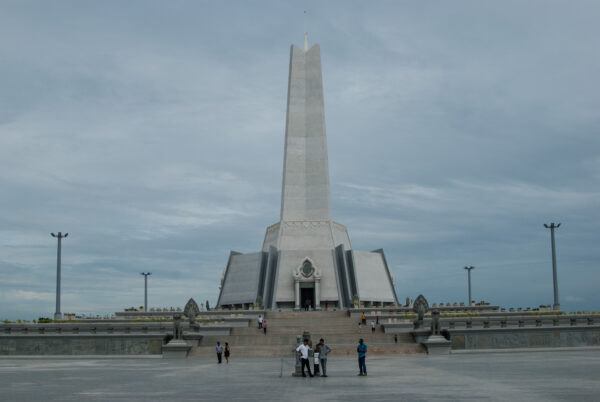
Each country commemorates its wars in its own way and Cambodia is no exception. And as shots continue to ring out across the disputed Thai border, authorities are prepping Cambodians to treat May 28 as a day of national remembrance, the start of last year’s armed conflict with Thailand.
At the Win-Win Memorial, built to remember the 30-year civil war that turned Cambodia into a failed state, murals focusing on the suffering, bravery, and solidarity of the Khmer people and their military during the 2025 undeclared border war are now being etched in stone.
The hero is Sgt. Suon Roan. He was killed inside a trench at Mom Bei – an area in the Dangrek Mountains where the Cambodian border meets Thailand and Laos – after Thai troops had allegedly crossed and opened fire.
“The day our heroic soldier was shot dead by Thai troops on May 28… That day is a reminder of invasion and illegal violations against Cambodia’s sovereignty, which the Cambodian people must remember,” said Hun Sen, the president of the Senate and the father of Prime Minister Hun Manet.
His death was the first in an unnecessary conflict that had its roots in organized crime and got way out of control amid poor diplomacy and shoddy politics from both sides. More than a million people would be displaced and many more troops would perish.
Of course, all the names of those killed in action deserve to be inscribed at the Win-Win Monument and authorities in Phnom Penh could follow an example set by the Vietnam Veterans Memorial in Washington, D.C.
It was here that designer Maya Lin, as an undergraduate architecture student, broke with tradition and inscribed all the names of America’s fallen soldiers chronologically rather than in alphabetical order. In doing so, their deaths mark the beginning and end of the Vietnam War.
That memorial is symbolism at its very best and resonates powerfully with visitors and veterans alike. It’s an idea that would not be out of place in Phnom Penh.
But there are issues with that. Cambodia still has not released a full casualty report from the conflict, which ended with the signing of a truce on December 27 and since then, the ceasefire has struggled to hold.
At least three shooting incidents have been reported recently, on April 19, May 14, and May 22, with both sides predictably trading blame as the Thai Navy conducted exercises near the Cambodian maritime border after Bangkok ended an agreement used to manage overlapping claims.
But importantly, Cambodia still seems unable to rid itself of organized crime and its scam compounds and human trafficking networks, a key plank in securing the cease-fire and a demand that is being insisted upon as much by Beijing as it is in Bangkok.
A self-imposed, end-of-April deadline to end the scourge of scams has long since passed. In the first three weeks of May, Cambodian police say they detained 3,320 suspected scammers from 32 countries after raids on 50 locations across the country.
The evidence also points to a rapid expansion of those networks into a “durable regional criminal economy,” a U.S. Select Committee said in a report, released in Washington last week, adding that this posed a direct threat to Americans, U.S. allies, and U.S. security.
The report did say that scam compounds had their origins in a Chinese state-owned company and went into great detail about how they spread to Myanmar, now “a failed state,” and are now taking root in Central Asia, Africa, and the Middle East.
But it described Cambodia as a “Stability-Embedded State Crime Ecosystem” where upwards of 150,000 people had been trafficked into compounds and forced to adopt the “pig butchering model” to target victims primarily in the U.S., Europe, and East Asia.
“Cambodia’s role cannot be understood simply as organized crime flourishing in a weak state. Rather, it reflects a politically consolidated, patronage-embedded system capable of absorbing and stabilizing large-scale illicit capital and efficiently transferring that capital to its ruling coalition,” it stated.
“In this environment, enclosed scam compounds – characterized by controlled access, private security, debt bondage, and violence against trafficked workers – have operated across the country with durable local tolerance, even amid periodic publicized crackdowns.”
These are the realities that fueled and helped shape a war that didn’t need to happen but will no doubt be enshrined in Cambodian history as Sgt. Suon Roan is remembered on May 28.
