

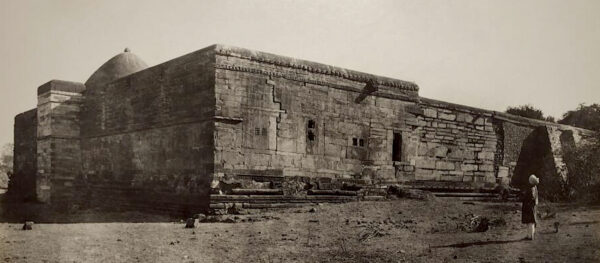
When India became independent in 1947, it inherited a range of unresolved communal issues. Foremost among them was the “disputed identity” of several historical structures, which both Hindus and Muslims claimed as their own. These places of worship included medieval era mosques that were allegedly built over ancient Hindu temples, triggering contested claims and even communal riots.
The most contentious of these structures was the Babri Masjid at Ayodhya, built by Mughal emperor Babur in the 16th century, which Hindus claimed was the site of the birthplace of the Hindu god, Ram. After the mosque was pulled down by Hindutva mobs in 1992, India’s Supreme Court, in its verdict of November 9, 2019, cleared the way for the construction of a Ram temple at the disputed site. A grand Ram temple was subsequently inaugurated by Prime Minister Narendra Modi on January 22, 2024.
It set the precedent for the “templing” of other such mosques with contested claims, the most recent instance being the Bhojshala temple associated with the Hindu goddess Saraswati in Dhar in central India’s Madhya Pradesh, where the Kamal Maula Mosque associated with the medieval-era Sufi saint Kamal-al-din Chishti is also located.
On May 15, the Madhya Pradesh High Court declared the 11th-century complex to be a Hindu temple dedicated to Vagdevi (Saraswati, the goddess of learning) and rejected claims of the Muslim side that it was a mosque.
Drawing on a recent scientific study by the Archaeological Survey of India (ASI), the High Court ruled that the original structure dated back to King Bhoj, a Rajput ruler who ruled the erstwhile Malwa region in central India. Bhoj established a Sanskrit teaching center, the Bhojshala, with a temple in it. The Bhojshala complex is recognized as a “protected monument” under the ASI.
With this ruling, the court struck down the 23-year-old ASI order of 2003, permitting shared use, i.e., with Muslims offering namaz on Fridays and Hindus worshipping at the site on Tuesdays. Additionally, Hindus were permitted to celebrate Basant Panchami (dedicated to the goddess Saraswati) at the temple. This arrangement was done after several violent clashes erupted between the two communities over the years, especially when Friday prayers coincided with the Basant Panchami festival.
While analyzing the “religious character” of the structure, the Madhya Pradesh High Court judges said that the mosque had been built with parts of an earlier Hindu temple.
Interestingly, under medieval Sultanate rule, with the mosque coming up on the site, structures in the complex displayed both Hindu and Islamic elements: Hindu temple pillars, inscriptions, and motifs alongside Islamic mihrabs or arches.
Expectedly, the Muslim community that has been praying at the mosque for close to 700 years has challenged the recent High Court ruling. Political commentators have pointed out that the court ruling brazenly flouts the Places of Worship Act, 1991, a law that helped to maintain the status quo on religious places since Independence. Enacted in order to freeze the frequent contentious claims by both Hindus and Muslims over medieval religious sites, the Places of Worship law seeks to maintain communal amity and protect the character of religious sites as they existed on August 15, 1947, the day India became independent. It also forbade lower courts from taking up such matters for adjudication. Among the few mandated exceptions was the Babri Masjid at Ayodhya, which was already embroiled in legal judicial proceedings.
Over the centuries, the Indian subcontinent witnessed several invasions, including that by Muslims – the Delhi Sultans, the Mughals, among others – who, during their rule, built mosques at the site of existing or older Hindu temples. Expectedly, the majority of such structures show remnants of ancient Hindu temples. Muslims have been worshiping in these mosques for centuries.
While tensions have simmered in some such sites as at the Gyanvapi Mosque in Varanasi, in other places, both Hindus and Muslims have worshiped side by side. Post-2014, when the Hindu supremacist Bharatiya Janata Party (BJP) under Narendra Modi came to power playing the Hindu majoritarian card, it fanned the flames of communal hatred at all such disputed sites.
According to analysts, Modi has entrenched himself in the heart of Hindu voters by managing to deliver the promised temple at the birthplace of Ram at Ayodhya in 2024 – something that could not be achieved in over 70 years since Independence. For BJP supporters, it also corrected a historical wrong by wiping out all traces of the Mughal-era mosque that was built there.
Whipping up communal tensions and religious polarization has worked time and again for the Modi-led BJP during elections.
Post-2014, a pliant judiciary has both overtly and covertly assisted in encouraging majoritarian politics. From ignoring the crime that was committed in the demolition of the Babri Masjid to green flagging the construction of the temple at Ayodhya, the Supreme Court has provided the legal stamp for all such conversions.
In the present Bhojshala temple case too, the High Court took recourse to a legal loophole in the law to legally intervene in a disputed religious structure matter. Calling out this High Court move, The Hindu newspaper stated in an editorial: “The courts may believe that they are neutral adjudicators but they are operating in politically polarized terrain. Groups such as the ‘Hindu Front for Justice’, which initiated parts of the Bhojshala litigation, are politically backed entities using judicial findings to consolidate agitation around contested religious sites.”
In its defense, the Madhya Pradesh High Court maintains that it only determined what existed in the first place. But the fact is that the court helped to establish Hindu majoritarian claims. Incidentally, the ruling BJP and its parent organization, the Rashtriya Swayamsewak Sangh, have fully bolstered and championed such claims wherever they have occurred.
In such temple-mosque disputes, courts have turned to the ASI to provide them with convenient “scientific evidence” to sanctify their subsequent verdicts, changing the status of disputed structures.
The Madhya Pradesh High Court had directed the ASI in March 2024 to conduct a scientific survey to “demystify” the character of the Bhojshala structure. In its 2,000-page report, the ASI concluded that the mosque was built from parts of preexisting temples. It cited idols and Sanskrit inscriptions it had found at the site. It also noted the monument’s Arabic and Islamic character. Muslims alleged that the ASI survey report was “biased” and predetermined to support the Hindu claims.
As eminent historian Audrey Truschke told Al Jazeera, “politically motivated and sub- standard surveys carry little weight.” She stressed the need for rigorous methodology that meets international standards.
There is no doubt that under the BJP regime the ASI has become increasingly “saffronized.” Indian archaeologists involved with a significant excavation in Tamil Nadu have also gone public with their criticism of the ASI.
The playbook of converting disputed sites into Hindu ones is often the same. Hidden Hindu idols are mysteriously found, and held up to buttress the court’s declaration of the structure as a Hindu one. The Supreme Court’s offer of land to Muslims, in its 2019 ruling on the Ayodhya dispute, at an alternate location, set the tone for the verdicts that followed.
In its ruling on the Bhojshala complex, the High Court said that the Muslim side can seek alternate land from the state government to construct a mosque.
As Truschke told Al Jazeera,“The current trend of targeting mosques in India is part of the entrenched Islamophobia of Hindu nationalism.”
There are several disputed structures in India, like the Gyanvapi mosque in Varanasi, which Hindus claim to be the site of a Shiva temple; the Shahi Idgah Mosque at Mathura, which is believed to be the site of the birthplace of the Hindu deity, Krishna; and the Bijamandal complex in Vidisha (Madhya Pradesh). The goal of Hindutva organizations is to gradually get these disputes settled once and for all.
In the majoritarian climate in India today, where institutions are far from objective and unbiased, the results almost invariably go in favor of the Hindutva groups.
These court verdicts are eroding the secular character of India and its diversity, hollowing out the guarantees and protections provided by India’s Constitution to the majority and the minority communities. A unique secular experiment that India set out on in 1947 is being destroyed in a systematic fashion.
